
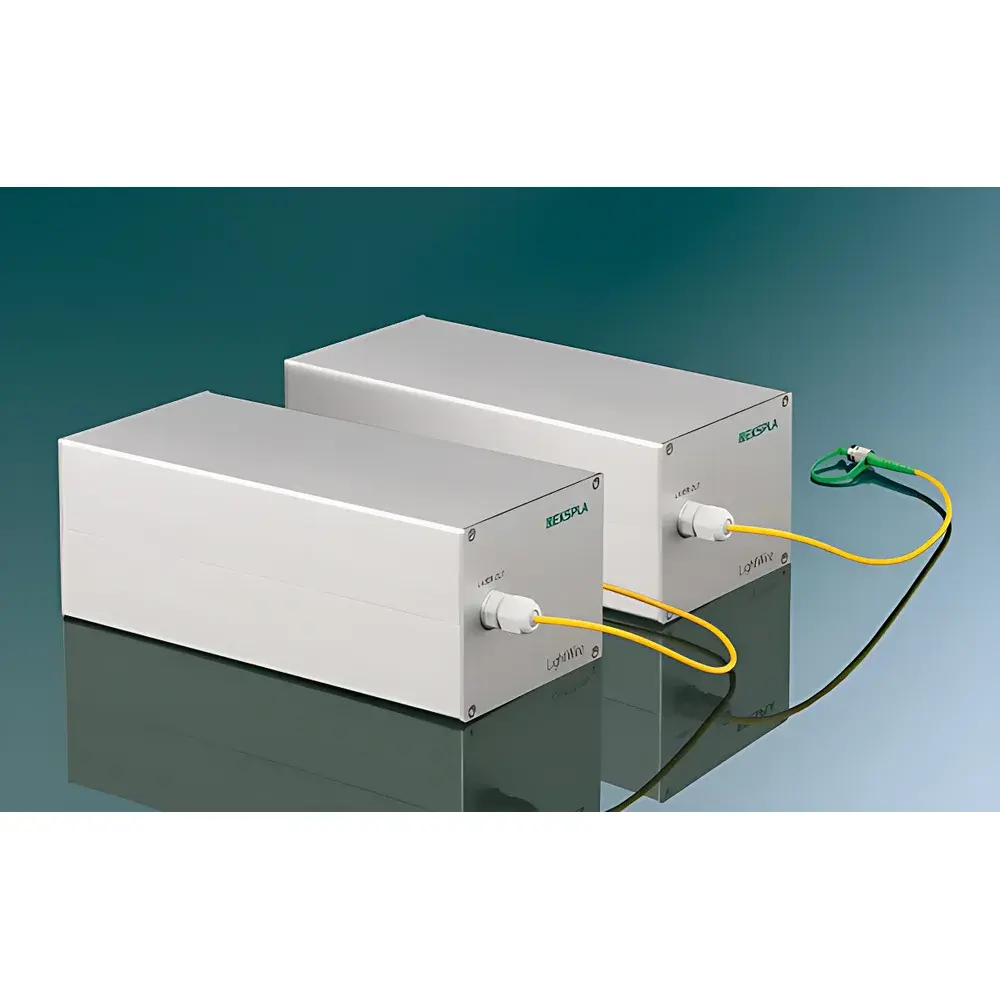
Ekspla OPCPA-680 Series Femtosecond Tunable Optical Parametric Chirped Pulse Amplification System
| Brand | Ekspla |
|---|---|
| Origin | Lithuania |
| Manufacturer Type | Original Equipment Manufacturer (OEM) |
| Product Category | Imported High-Performance Ultrafast Laser System |
| Model | Ekspla-OPCPA-680 |
| Core Architecture | All-Solid-State, Fiber-Seeded, Diode-Pumped Picosecond Pump + Noncollinear Optical Parametric Amplification |
| Max Pulse Energy | 0.35 mJ |
| Tuning Range (Signal) | 680–690 nm |
| Pulse Duration | 30–50 fs |
| Repetition Rate | 1 kHz |
| RMS Pulse Energy Stability | <1% |
| Optional Outputs | CEP-Stabilized Idler (1200–2200 nm), Compressed Supercontinuum (1 µJ, <10 fs, 680–960 nm) |
Overview
The Ekspla OPCPA-680 Series is a turnkey, all-solid-state femtosecond optical parametric chirped pulse amplification (OPCPA) system engineered for ultrafast science laboratories requiring high peak power, precise wavelength tunability, and exceptional temporal stability without reliance on complex regenerative amplifier architectures. Based on noncollinear optical parametric amplification pumped by a compact, diode-pumped picosecond Yb-based solid-state laser, the system eliminates the need for traditional Ti:sapphire regenerative amplifiers—reducing complexity, cost, and long-term maintenance overhead while preserving sub-50-fs pulse fidelity and microjoule-level energy scalability. Its core architecture integrates fiber-seeded oscillator timing, active synchronization between pump and signal pulses at the 10-fs level, and intracavity dispersion management to ensure transform-limited output across the full tuning range. Designed for demanding pump–probe spectroscopy, high-harmonic generation (HHG), and time-resolved nonlinear optical experiments, the OPCPA-680 delivers deterministic pulse parameters traceable to international metrology standards and compatible with GLP-compliant experimental workflows.
Key Features
- Integrated picosecond pump source: Diode-pumped Yb:YAG or Yb:KGW amplifier delivering >10 mJ at 1030 nm, enabling high-gain, low-noise OPCPA stages without regenerative cavity alignment.
- Femtosecond signal generation: Noncollinear geometry with β-BBO or LBO crystals ensures broad gain bandwidth and intrinsic phase-matching stability over 680–690 nm.
- Automated wavelength scanning: Motorized grating and crystal angle control with closed-loop feedback enables reproducible, step-and-set wavelength selection with ±0.1 nm resolution.
- CEP-stabilized idler output: Optional carrier-envelope phase stabilization of the 1200–2200 nm idler beam supports attosecond pulse synthesis and coherent control experiments.
- Compressed supercontinuum option: Integrated hollow-core fiber compression yields <10 fs pulses with 1 µJ energy across 680–960 nm, suitable for broadband transient absorption and multi-color excitation.
- Robust thermal and mechanical design: Monolithic optomechanical baseplate, active air-cooling, and vibration-damped housing meet ISO 10110 surface quality and cleanroom-compatible operational requirements.
Sample Compatibility & Compliance
The OPCPA-680 is designed for integration into vacuum-compatible ultrafast beamlines and operates reliably in Class 1000 cleanroom environments. Its output meets ANSI Z136.1 and IEC 60825-1 Class 4 laser safety specifications when properly enclosed. All firmware and hardware interfaces comply with IEEE 1394 and USB 3.0 industrial communication protocols. The system supports audit-trail logging for GLP/GMP-aligned labs and is compatible with FDA 21 CFR Part 11–compliant data acquisition platforms via optional Ethernet-based remote control API. No hazardous materials are used in optical coatings or crystal mounts; all components conform to RoHS 2015/863/EU directives.
Software & Data Management
Control is managed through Ekspla’s proprietary OPCPA Control Suite v4.x—a Windows-based application supporting real-time monitoring of pulse energy, spectral centroid, FWHM bandwidth, and RMS stability metrics. The software provides scripting support (Python/LabVIEW APIs), automated calibration routines for group delay dispersion (GDD) compensation, and export of timestamped HDF5 datasets compliant with NeXus format standards. All parameter changes are logged with user ID, timestamp, and system state metadata—enabling full traceability for ISO/IEC 17025-accredited laboratories. Remote diagnostics and firmware updates are performed over secure TLS-encrypted channels.
Applications
- Pump–probe spectroscopy: Sub-50-fs time resolution enables tracking of electronic coherence, vibrational wavepacket dynamics, and charge-transfer processes in molecular, condensed-phase, and 2D material systems.
- High-harmonic generation (HHG): Stable 0.35 mJ pulses at 1 kHz drive efficient XUV continuum generation in gas jets or solid targets, supporting attosecond streaking and photoelectron spectroscopy.
- Nonlinear optical microscopy: Tunable near-IR output enables label-free multimodal imaging—including CARS, SRS, and SHG—with optimized penetration depth and reduced photodamage.
- Strong-field physics: CEP-stabilized idler beam facilitates isolated attosecond pulse generation and electron recollision control in few-cycle regimes.
- Ultrafast metrology: Integrated autocorrelator and FROG-compatible output ports enable in-situ pulse characterization and cross-calibration against NIST-traceable reference sources.
FAQ
What is the typical warm-up time required before stable operation?
The system achieves thermal equilibrium and pulse parameter stability within 30 minutes after cold start, verified by continuous RMS energy monitoring over 10,000 consecutive shots.
Is vacuum compatibility available for the idler beam path?
Yes—optional UHV-compatible beam transport modules (CF-63 flanges, bakeable to 150 °C) are available for direct coupling into HHG vacuum chambers.
Can the system be synchronized to external RF triggers or delay generators?
Yes—dedicated TTL and LVDS inputs support external triggering with jitter <50 ps RMS; internal clock distribution supports multi-channel synchronization for pump–probe or multi-beam experiments.
Does the OPCPA-680 support custom crystal sets for extended tuning beyond 690 nm?
Yes—Ekspla offers factory-qualified crystal kits (e.g., KTA, AGS, OP-GaAs) enabling signal tuning up to 2.5 µm upon request and system recalibration.
What maintenance intervals are recommended for optimal long-term performance?
Preventive maintenance—including optical alignment verification, pump laser diode current calibration, and humidity-controlled desiccant replacement—is recommended every 12 months or 5,000 operating hours, whichever occurs first.




