
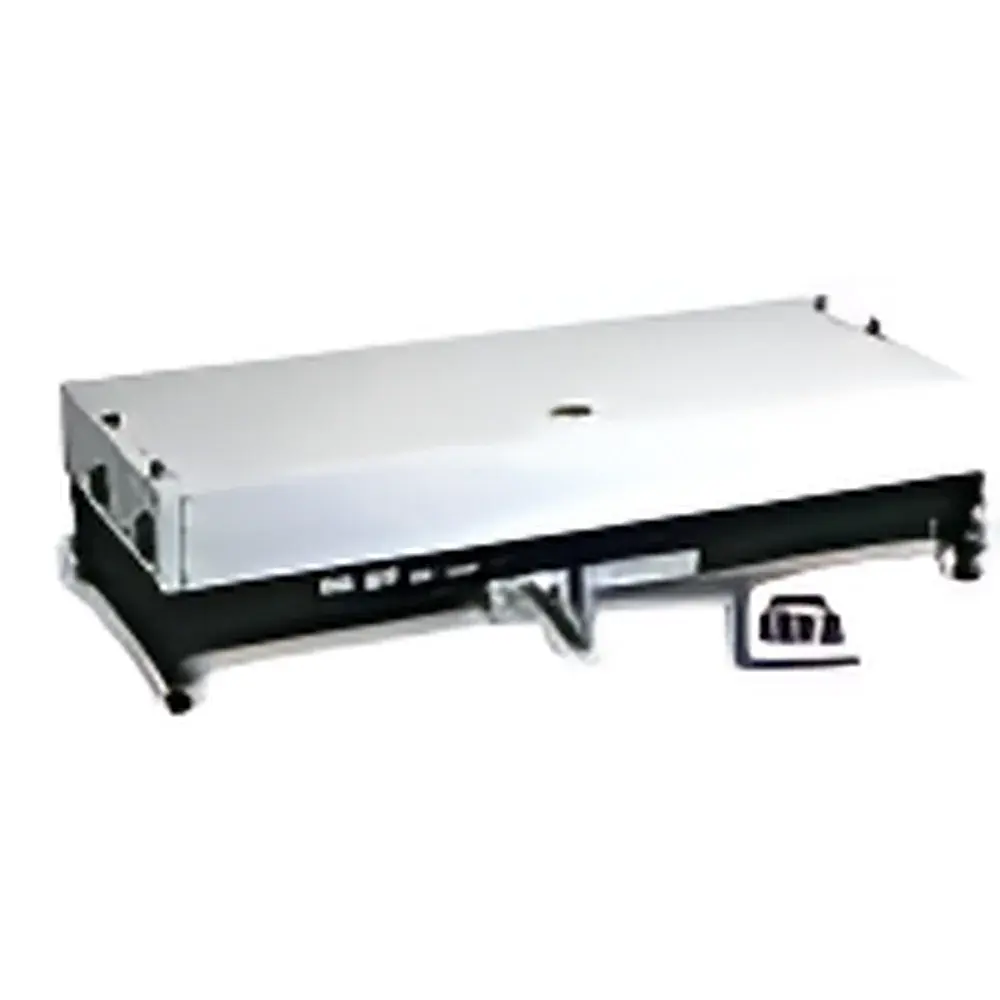
Ekspla PG400 Series Picosecond Optical Parametric Generator and Amplifier System
| Brand | Ekspla |
|---|---|
| Origin | Lithuania |
| Manufacturer Type | Original Equipment Manufacturer (OEM) |
| Product Category | Imported Scientific Instrument |
| Model | PG400 |
| Core Component | Solid-State Nd:YAG Pump Laser + OPG/OPA Architecture |
| Tuning Range | 210 nm – 16 µm |
| Visible Output Energy | ≥1 mJ (at 532 nm pump, 500–700 nm signal) |
| Mid-IR Output Energy | ≥300 mJ (idler, 3–16 µm) |
| Spectral Bandwidth | <6 cm⁻¹ (FWHM) |
| Pump Compatibility | PL2140 Series Picosecond Mode-Locked Nd:YAG Laser (1064 nm, 50–100 ps, 10 Hz–100 Hz) |
| Control Interface | LabVIEW-compatible drivers, RS-232/Ethernet remote operation |
| Cooling | Closed-loop water cooling |
| Compliance | CE, RoHS, IEC 60825-1 Class 4 Laser Safety |
Overview
The Ekspla PG400 Series is a high-performance, solid-state picosecond optical parametric generator and amplifier (OPG/OPA) system engineered for ultrafast spectroscopy, time-resolved nonlinear optics, and broadband mid-infrared generation. Based on non-collinear optical parametric amplification in β-barium borate (BBO) and silver gallium sulfide (AgGaS₂) crystals, the PG400 delivers tunable, transform-limited pulses across an unprecedented spectral span—from deep ultraviolet (210 nm) to mid-infrared (16 µm)—with pulse durations maintained in the picosecond regime (typically 50–100 ps). Its architecture is optimized for use with Ekspla’s PL2140 series mode-locked Nd:YAG pump lasers, ensuring exceptional temporal stability (<±1% RMS pulse-to-pulse energy fluctuation) and long-term reproducibility required for quantitative pump-probe experiments, coherent anti-Stokes Raman scattering (CARS), and ultrafast vibrational spectroscopy.
Key Features
- Ultra-broad spectral coverage: Continuous tuning from 210 nm (UV) to 16 µm (mid-IR) via cascaded OPG/OPA stages and idler wavelength extension.
- High-energy output: ≥1 mJ in visible (signal) range; ≥300 mJ in mid-IR (idler) range—enabling nonlinear frequency conversion, photoacoustic excitation, and strong-field physics applications.
- Narrow spectral bandwidth: <6 cm⁻¹ FWHM across full tuning range, supporting high-resolution spectroscopic measurements without external filtering.
- Robust solid-state design: All-crystal, alignment-stable optical path with motorized wavelength selection and automated crystal angle control.
- Integrated pump synchronization: Native compatibility with PL2140-series picosecond Nd:YAG lasers (1064 nm, 10–100 Hz repetition rate), including timing jitter <100 fs and pulse energy stability ±1.5% (std dev).
- Remote operability: Full system control via Ethernet or RS-232 interface; native LabVIEW drivers included for seamless integration into custom data acquisition environments.
Sample Compatibility & Compliance
The PG400 system is designed for laboratory-based ultrafast science applications requiring precise, repeatable excitation sources. It supports gas-phase molecular beams, condensed-phase thin films, single crystals, and biological tissue samples under ambient or cryogenic conditions. No sample consumables or vacuum requirements are imposed by the source itself—though optional vacuum-compatible harmonic separators and IR-transmissive beamlines (e.g., KBr, ZnSe, or CsI optics) may be integrated per application. The system complies with IEC 60825-1:2014 (Class 4 laser safety), CE Directive 2014/35/EU (Low Voltage Directive), and RoHS 2011/65/EU. All firmware and hardware configurations meet GLP-relevant traceability standards for instrument calibration logs and operational parameter recording.
Software & Data Management
Ekspla provides the proprietary “OPG Control Suite” software for real-time wavelength scanning, pulse energy monitoring, crystal angle mapping, and interlock status visualization. The suite supports export of ASCII-formatted spectral metadata (wavelength, energy, shot count, timestamp) compatible with MATLAB, Python (NumPy/Pandas), and Igor Pro workflows. LabVIEW drivers include VI libraries for closed-loop feedback control (e.g., energy stabilization via motorized attenuators), enabling automated multi-wavelength acquisition protocols. Audit trails—including user login, parameter changes, and emergency stop events—are stored locally with configurable retention policies, satisfying basic FDA 21 CFR Part 11 readiness requirements when deployed on validated Windows platforms.
Applications
- Time-resolved transient absorption spectroscopy (fs/ps-TAS) across UV–Vis–NIR–MIR domains.
- Coherent Raman scattering (CARS, SRS) imaging using dual-wavelength synchronized outputs.
- Mid-IR pump-probe studies of phonon dynamics, carrier relaxation, and hydrogen-bonding networks.
- Photoinduced electron transfer kinetics in organic semiconductors and perovskite thin films.
- Gas-phase rotational/vibrational spectroscopy via difference-frequency generation (DFG) in AgGaS₂.
- Calibration source for FTIR spectrometers and quantum cascade laser characterization.
FAQ
What pump laser is required to operate the PG400?
The PG400 is engineered exclusively for use with Ekspla’s PL2140 series picosecond mode-locked Nd:YAG lasers (1064 nm fundamental, 50–100 ps pulse width, 10–100 Hz repetition rate). Pump energy stability and temporal profile are critical to OPG/OPA conversion efficiency and spectral reproducibility.
Can the PG400 generate ultrashort (sub-100 fs) pulses?
No—the PG400 is a picosecond OPG/OPA system. Pulse duration is determined primarily by the pump laser and crystal group-velocity matching; typical output is 50–100 ps. For femtosecond tunable sources, consider Ekspla’s TOPAS-fe or ORPHEUS-FW platforms.
Is vacuum operation supported?
The core OPG/OPA module operates at atmospheric pressure. Optional vacuum-compatible beam transport modules (e.g., evacuated IR beamlines with ZnSe windows) are available as add-ons for specific end-station integrations.
Does the system include calibration certificates?
Yes—each shipped PG400 includes NIST-traceable wavelength calibration data (using reference gas cells and calibrated monochromators) and factory-measured pulse energy maps across the full tuning range, documented in the Certificate of Conformance.
What maintenance is required?
Annual preventive maintenance includes crystal inspection, alignment verification, cooling loop integrity check, and firmware update validation. No consumables or periodic part replacements are specified under normal operating conditions.




