
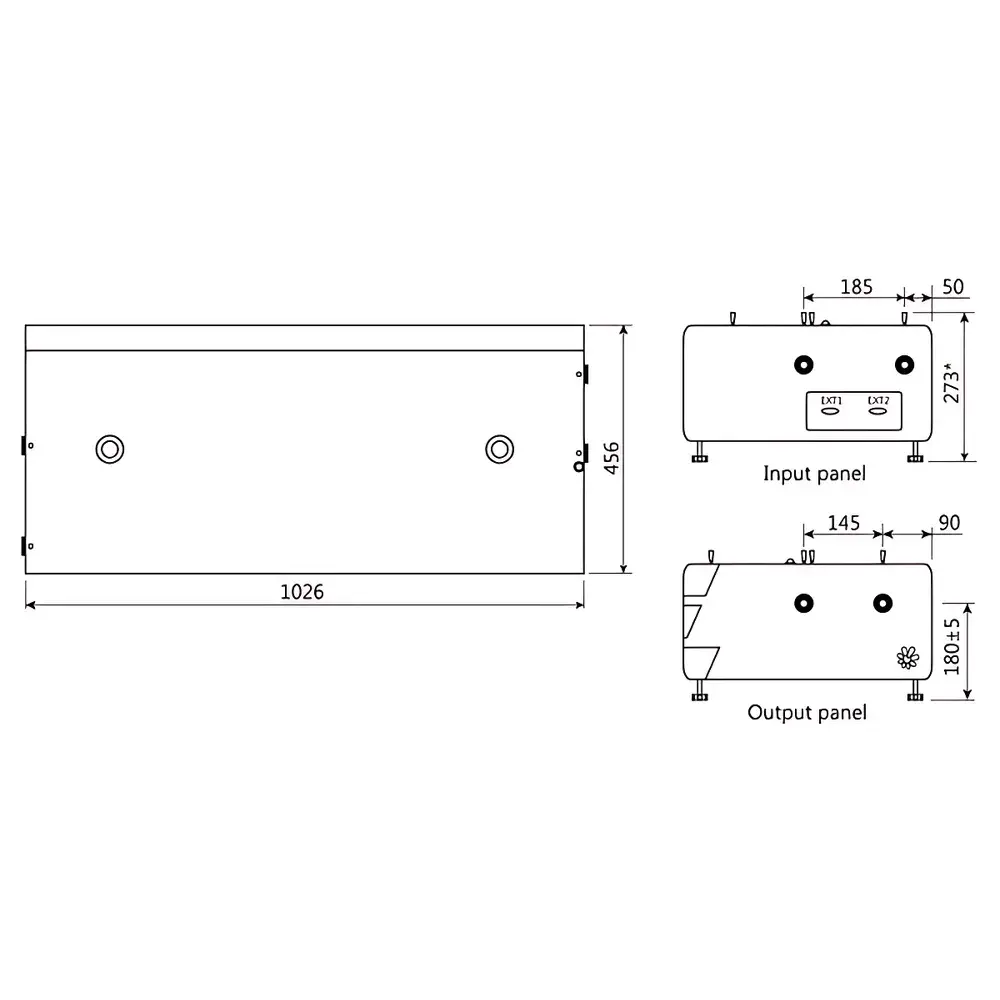
Ekspla PGx11 Narrow-Linewidth Picosecond Optical Parametric Generator
| Brand | Ekspla |
|---|---|
| Origin | Lithuania |
| Manufacturer Type | Original Equipment Manufacturer (OEM) |
| Product Category | Imported Instrument |
| Model | PGx11 |
| Core Architecture | Solid-State Pump Laser + Synchronously Pumped OPG/OPA System |
| Tuning Range | 193 nm – 16,000 nm |
| Pulse Duration | <15 ps (Fourier-transform limited) |
| Repetition Rate | Up to 1 kHz |
| Spectral Linewidth | <0.1 cm⁻¹ (typical, signal/idler) |
| Beam Divergence | <2 mrad (full angle, RMS) |
| Control Interface | USB 2.0 (RS-232 optional), LabVIEW™ driver included |
| Compliance | CE marked, RoHS compliant, Class 4 laser product per IEC 60825-1 |
Overview
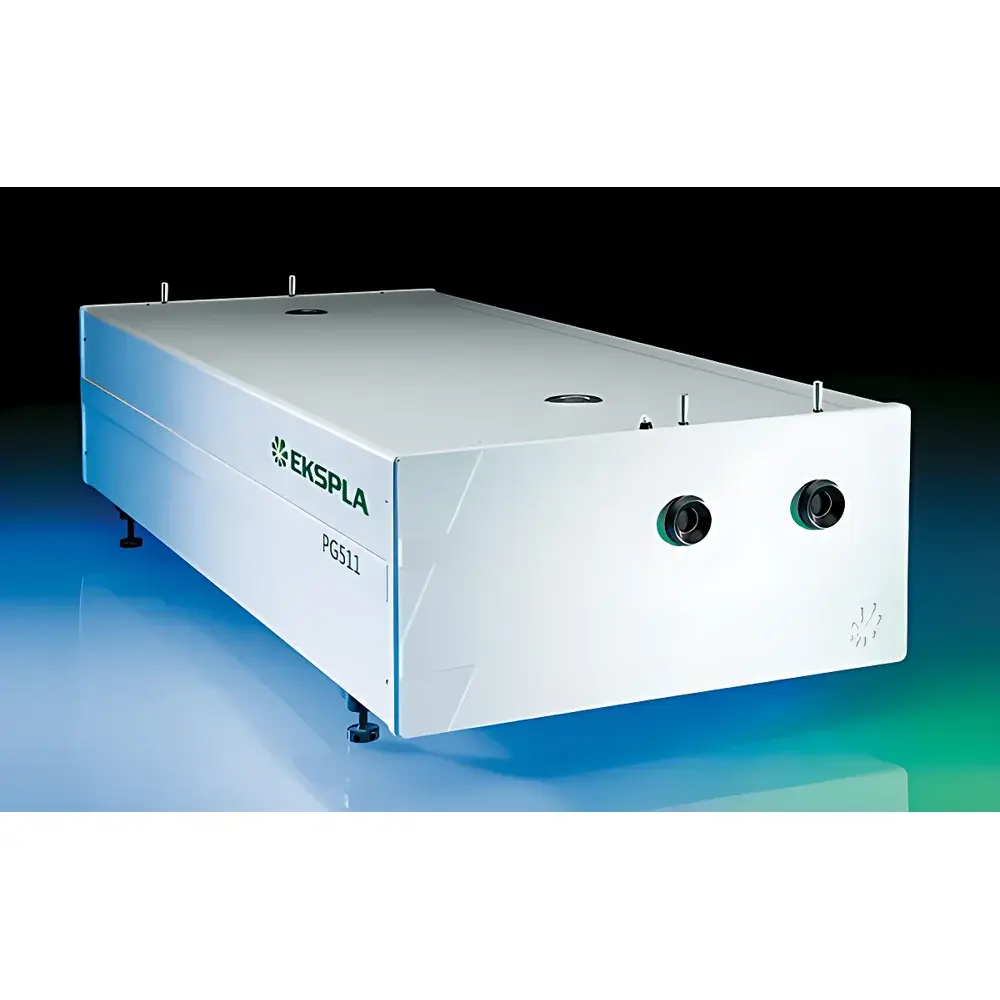
The Ekspla PGx11 is a high-stability, narrow-linewidth picosecond optical parametric generator engineered for advanced ultrafast spectroscopy and nonlinear optics applications. Built around a diode-pumped, mode-locked Nd:YAG or Nd:YLF solid-state master oscillator amplifier (MOA) platform, the PGx11 delivers transform-limited pulses with sub-15 ps duration at repetition rates up to 1 kHz. Its core architecture integrates a synchronously pumped optical parametric generator (OPG) followed by tunable optical parametric amplification (OPA) stages, enabling continuous, hands-free wavelength coverage from deep ultraviolet (193 nm) through visible and near-infrared into the mid-infrared (16,000 nm). Unlike broadband supercontinuum sources, the PGx11 maintains high spectral brightness and coherence across its tuning range—critical for phase-matching-sensitive processes such as sum-frequency generation (SFG), difference-frequency generation (DFG), and coherent anti-Stokes Raman scattering (CARS). The system operates under strict thermal and mechanical stability protocols, ensuring long-term pointing stability (<10 µrad/h) and spectral reproducibility essential for quantitative time-resolved measurements.
Key Features
- Ultra-narrow spectral linewidth: <0.1 cm⁻¹ (FWHM) in signal and idler outputs, achieved via intracavity etalon stabilization and cavity-length feedback control
- Low spatial divergence: <2 mrad full-angle beam divergence (RMS), optimized for efficient coupling into monochromators, interferometers, and waveguide-based detection systems
- Full electronic wavelength tuning: Motorized grating and crystal angle actuators enable automated, repeatable scanning without manual realignment
- Integrated handheld controller and PC-based operation: Real-time parameter adjustment via USB 2.0 interface; RS-232 available for legacy integration
- LabVIEW™-compatible driver suite: Includes VIs for pulse energy monitoring, wavelength calibration lookup tables, and synchronized trigger output for pump-probe delay stages
- Rugged OEM-grade mechanical design: Aluminum alloy housing with passive thermal management, qualified for continuous 24/7 operation in laboratory environments
Sample Compatibility & Compliance
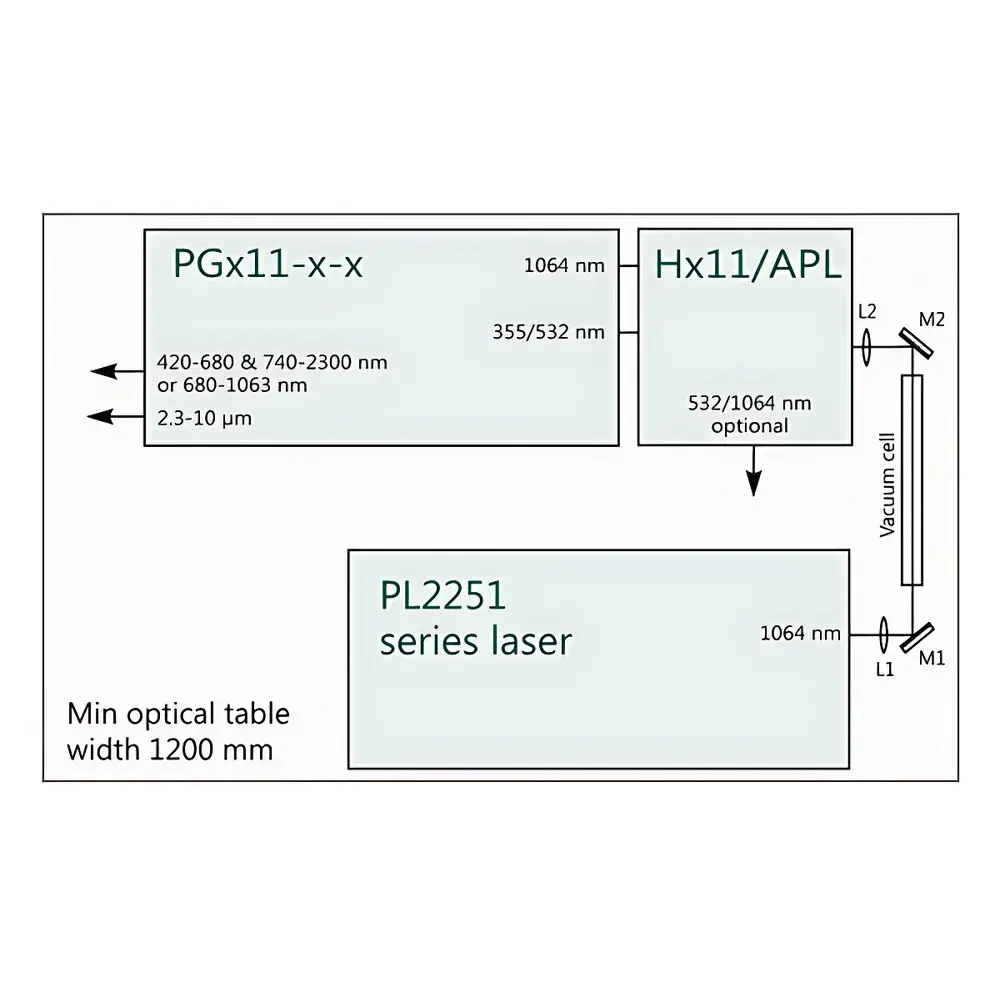
The PGx11 is compatible with standard optical table mounting (M6 threaded holes), vacuum-compatible beam paths (optional), and common spectroscopic accessories including imaging spectrometers (e.g., Andor Kymera), streak cameras (e.g., Hamamatsu C5680), and lock-in amplifier interfaces (e.g., Zurich Instruments HF2LI). It meets IEC 60825-1:2014 Class 4 laser safety requirements and carries CE marking for electromagnetic compatibility (EN 61326-1) and low-voltage directive (2014/35/EU). All firmware and control software support audit-trail logging per GLP/GMP guidelines when integrated with validated LabVIEW™ runtime environments. While not FDA-cleared as a medical device, its optical performance adheres to ASTM E275–22 (standard practice for UV-Vis-NIR spectrophotometer calibration) and ISO 13694:2021 (laser beam parameters — measurement methods).
Software & Data Management
The PGx11 ships with Ekspla’s proprietary PicoControl v3.2 software—a Windows-based application supporting multi-axis motor control, spectral calibration mapping, and real-time pulse energy normalization. All user-defined scan sequences are exportable as ASCII (.csv) or HDF5 files for post-processing in MATLAB, Python (NumPy/SciPy), or Igor Pro. The LabVIEW™ driver includes built-in support for NI-DAQmx synchronization, enabling hardware-timed triggering of delay generators (e.g., Berkeley Nucleonics BNC 575), CCD readout, and shutter control. Firmware updates preserve backward compatibility and include SHA-256 checksum verification. Data provenance features include embedded timestamps (UTC), operator ID tagging, and automatic metadata capture (wavelength, pump energy, repetition rate, ambient temperature).
Applications
- Time-resolved pump-probe spectroscopy: Sub-picosecond temporal resolution enabled by stable pulse-to-pulse jitter (<300 fs rms) and precise inter-pulse delay control
- Laser-induced fluorescence (LIF) in combustion diagnostics and plasma physics, where narrow linewidth improves species selectivity in congested emission spectra
- Vibrational sum-frequency generation (v-SFG) and surface second-harmonic generation (surface-SHG) for in situ molecular orientation analysis at buried interfaces
- Coherent anti-Stokes Raman scattering (CARS) microscopy: High peak power (>100 µJ/pulse) and tunability support broadband vibrational imaging in biological tissues
- Z-scan measurements for third-order nonlinear susceptibility (χ⁽³⁾) quantification in novel 2D materials and organic thin films
- Infrared action spectroscopy: Direct absorption probing of rovibrational transitions in cold molecular beams using tunable mid-IR idler output
FAQ
What pump laser sources are compatible with the PGx11?
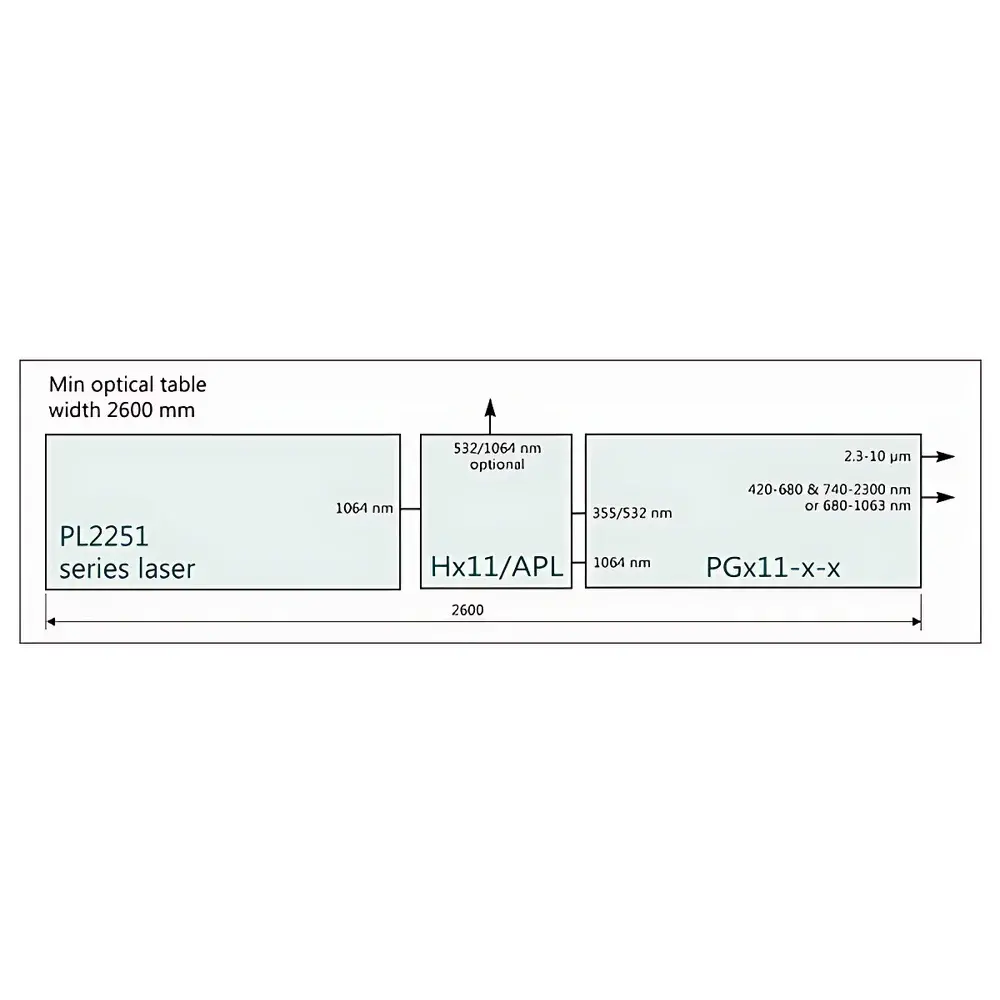
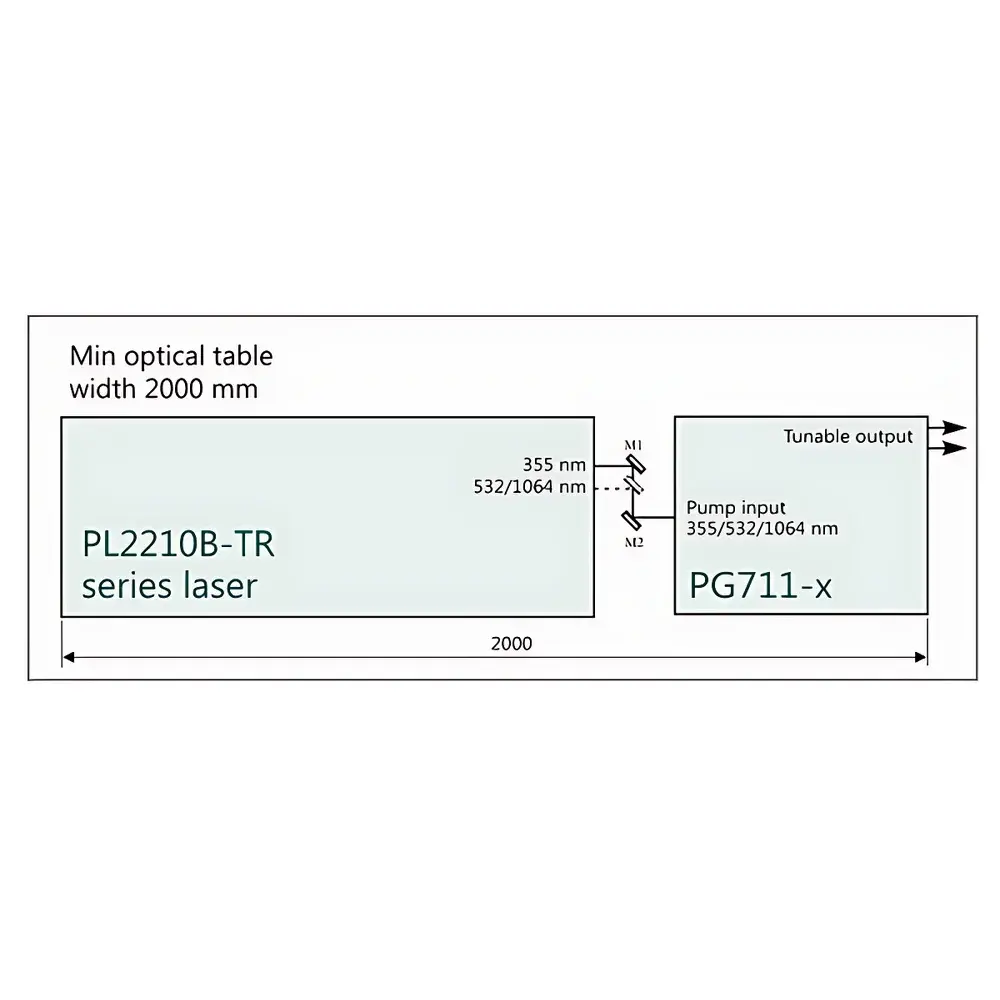
The PGx11 is factory-aligned and optimized for use with Ekspla’s PL2250 series or Atlantic series picosecond Nd:YAG/Nd:YLF oscillators delivering 10–50 mJ at 1064 nm or 532 nm with ≤15 ps pulse width and ≤1 kHz repetition rate.
Can the PGx11 be upgraded to include OPA stages for higher conversion efficiency?
Yes—Ekspla offers field-installable OPA modules (PGx11-OPA) with BBO, LBO, or KTA crystals, extending tunability into the 2–16 µm range with >15% signal conversion efficiency at 1 kHz.
Is remote operation supported over Ethernet or TCP/IP?
Standard configuration uses USB 2.0; however, an optional Ethernet-to-USB gateway module (EKS-ETH-USB) enables networked control via TCP/IP with latency <5 ms for distributed lab environments.
Does the system include wavelength calibration traceability?
Each unit ships with NIST-traceable HeNe and iodine vapor absorption line calibration certificates, and internal wavemeter feedback ensures ±0.05 nm absolute accuracy across the UV–NIR range.
What maintenance intervals are recommended for long-term stability?
Optical alignment verification is recommended every 6 months; crystal humidity control (integrated desiccant cartridge) requires replacement annually; no laser gain medium replacement is needed within the 10,000-hour rated lifetime of the pump oscillator.





