
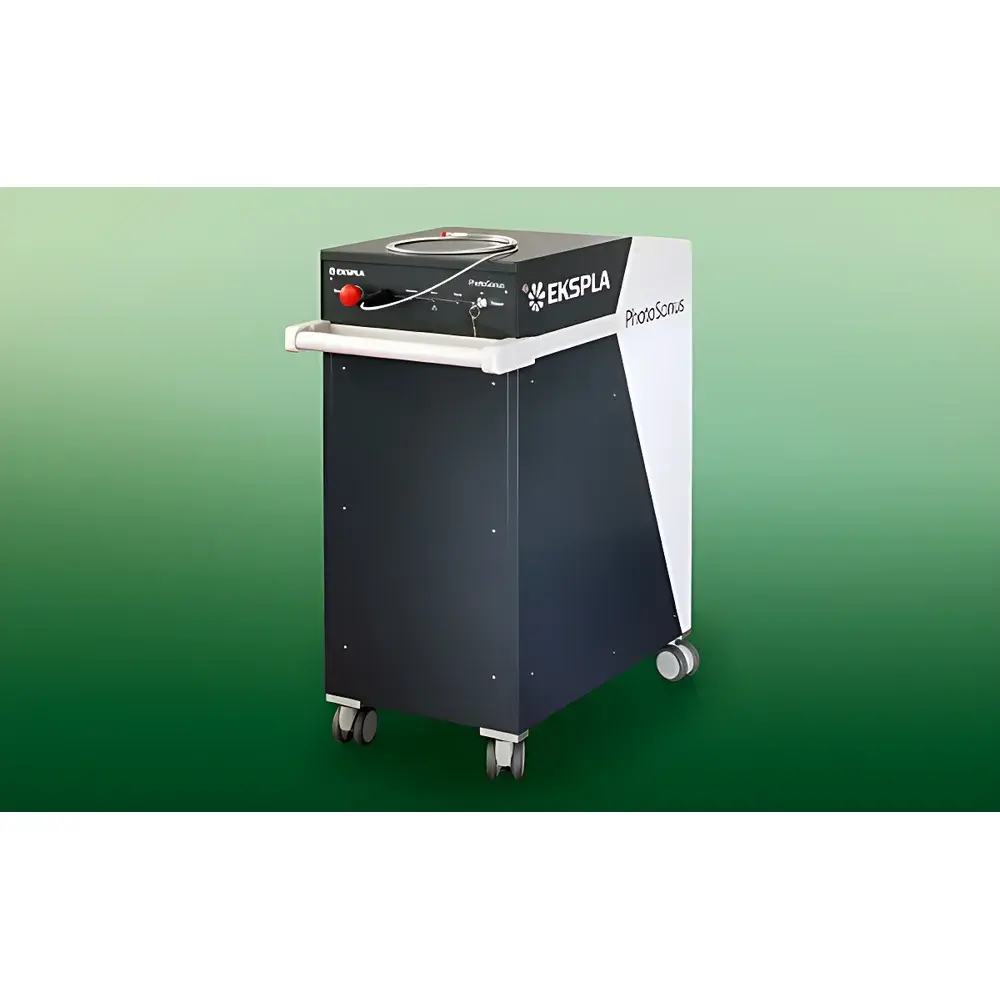
Ekspla PhotoSonus-1 Mobile Tunable Laser System
| Brand | Ekspla |
|---|---|
| Origin | Lithuania |
| Manufacturer Type | Original Equipment Manufacturer (OEM) |
| Product Category | Imported Instrument |
| Model | PhotoSonus-1 |
| Core Technology | Diode-Pumped Solid-State (DPSS) Laser with Integrated Optical Parametric Oscillator (OPO) |
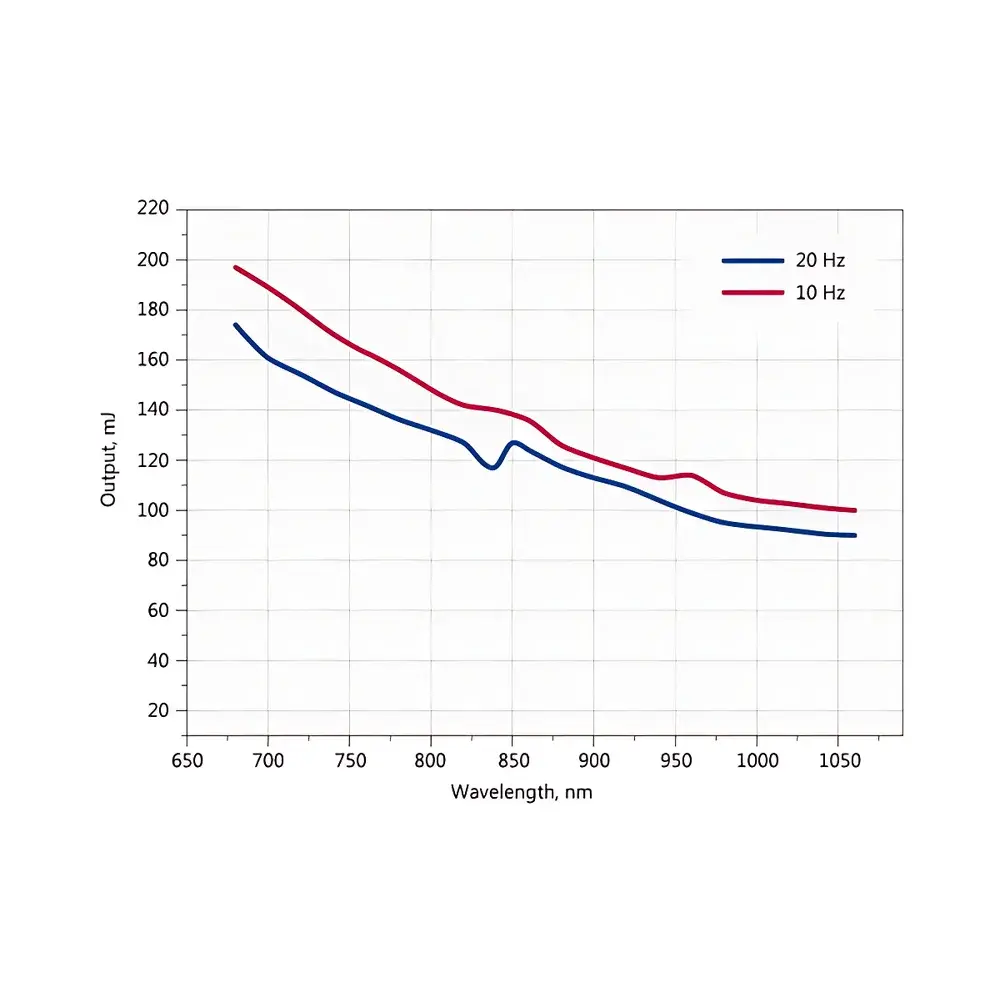
| Pulse Repetition Rate | 10 Hz or 20 Hz |
| Max Output Energy | 200 mJ |
| Tuning Speed | Full Spectral Range in <100 ms |
| Tuning Range (Signal + Idler) | 210–2300 nm |
| Pump Wavelength Options | 1064 nm and 532 nm (switchable) |
| Trigger Interface | TTL-compatible external trigger input |
| Control Interface | USB 2.0 with LabVIEW™ drivers |
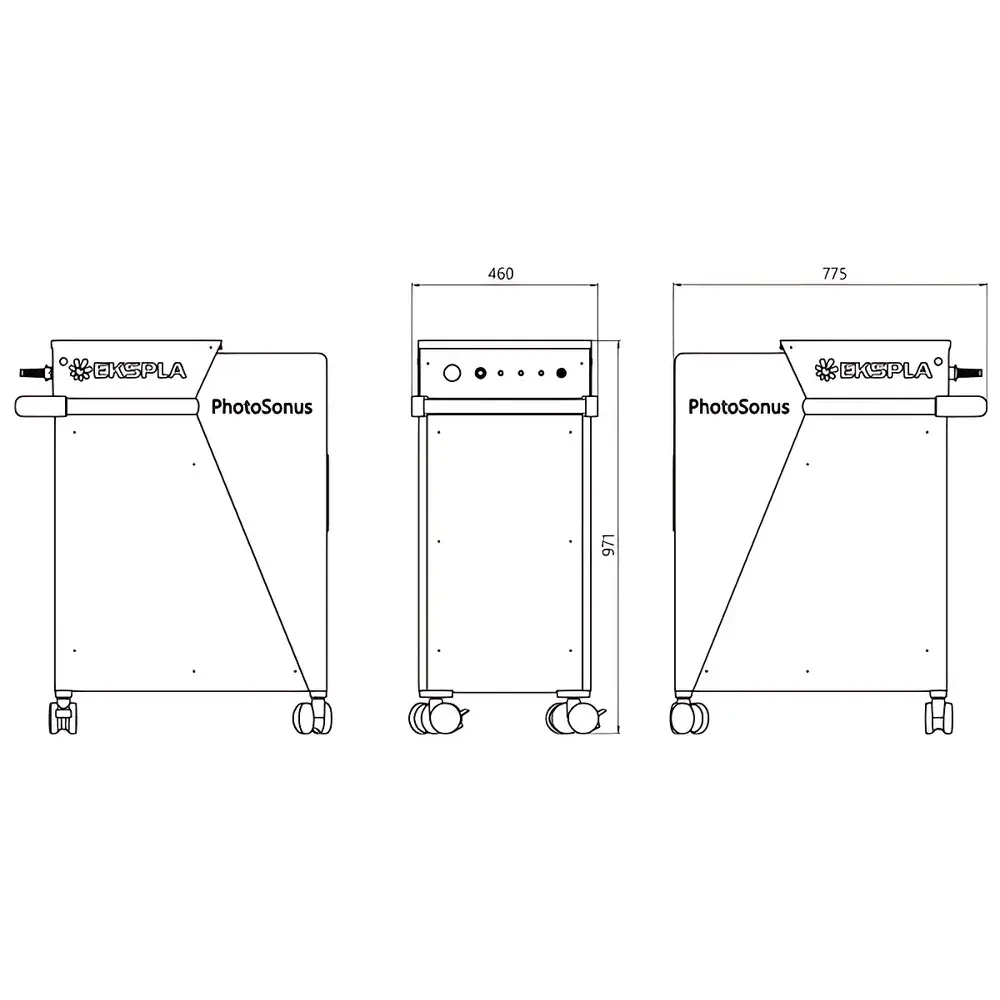
| Form Factor | Integrated mobile rack-mounted platform |
| Optional Components | Motorized variable attenuator, calibrated energy meter, fiber-coupled output module |
Overview
The Ekspla PhotoSonus-1 is a fully integrated, mobile tunable laser system engineered for demanding spectroscopic, photochemical, and time-resolved measurement applications in academic, industrial, and national laboratory environments. At its core lies a diode-pumped solid-state (DPSS) Nd:YAG pump laser (1064 nm / 532 nm), optically coupled to a high-efficiency, singly resonant optical parametric oscillator (OPO). This architecture enables broad spectral coverage—from deep ultraviolet (via harmonic generation) through visible to mid-infrared—without requiring realignment or manual optics exchange. Unlike modular benchtop configurations, the PhotoSonus-1 consolidates the pump laser, OPO cavity, power supply, cooling subsystem, and control electronics into a single, vibration-damped, castor-mounted rack. Its design emphasizes operational robustness, thermal stability, and long-term pulse-to-pulse energy reproducibility (<±2% RMS over 8 hours), critical for quantitative pump-probe experiments and calibration-grade photolysis studies.
Key Features
- Motor-driven, fully automated wavelength tuning across 210–2300 nm with <100 ms step response and <0.1 nm repeatability
- Two selectable pulse repetition rates: 10 Hz (optimized for high-energy operation) and 20 Hz (balanced energy-throughput trade-off)
- Maximum signal/idler output energy of 200 mJ at 1064 nm (pump-limited); typical idler output >30 mJ across 1600–2300 nm
- Integrated TTL-compatible external trigger input for synchronization with streak cameras, delay generators, or data acquisition systems
- USB 2.0 interface with native LabVIEW™ drivers, Python API support, and SCPI-compliant command set for automated experiment scripting
- Optional motorized variable attenuator (OD 0–6, 210–2300 nm) and NIST-traceable pyroelectric energy meter (±3% accuracy) for in-situ calibration
- Fiber-coupling option supports SMF-28 or HI1060 delivery up to 2 µm, enabling remote sample illumination in confined or hazardous environments
Sample Compatibility & Compliance
The PhotoSonus-1 is routinely deployed in laboratories conducting ASTM E2937-22 (laser-induced fluorescence spectroscopy), ISO 13485-aligned photobiomodulation R&D, and USP compliant photo-stability testing. Its stable pulse timing (jitter <1 ns), consistent beam pointing (<5 µrad drift over 4 h), and TEM00-like spatial profile (M² <1.3) ensure compatibility with scanning monochromators, FTIR spectrometers, and ultrafast transient absorption setups. All electrical subsystems comply with IEC 61000-6-3 (EMC emission limits) and IEC 61010-1 (safety requirements for laboratory equipment). Laser housing meets Class 1 enclosure standards per IEC 60825-1 when interlocked; optional key-switched access control supports GLP/GMP audit readiness.
Software & Data Management
System control is managed via Ekspla’s cross-platform PhotoSonus Control Suite (Windows/Linux/macOS), which provides real-time monitoring of OPO crystal angle, cavity alignment status, pump energy, and temperature stabilization feedback. The software logs all parameter changes with timestamped metadata (ISO/IEC 17025 traceable), supporting 21 CFR Part 11 compliance when paired with network-authenticated user accounts and electronic signature modules. Export formats include CSV, HDF5, and MATLAB .mat—enabling direct ingestion into Igor Pro, OriginLab, or custom Python analysis pipelines. Remote operation via SSH tunneling is supported for facility-wide instrument sharing without compromising local security policies.
Applications
- Time-resolved fluorescence lifetime imaging (FLIM) using tunable excitation between 250–650 nm
- Infrared vibrational spectroscopy of polymers and pharmaceutical excipients (1200–2300 nm idler output)
- Photoacoustic tomography source calibration requiring precise wavelength-dependent absorption coefficient validation
- Multi-photon microscopy excitation source (e.g., 800 nm via SHG of 1600 nm idler)
- Atmospheric LIDAR simulation using narrowband 210–250 nm UV output (with optional BBO harmonic generator)
- Photocatalytic reaction kinetics studies under controlled, wavelength-specific irradiance
FAQ
Is the PhotoSonus-1 certified for use in ISO 17025-accredited testing laboratories?
Yes—the system includes factory calibration certificates traceable to NPL (UK) and PTB (Germany), and its embedded logging meets ISO/IEC 17025:2017 clause 7.7 requirements for measurement uncertainty documentation.
Can the OPO be operated without the integrated pump laser?
No—the PhotoSonus-1 is a monolithic system; the OPO is optically and thermally optimized for the included DPSS pump. External pumping is not supported.
What is the typical warm-up time to achieve spectral stability?
Less than 15 minutes from cold start; full energy and pointing stability is achieved within 30 minutes under ambient conditions of 20–25 °C and <60% RH.
Does the system support third-party DAQ integration beyond LabVIEW?
Yes—SCPI command set and documented TCP/IP socket interface enable integration with National Instruments DAQmx, Keysight PathWave, or custom C++/Python frameworks.
Are replacement OPO crystals user-serviceable?
OPO crystal replacement requires factory recalibration and alignment; it is performed exclusively by Ekspla-certified service engineers to maintain wavelength accuracy and damage-threshold specifications.





