
Ekspla THz Emitter and Detector System for 800 nm Pump Laser
| Key | Brand: Ekspla |
|---|---|
| Origin | Imported (Lithuania) |
| Model | Ekspla-THz |
| Spectral Range | 0.1–3 THz |
| Temporal Resolution | <1 ps |
| Emitter Substrate | Low-Temperature-Grown GaAs (LT-GaAs) |
| Integrated Optics | Hyper-spherical high-resistivity silicon lens |
| Pump Laser Requirement | <150 fs pulses, 800 nm central wavelength |
| Detection Bandwidth (FWHM) | >700 GHz |
| Typical Output Power | >10 µW (with 100 mW Ti:Sapphire laser) |
| Compliance | Designed for ASTM E2964-compliant THz-TDS configurations |
| Software Interface | Compatible with LabVIEW, MATLAB, and Python-based acquisition frameworks |
Overview
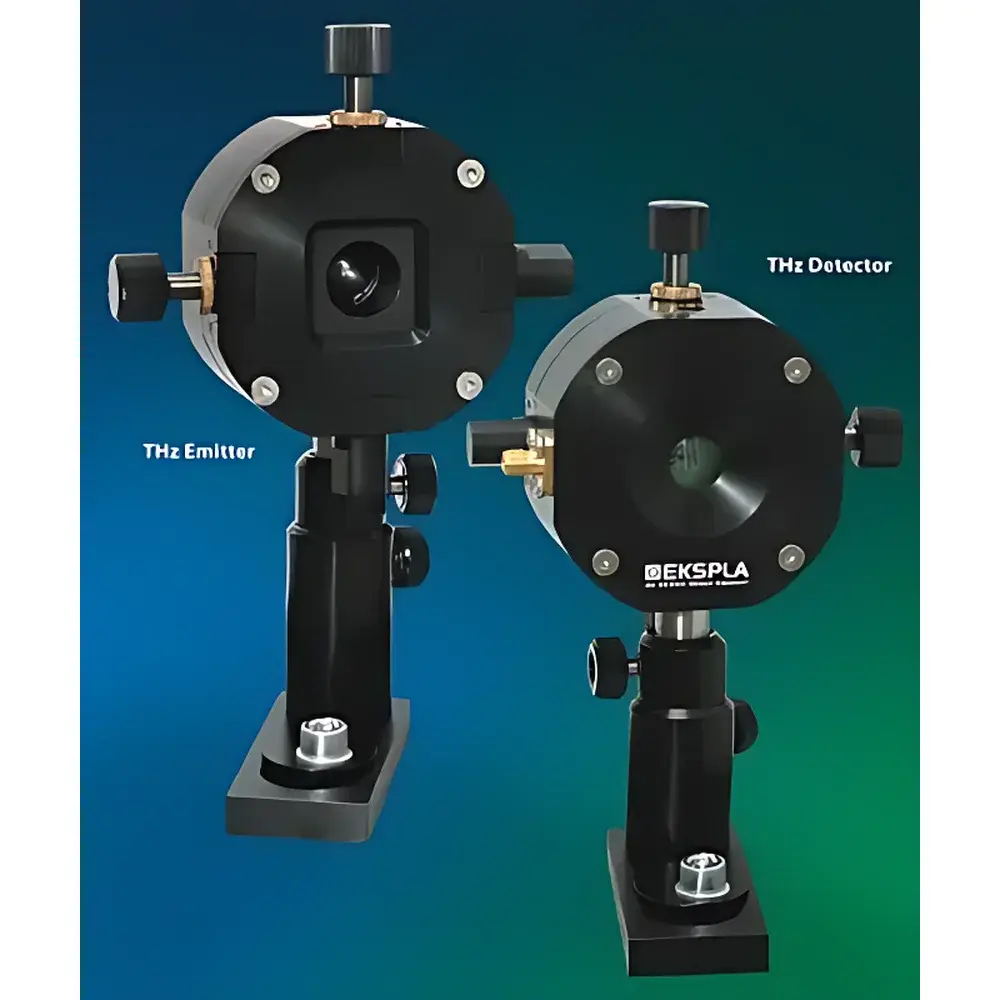
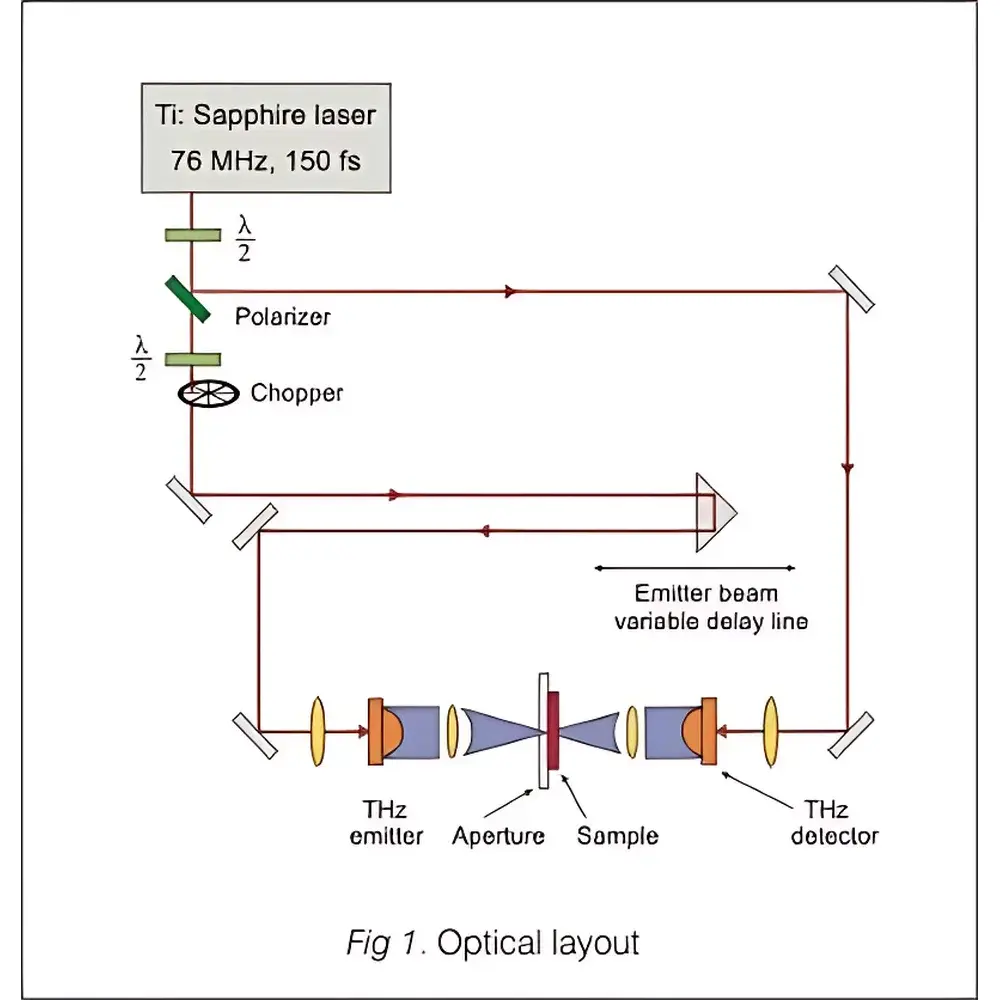
The Ekspla-THz emitter and detector system is a turnkey photoconductive antenna (PCA)-based platform engineered for time-domain terahertz (THz) spectroscopy and ultrafast dynamics studies. Operating in the 0.1–3 THz spectral band, it bridges the electromagnetic gap between microwave and infrared regimes—enabling non-ionizing, label-free interrogation of molecular vibrations, phonon modes, and carrier dynamics in semiconductors, pharmaceuticals, polymers, and biological tissues. The system relies on optical rectification and photoconductive switching principles: an ultrashort (<150 fs), 800 nm pump laser pulse excites carriers in a low-temperature-grown GaAs (LT-GaAs) photoconductive antenna, generating sub-picosecond THz transients; a matched PCA detector, gated by the same laser pulse train, enables coherent electro-optic sampling with phase-sensitive detection. Integrated hyper-spherical high-resistivity silicon lenses ensure efficient collimation and coupling of THz radiation, minimizing diffraction losses and maximizing signal-to-noise ratio across the usable bandwidth.
Key Features
- Monolithic LT-GaAs photoconductive antennas optimized for 800 nm excitation, delivering high dynamic range and reproducible THz output
- Integrated hyper-spherical Si lens mounted on precision X-Y translation stage for beam alignment and focal plane optimization
- Sub-picosecond temporal resolution (<1 ps FWHM pulse width) enabling precise time-domain waveform reconstruction
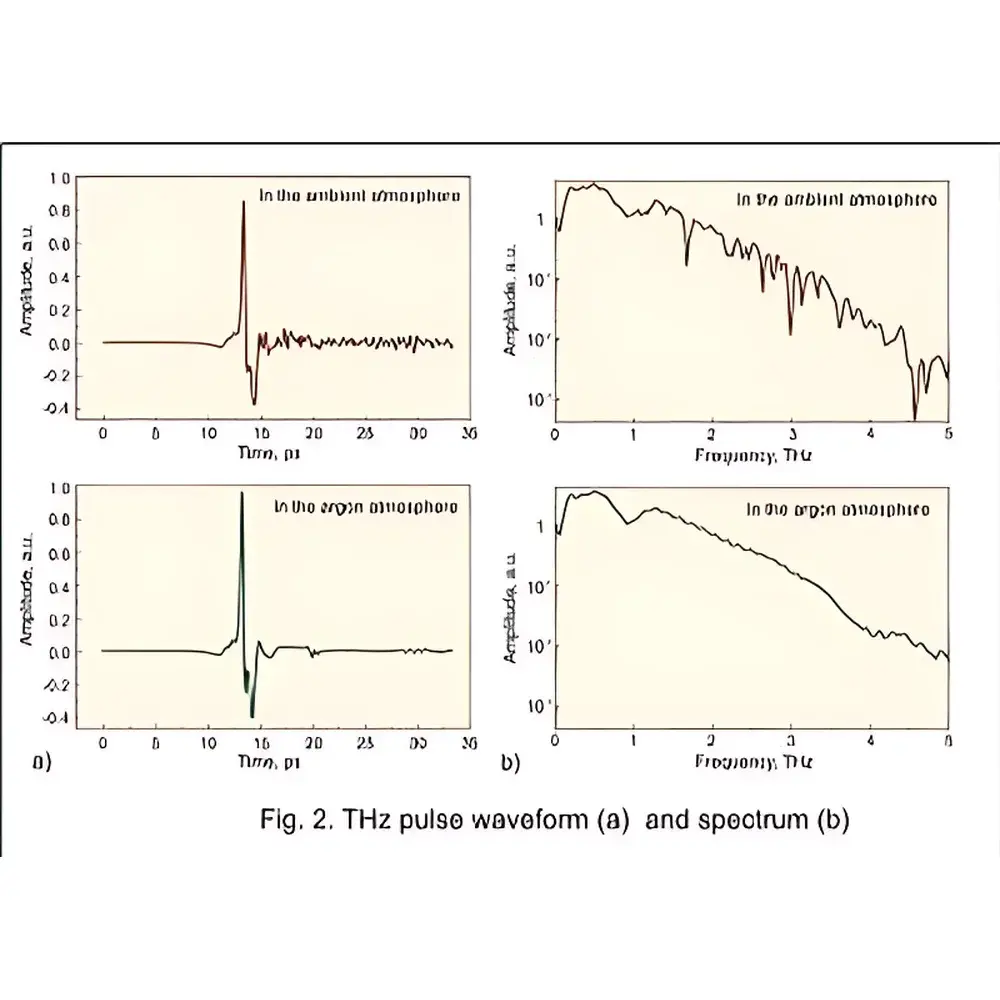
- Measured detection bandwidth exceeding 700 GHz (FWHM), supporting high-resolution spectral analysis from 0.1 to 3 THz
- Typical THz average power >10 µW when driven by a standard mode-locked Ti:Sapphire oscillator (100 mW, 80 MHz, 150 fs)
- Modular mechanical architecture compatible with vacuum, purged (N₂ or Ar), or ambient-air operation
- Pre-aligned optical path layout on a rigid 60 × 80 cm baseplate, reducing setup time and alignment drift
Sample Compatibility & Compliance
The Ekspla-THz system supports transmission and reflection-mode measurements across solid, liquid, and thin-film samples up to 20 mm in thickness (depending on material absorption). It is routinely deployed in laboratories adhering to GLP and GMP frameworks for pharmaceutical crystallinity analysis (e.g., polymorph identification per USP and ICH Q5A), semiconductor wafer characterization (ASTM F398 for carrier lifetime mapping), and security screening validation (ISO/IEC 17025-accredited THz imaging protocols). All electrical bias supplies comply with IEC 61000-4-3 immunity standards; optical components meet ISO 10110 surface quality specifications. The system’s mechanical and electronic design facilitates integration into ISO 14644-1 Class 5 cleanroom environments when configured with purge-compatible enclosures.
Software & Data Management
Data acquisition is supported via vendor-provided LabVIEW VIs and open-source Python libraries (e.g., thztools, scikit-tds) enabling full control over delay-stage positioning, lock-in amplifier parameters, and real-time FFT processing. Raw time-domain waveforms are saved in HDF5 format with embedded metadata (laser repetition rate, bias voltage, ambient conditions, sample ID), ensuring traceability for FDA 21 CFR Part 11–compliant audit trails. Optional add-ons include automated spectral library matching (using reference datasets compliant with NIST SRM 2067), batch-processing pipelines for THz tomography reconstructions (filtered backprojection, iterative SART), and export modules for MATLAB and OriginLab interoperability.
Applications
- THz Time-Domain Spectroscopy (THz-TDS): Quantitative determination of complex refractive index (n, κ) and absorption coefficient spectra for dielectric materials, including explosives simulants, hydrates, and amorphous APIs
- Optical Pump–THz Probe (OPTP): Direct monitoring of photoexcited carrier relaxation, mobility, and screening dynamics in 2D materials (e.g., MoS₂, graphene) without bandgap resonance artifacts
- THz Imaging: Raster-scanned transmission/reflection mapping at sub-millimeter spatial resolution (λ/3 at 1 THz ≈ 300 µm in air), validated for leaf vein structure analysis and tablet coating uniformity assessment
- Non-Destructive Testing (NDT): Delamination detection in CFRP composites and moisture ingress mapping in polymer laminates per ASTM E2792 guidelines
- Gas-Phase Rotational Spectroscopy: High-resolution rotational line identification in low-pressure molecular gases (e.g., HCl, NH₃) using frequency-comb-referenced THz-TDS
FAQ
What laser specifications are required to drive the Ekspla-THz system?
A femtosecond Ti:Sapphire oscillator emitting at 800 nm, with pulse duration ≤150 fs, average power ≥80 mW, and repetition rate between 70–100 MHz is recommended. Fiber-based Yb-doped oscillators (e.g., Menlo Systems C-Fiber) may be used with appropriate dispersion compensation.
Can the system operate under vacuum or inert gas?
Yes—the baseplate-mounted configuration allows integration into sealed chambers. Optional purging ports and vacuum-rated Si lens mounts are available upon request.
Is the detector sensitive to polarization state?
The LT-GaAs PCA exhibits linear polarization sensitivity aligned with the antenna gap direction; rotation of the detector mount enables polarization-resolved measurements.
How is calibration performed for quantitative spectroscopy?
Calibration uses a reference measurement in air (or argon) followed by Fourier deconvolution with known atmospheric absorption lines (HITRAN database) to extract instrument response function; NIST-traceable polyethylene and silicon standards are recommended for amplitude normalization.
Does the system support lock-in detection with external modulation?
Yes—integrated bias supply includes TTL-synchronized modulation input (up to 10 kHz), compatible with standard SR830 and Zurich Instruments HF2LI lock-in amplifiers.





