
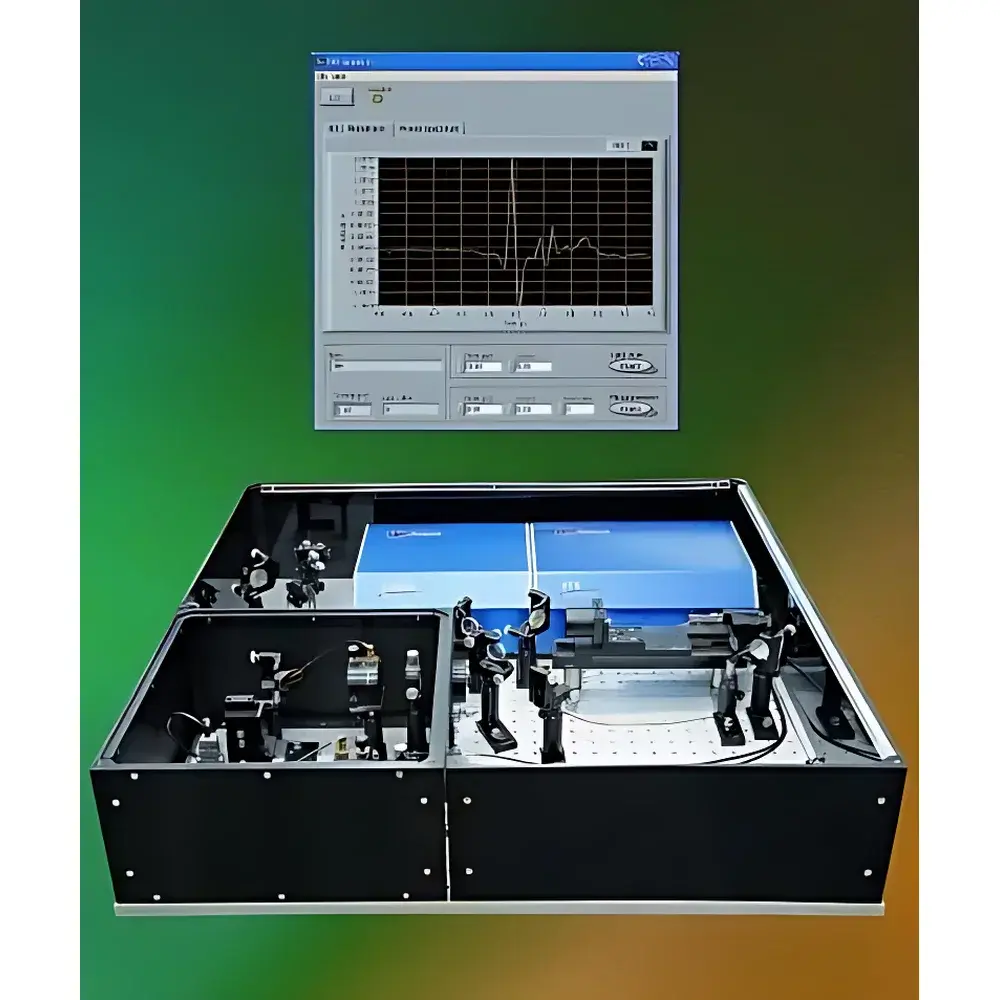
Ekspla THz-TDS Terahertz Time-Domain Spectroscopy System
| Brand | Ekspla |
|---|---|
| Origin | Imported (Lithuania) |
| Model | THz-TDS |
| Pump Laser | Mode-locked Ti:Sapphire, 760–840 nm, >60 mW avg. power, pulse width <50 fs (optional 20 fs), rep rate 50–100 MHz |
| THz Bandwidth | 0.1–3 THz (3.3–100 cm⁻¹) |
| Spectral Resolution | >15 GHz (corresponding to >70 ps time-domain scan window) |
| Dynamic Range | >1000:1 (electric field amplitude at 0.6 THz) |
| THz Emitter & Detector | LT-GaAs photoconductive antennas with integrated hyperhemispherical Si lenses, mounted on precision X-Y stages |
| Delay Line | Motorized optical delay line, max. scan range 300 ps (extendable) |
| Detection | Lock-in amplified electro-optic or photoconductive sampling |
| Polarization | Linear, configurable for horizontal/vertical THz polarization |
| Incidence Angle for Reflection | Adjustable 30°–50° |
| Imaging Resolution | ~1 mm (raster-scanned 2D transmission/reflection mapping) |
| Software | Real-time acquisition, FFT-based spectral extraction, transmission/reflection coefficient calculation, raw data export (.txt, .mat), source code available for customization |
| Compliance | Designed for GLP-compliant lab environments |
Overview
The Ekspla THz-TDS Terahertz Time-Domain Spectroscopy System is a turnkey, research-grade platform engineered for coherent, phase-sensitive measurement of electromagnetic responses in the 0.1–3 THz (3.3–100 cm⁻¹) spectral region. Operating on the principle of ultrafast optoelectronic generation and detection of broadband THz pulses, the system employs femtosecond Ti:sapphire laser excitation of low-temperature-grown gallium arsenide (LT-GaAs) photoconductive antennas to produce and sample transient electric fields in the time domain. Subsequent Fourier transformation yields both amplitude and phase information across the THz band—enabling absolute complex refractive index extraction without Kramers–Kronig assumptions. This capability distinguishes THz-TDS from intensity-only techniques such as FTIR, making it uniquely suited for quantitative dielectric characterization, carrier dynamics analysis, and non-destructive evaluation where phase coherence and picosecond temporal resolution are critical.
Key Features
- Coherent broadband THz generation and detection with full electric-field waveform capture (0.1–3 THz bandwidth, >700 GHz FWHM detector response)
- Integrated LT-GaAs photoconductive emitters and receivers featuring hyperhemispherical silicon lenses and precision X-Y alignment stages
- Motorized optical delay line with 300 ps maximum scan range (extendable), enabling high-resolution time-domain sampling and sub-15 GHz spectral resolution
- Configurable polarization optics supporting horizontal/vertical THz polarization measurements for anisotropic material analysis
- Adjustable incidence angle (30°–50°) for reflection-mode spectroscopy, optimized for non-contact surface inspection and thin-film interface characterization
- Real-time spectral acquisition engine with on-the-fly FFT processing, transmission/reflection coefficient computation, and dual-channel lock-in detection
- Open software architecture: acquisition software includes documented API and optional source code distribution for custom algorithm integration and lab-specific workflow automation
Sample Compatibility & Compliance
The THz-TDS system accommodates solid, liquid, and powder samples in transmission, reflection, and pump–probe configurations. Its non-ionizing, low-photon-energy radiation (meV scale) enables safe interrogation of biological tissues, pharmaceutical tablets, polymer composites, semiconductor wafers, and explosive simulants without thermal or photochemical damage. For regulatory-aligned operation, the system supports traceable parameter logging—including laser energy, delay stage position, lock-in settings, ambient temperature/humidity (when interfaced with external sensors), and operator ID—facilitating GLP/GMP documentation requirements. While not pre-certified as a medical device, its architecture complies with foundational elements of ISO/IEC 17025 for testing laboratories and aligns with ASTM E3121–22 guidelines for THz material property measurement. Optional purge enclosure mitigates atmospheric water vapor absorption (notably at 1.5–2.0 THz), ensuring reproducible spectral baselines in ambient lab conditions.
Software & Data Management
Acquisition and analysis are performed via Ekspla’s native THz-SpecSuite software, running on Windows-based control laptops (minimum Intel Pentium 4 1.6 GHz, recommended ≥8 GB RAM). The software provides synchronized hardware control of the delay stage, lock-in amplifier, laser repetition rate, and detector bias. All raw time-domain waveforms and derived spectra are stored with embedded metadata (timestamp, instrument configuration hash, user-defined sample ID). Export formats include ASCII (.txt), MATLAB (.mat), and HDF5 for interoperability with Python (NumPy/SciPy), Igor Pro, or commercial chemometrics packages. For regulated environments, the software can be deployed within a validated computing environment; audit trails, electronic signatures, and version-controlled script execution are achievable via integration with third-party LIMS or ELN platforms compliant with FDA 21 CFR Part 11.
Applications
- Pharmaceutical Solid-State Analysis: Quantitative polymorph identification, hydration state mapping, and coating thickness verification in tablet formulations using THz refractive index dispersion
- Semiconductor Carrier Dynamics: Femtosecond-to-picosecond monitoring of photoexcited carrier relaxation, mobility, and trapping in GaAs, SiC, perovskites, and 2D materials via pump–THz probe spectroscopy
- Non-Destructive Testing (NDT): Delamination detection in carbon-fiber composites, corrosion under paint, and moisture ingress in insulation layers through reflection-phase contrast imaging
- Security Screening: Spectral fingerprinting of concealed explosives, narcotics, and precursors based on rotational and vibrational resonances in the 0.3–2.5 THz range
- Biochemical Sensing: Label-free protein conformational analysis and DNA hybridization kinetics monitoring in aqueous environments using differential THz absorption signatures
- Materials Science: Complex permittivity extraction of metamaterials, MOFs, and topological insulators across the THz gap, supporting design validation for next-generation photonic devices
FAQ
What is the typical dynamic range of this system, and how is it measured?
Dynamic range is defined as the ratio of peak THz electric field amplitude (with sample removed) to RMS noise floor in the frequency domain at 0.6 THz. Under standard operating conditions (60 mW pump, 70 ps delay scan), the system achieves >1000:1 (60 dB), verified per ASTM E3121 Annex B protocols.
Can the system operate in ambient air, or is vacuum/purged operation required?
Ambient operation is fully supported; however, strong water vapor absorption lines between 1.5–2.0 THz reduce signal-to-noise in that sub-band. An optional nitrogen-purged enclosure is available to suppress these features and extend usable bandwidth toward 3 THz.
Is the software compatible with automated sample changers or robotic staging systems?
Yes—the THz-SpecSuite SDK provides TCP/IP and DLL-based interfaces for integration with third-party motion controllers, XYZ stages, and auto-samplers, enabling unattended multi-sample screening and spatially resolved hyperspectral mapping.
Does the system support time-resolved pump–probe measurements beyond semiconductor studies?
Absolutely. The modular optical layout permits insertion of arbitrary pump wavelengths (UV–MIR) and variable probe delays, enabling studies of spin dynamics in magnetic heterostructures, phonon–polariton coupling in van der Waals crystals, and ultrafast superconducting gap recovery.
How is calibration traceability maintained for quantitative refractive index measurements?
Calibration relies on reference measurements of fused silica and polyethylene standards with certified THz optical constants (NIST-traceable literature values). System-specific transfer functions are recorded during commissioning and applied during post-processing to correct for antenna response roll-off and lens dispersion effects.





