
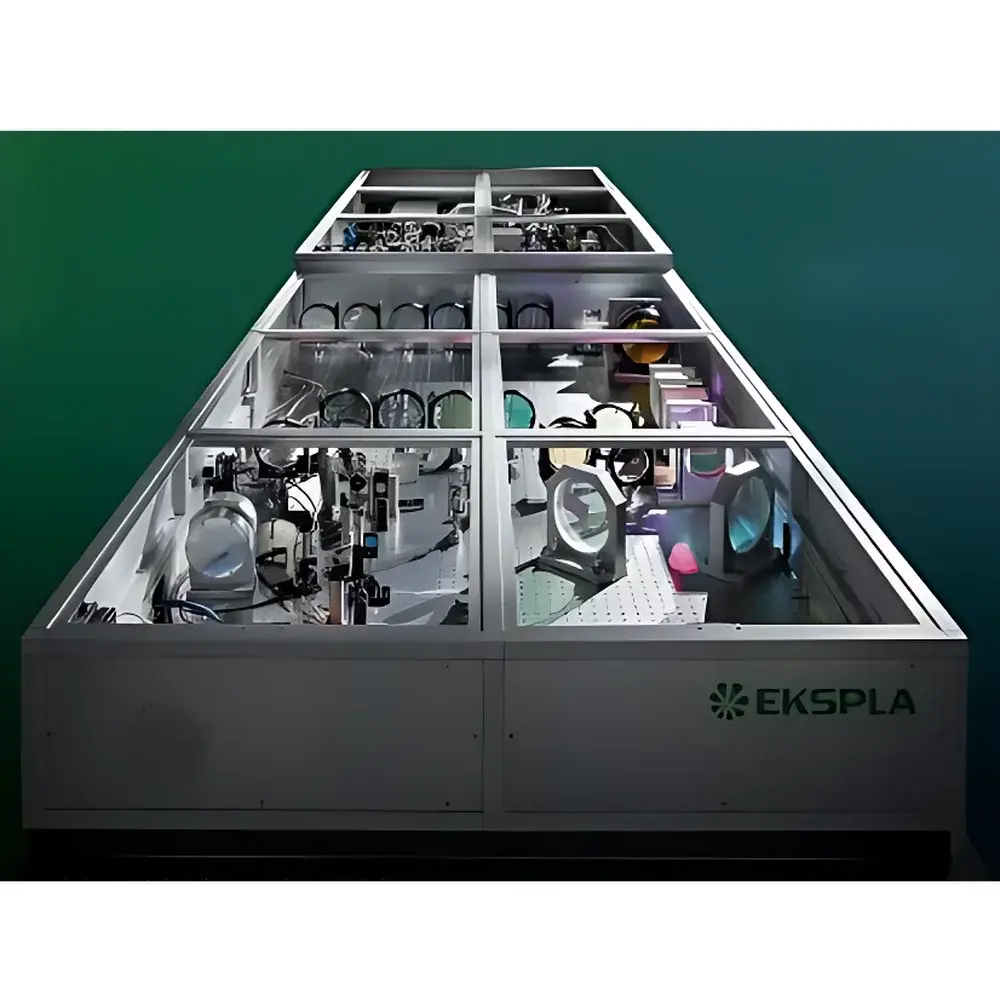
Ekspla UltraFlux HE High-Energy Femtosecond OPCPA System
| Brand | Ekspla |
|---|---|
| Origin | Lithuania |
| Manufacturer Type | Original Equipment Manufacturer (OEM) |
| Origin Category | Imported |
| Model | UltraFlux HE |
| Core Architecture | Solid-State Laser System Based on Optical Parametric Chirped Pulse Amplification (OPCPA) |
| Max Pulse Energy | 1 J @ 5 Hz |
| Min Pulse Duration | ≤10 fs |
| Repetition Rate | Single Shot to 100 Hz |
| Output Wavelength Tuning Range (Signal) | 750–960 nm |
| Harmonic Outputs | SH (375–480 nm), TH (250–320 nm), FH (210–230 nm) |
| Pulse Energy Stability | ≤1 % RMS |
| Long-Term Power Stability | ≤1.5 % RMS (8 h) |
| Temporal Contrast (APFC) | 10¹⁰ : 1 |
| Beam Profile | Super-Gaussian (6th–11th order) |
| Cooling Requirement | Water-cooled (up to 14 L/min, 2 bar, ≤20 °C) |
| Compliance | ISO Class 7 Cleanroom Environment Required |
| Optional Features | CEP Stabilization (≤400 mrad), Deformable Mirror (Strehl >0.9), Air-Water Hybrid Cooling, Dazzler-based Dispersion Control |
Overview
The Ekspla UltraFlux HE is a high-energy, turnkey femtosecond optical parametric chirped pulse amplification (OPCPA) laser system engineered for ultrafast science applications demanding extreme peak power, exceptional temporal contrast, and long-term operational stability. Designed and manufactured in Lithuania by Ekspla—a globally recognized leader in ultrafast laser technology—the UltraFlux HE series delivers up to 1 J pulse energy at 5 Hz repetition rate or 50 mJ at 100 Hz, with pulse durations compressible to ≤10 fs (with optional F10 configuration). Its architecture is rooted in patented front-end design (EP2827461, EP2924500), integrating an all-fiber Yb-doped picosecond oscillator that simultaneously seeds both the NOPCPA front-end and a synchronized Nd:YAG picosecond pump laser. This co-located, fiber-coupled seeding eliminates complex active timing electronics, ensuring intrinsic optical synchronization between femtosecond signal and picosecond pump beams—critical for pump-probe experiments requiring sub-100 ps jitter.
Key Features
- Patented all-fiber picosecond oscillator seed source enabling passive synchronization between fs signal and ps pump outputs
- Non-collinear OPCPA (NOPCPA) amplification architecture with broadband white-light generation and multi-stage parametric amplification
- Flexible repetition rate operation: single-shot, 5 Hz, 10 Hz, or 100 Hz—configurable per application requirements
- High-fidelity pulse compression using either bulk-glass + chirped-mirror or grating-based compressors, optimized for energy and duration trade-offs
- Integrated output diagnostics module monitoring real-time pulse energy, spatial beam profile (FWHM/Super-Gaussian fit), and beam pointing stability (≤30 µrad RMS)
- Optional Acousto-Optic Programmable Dispersive Filter (Dazzler) for adaptive higher-order phase compensation and pulse shaping
- CEP stabilization option (≤400 mrad RMS) compatible with few-cycle pulse generation and attosecond metrology
- Harmonic generation modules (SH/TH/FH) with typical conversion efficiencies of ~35%, ~12%, and ~3% respectively—non-simultaneous with fundamental output
Sample Compatibility & Compliance
The UltraFlux HE is designed for integration into controlled laboratory environments compliant with ISO Class 7 cleanroom standards. Its optical path is sealed against particulate contamination, and thermal management requires stable ambient conditions (22 ± 2 °C) with minimal air turbulence—especially critical for maintaining beam pointing stability and long-term power reproducibility. The system meets electromagnetic compatibility (EMC) requirements per EN 61326-1 and laser safety standards per IEC 60825-1 (Class 4). For regulated research environments—including those operating under GLP or GMP frameworks—the built-in diagnostics interface supports timestamped logging of energy, duration, and alignment parameters, enabling traceable audit trails. While not FDA 21 CFR Part 11–certified out-of-the-box, the system’s deterministic behavior, low RMS drift (<1.5 % over 8 h), and hardware-triggered acquisition architecture facilitate validation for use in preclinical photonics research and industrial process development where regulatory documentation is required.
Software & Data Management
Control and monitoring are executed via Ekspla’s proprietary LabView-based UltraFlux Control Suite, offering remote operation through Ethernet (TCP/IP) or local touchscreen HMI. All operational parameters—including wavelength tuning (5 nm steps in signal band), repetition rate selection, harmonic module activation, and compressor alignment presets—are accessible through intuitive GUI panels. Real-time diagnostics data (pulse energy, beam centroid position, compressor grating angle feedback) are logged in HDF5 format with nanosecond-resolution timestamps, supporting post-acquisition correlation with external detectors (e.g., streak cameras, TOF spectrometers). The software architecture permits integration with third-party experiment control platforms (e.g., Python-based automation via PyVISA, MATLAB Instrument Control Toolbox) and supports custom scripting for automated spectral scanning or pump-probe delay sweeps. Optional firmware upgrades enable compatibility with industry-standard communication protocols such as EPICS for synchrotron or large-scale facility integration.
Applications
- Broadband coherent anti-Stokes Raman scattering (CARS) and sum-frequency generation (SFG) microscopy
- Femtosecond time-resolved pump-probe spectroscopy across UV–NIR spectral ranges
- High-harmonic generation (HHG) in gas and solid targets for tabletop attosecond pulse sources
- Laser-driven wakefield electron acceleration and compact X-ray source development
- Strong-field ionization dynamics, non-sequential double ionization (NSDI), and tunneling studies
- Ultrafast magnetization dynamics and spin-resolved photoemission experiments
- Multi-dimensional nonlinear optical spectroscopy (e.g., 2D electronic spectroscopy)
FAQ
What is the difference between the UltraFlux HE and conventional Ti:sapphire CPA systems?
The UltraFlux HE replaces the broadband Ti:sapphire amplifier chain with an OPCPA architecture, eliminating gain narrowing and ASE limitations. It offers broader tunability (750–960 nm), superior temporal contrast (10¹⁰ : 1 APFC-limited), and no thermal lensing—enabling higher average power scalability without crystal degradation.
Can the system operate at both 100 Hz and 1 J simultaneously?
No. Maximum pulse energy (1 J) is specified at 5 Hz; at 100 Hz, maximum output is 50 mJ. These are distinct operational modes governed by thermal load and pump energy distribution across amplification stages.
Is wavelength tuning available with the ≤10 fs ‘F10’ option?
No. The F10 short-pulse configuration fixes the central wavelength near 840 nm to optimize compressor alignment and dispersion control—tunability is disabled in this mode.
How is temporal contrast measured, and what limits it?
Contrast is measured via third-order autocorrelation and limited primarily by amplified parametric fluorescence (APFC) within ±50 ps of the main pulse. The system is ASE-free; post-pulses are suppressed using wedged optics, and no pre-pulses are generated inherently.
What cooling infrastructure is required for continuous operation?
A closed-loop deionized water system delivering up to 14 L/min at ≤20 °C and ≥2 bar is mandatory for the FF8005 model. Optional air-water hybrid cooling (AW option) eliminates external chillers but increases footprint and power draw.



