
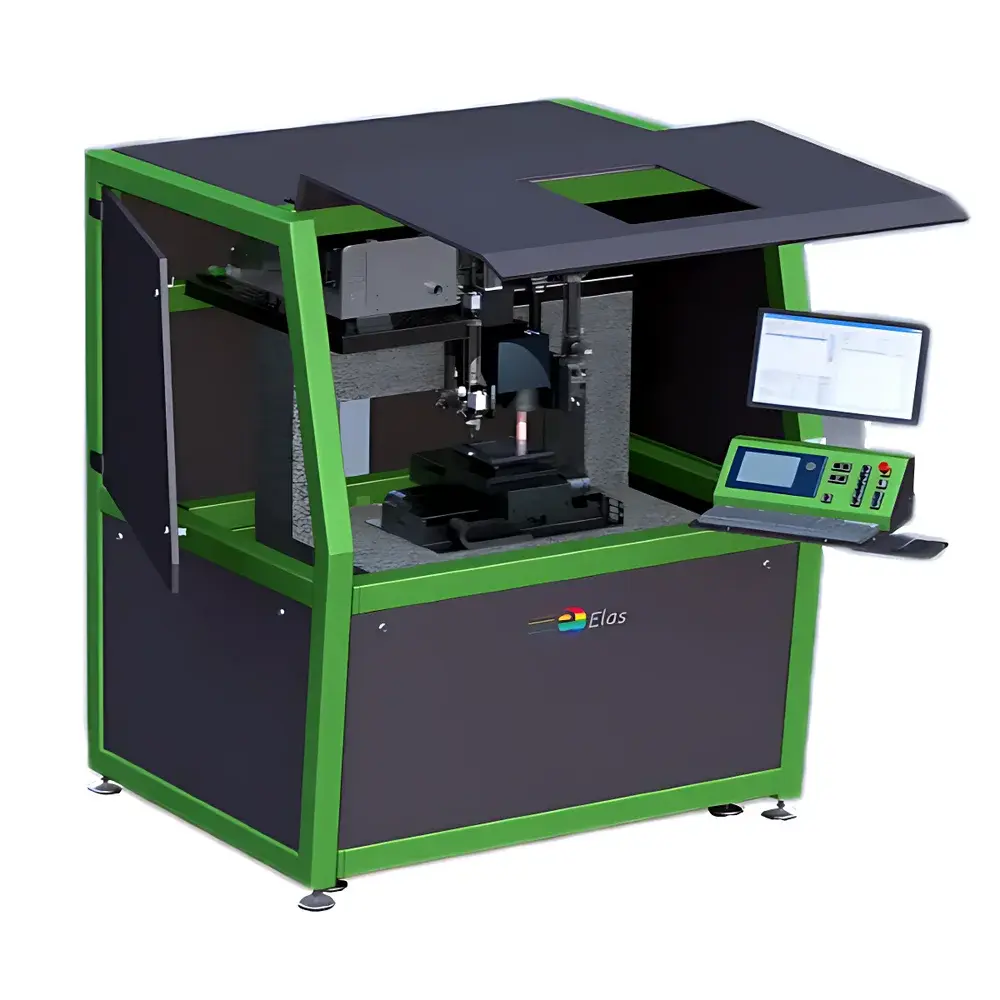
ELAS MASTER Series Ultrafast Laser Micromachining Workstation
| Brand | ELAS |
|---|---|
| Model | MASTER Series |
| Origin | Imported |
| Manufacturer Type | Authorized Distributor |
| Core Components | Semiconductor-based Ultrafast Laser System (Picosecond & Femtosecond) |
| Laser Types | Pulsed IR/Vis/UV (1064 nm, 532 nm, 355 nm, 1028 nm) |
| Positioning Accuracy | ±1 µm (XY/Z), Repeatability: ≤0.10 µm |
| Max XY Travel | 200 mm |
| Max Z Travel | 100 mm |
| Max XY Speed | 2000 mm/s |
| Max Acceleration | 30 m/s² |
| Spot Size | Down to 3 µm |
| Pulse Duration | <10 ps (ps-Master), <200 fs (fs-Master) |
| Repetition Rate | Single-shot to 500 kHz |
| Beam Quality | M² < 1.5 (ps), M² < 1.2 (fs) |
| Platform | Vibration-isolated Granite Base |
| Safety Class | Integrated Class 1 Enclosure |
| Software | SCA – Windows-based Laser Process Control & Pattern Design Suite |
| Power Requirement | Up to 4500 W |
| Dimensions (W×D×H) | ~1300 × 1200 × 1700 mm |
Overview
The ELAS MASTER Series Ultrafast Laser Micromachining Workstation is an engineered platform for high-precision, non-thermal laser material processing across research laboratories and industrial R&D environments. Built on the principles of ultrafast photon–matter interaction, the system leverages picosecond (ps) and femtosecond (fs) laser pulses to induce highly localized ablation with minimal thermal diffusion—enabling sub-micron feature resolution in metals, semiconductors, ceramics, polymers, and transparent dielectrics. Unlike nanosecond systems, the MASTER Series avoids melt zones, recast layers, and microcracking by delivering pulse energies within timescales shorter than electron–phonon coupling durations. This ensures deterministic material removal, critical for applications demanding metrological traceability, surface integrity, and structural fidelity—such as photovoltaic cell scribing, fuel injector nozzle drilling, and microfluidic channel fabrication.
Key Features
- Ultrafast Laser Sources: Dual-path configurable lasers—including 16 W ps-laser (1064/532/355 nm) and 5 W fs-laser (1028 nm)—with pulse energy >160 µJ (ps) and >1 mJ (fs), repetition rates from single-shot to 500 kHz, and diffraction-limited beam quality (M² < 1.5 for ps, <1.2 for fs).
- Nanometric Positioning Architecture: Three-axis linear stages with ±1 µm absolute accuracy and ≤0.10 µm repeatability; XY travel up to 200 mm at 2000 mm/s, Z-axis travel 100 mm at 400 mm/s, and acceleration up to 30 m/s² under no-load conditions.
- Multi-Modal Beam Delivery: Integrated galvanometric scanner for high-throughput 2D patterning, trepanning unit for conical or tapered hole drilling, and optional dual-axis galvo for complex freeform scanning trajectories.
- Vibration-Isolated Platform: Monolithic granite base housed within a fully interlocked Class 1 laser safety enclosure compliant with IEC 60825-1 and compatible with ISO Class 5 cleanroom environments.
- Wavelength Flexibility: Standard harmonics generation (2nd/3rd/4th) enables simultaneous or sequential use of 1064 nm, 532 nm, and 355 nm beams—optimized for wavelength-dependent absorption in Si, Cu, Al₂O₃, fused silica, and polyimide.
Sample Compatibility & Compliance
The MASTER Series processes materials spanning conductive (Cu, Ti, stainless steel), brittle (Si, sapphire, glass), polymeric (PI, PET, PC), and composite substrates without pre- or post-processing. Its non-contact, maskless approach eliminates tool wear and mechanical stress—making it suitable for low-volume prototyping and pilot-line production. The workstation meets international regulatory expectations for laboratory instrumentation: full alignment with ISO 13849-1 (safety-related control systems), CE marking per Machinery Directive 2006/42/EC and EMC Directive 2014/30/EU, and design provisions supporting GLP-compliant audit trails via SCA software logging (timestamped parameter sets, process logs, user authentication). Optional filter integration satisfies OSHA PEL requirements for airborne particulate capture during ablation of hazardous materials (e.g., CdTe, Pb-based perovskites).
Software & Data Management
SCA (Smart Control Architecture) is a native Windows-based application providing unified control of laser parameters, motion axes, vision feedback, and real-time process monitoring. It supports CAD import (DXF, SVG, G-code), parametric pattern generation, multi-layer stacking, and physics-informed simulation of ablation depth vs. fluence. All operational events—including laser firing timestamps, stage coordinates, pulse counts, and environmental sensor readings—are logged in encrypted SQLite databases with configurable retention policies. SCA complies with FDA 21 CFR Part 11 requirements through electronic signature support, role-based access control, and immutable audit trails—ensuring data integrity for regulated development workflows in medical device micromachining or aerospace component qualification.
Applications
- High-aspect-ratio drilling of diesel injector nozzles (aspect ratios >20:1 in hardened steel)
- Surface structuring of optical-grade sapphire for anti-reflective and hydrophobic functionalization
- Through-glass vias (TGVs) and thin-film circuit patterning for advanced packaging
- Microchannel fabrication in PDMS, glass, and quartz for lab-on-chip platforms
- Direct-write marking of serial numbers and 2D barcodes in transparent materials (e.g., ophthalmic lenses)
- Selective laser-induced periodic surface structures (SLIPS) for tribological enhancement of bearing surfaces
- Production of micro-molds for injection molding of polymer micro-optics
- Filter membrane fabrication via controlled pore array generation in Ni and Ti foils
FAQ
What laser wavelengths are standard on the MASTER Series?
The ps-Master offers harmonically converted outputs at 1064 nm, 532 nm, and 355 nm; the fs-Master operates at 1028 nm with optional harmonic generation modules.
Can the system be integrated into an existing cleanroom environment?
Yes—the enclosure is ISO Class 5 compatible, features HEPA-filtered air recirculation, and supports external exhaust ducting for particle extraction.
Is remote operation supported?
SCA software enables secure remote desktop access and API-driven automation via TCP/IP, supporting integration with MES and PLM systems.
What level of training and documentation is provided?
ELAS delivers on-site installation verification, operator certification, SOP development support, and comprehensive technical manuals—including laser safety protocols, maintenance schedules, and calibration procedures aligned with ISO/IEC 17025 guidelines.
Are custom optical paths available for specialized beam shaping?
Yes—options include Bessel beam generators, vortex phase plates, and adaptive optics modules for dynamic wavefront correction during deep-trench machining.





