
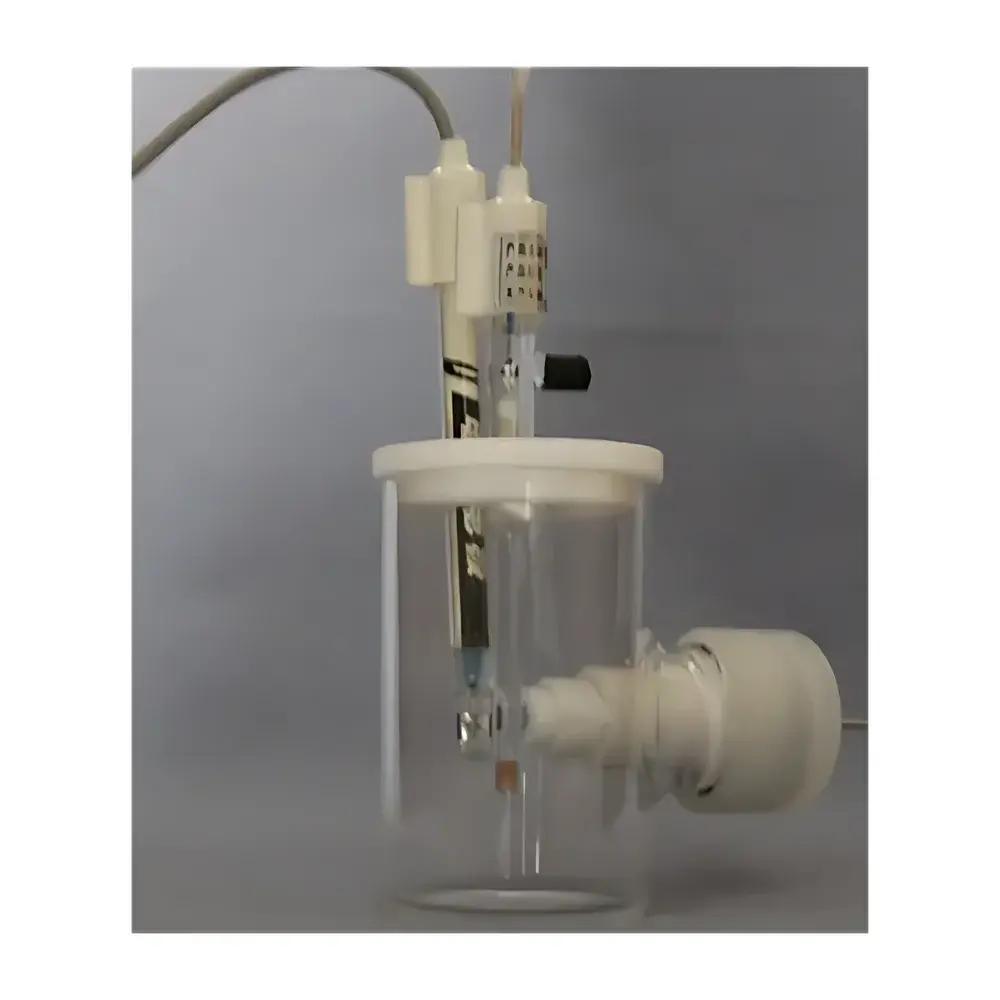
Electrochemical Cell (Customizable Horizontal-Configuration Electrolytic Cell)
| Brand | CME (Zhongjiao Jinyuan) |
|---|---|
| Origin | Beijing, China |
| Manufacturer Type | OEM Producer |
| Country of Origin | China |
| Model | Electrochemical Cell |
| Pricing | Upon Request |
Overview
The CME Electrochemical Cell is a precision-engineered, horizontally configured three-electrode electrochemical measurement system designed for fundamental and applied research in electrocatalysis, battery materials screening, corrosion science, and sensor development. Its core architecture follows the standard working electrode (WE), counter electrode (CE), and reference electrode (RE) configuration, with the defining feature being the lateral (horizontal) alignment of the working electrode—enabling precise spatial control between WE and CE. This geometry minimizes uncompensated solution resistance (Ru) and facilitates reproducible mass transport conditions, particularly under quiescent or controlled convection environments. Unlike vertical or sealed-cell designs, this horizontal layout allows direct optical access to the electrode surface and accommodates in situ/operando spectroscopic coupling (e.g., Raman, UV-Vis transmission). The cell body is constructed from chemically inert, high-purity PTFE and quartz-glass components to ensure electrochemical stability across wide pH ranges (0–14) and potential windows (−2.5 V to +2.5 V vs. Ag/AgCl).
Key Features
- Horizontal Electrode Geometry: Working electrode mounted orthogonally to the electrolyte flow axis, enabling fine-tuned inter-electrode distance adjustment (range: 1–10 mm) via micrometer-driven translation stage—critical for systematic ohmic drop analysis and diffusion-layer modeling.
- Modular & Customizable Design: Standard cell volume: 15 mL (adjustable from 5–50 mL via interchangeable spacers); optional ports for gas purging (N2, Ar), temperature probe insertion, and fiber-optic feedthroughs; available with Pt, Au, GC, or custom-modified WE substrates (e.g., Ni foam, FTO, carbon cloth).
- Reference Electrode Compatibility: Dual Luggin capillary ports support stable placement of reversible reference electrodes (e.g., Ag/AgCl, SCE, Hg/HgO) with minimal junction potential drift; optional double-junction configuration for aggressive media (e.g., HF-containing electrolytes).
- Robust Sealing Architecture: Viton O-ring seals and stainless-steel compression fittings ensure leak-tight operation up to 1 bar pressure; all wetted parts comply with ASTM D5202 (electrochemical compatibility of fluoropolymers).
- GLP-Ready Construction: Traceable material certifications (ISO 9001-compliant manufacturing), serialized component labeling, and documentation package aligned with OECD Test Guideline 111 (electrochemical characterization of nanomaterials).
Sample Compatibility & Compliance
This cell supports aqueous, non-aqueous (e.g., LiPF6/EC:DMC), and ionic liquid-based electrolytes. It accommodates solid-state thin-film electrodes (≤500 µm thickness), powder-coated working electrodes (via Nafion binder or drop-casting), and rotating disk electrode (RDE) integration with external motorized stages. All materials meet USP Class VI biocompatibility requirements and are certified free of heavy-metal leachables per EPA Method 6010D. The design conforms to ISO 13485:2016 (medical device-related electrochemical testing) and supports audit-ready documentation for FDA 21 CFR Part 11 compliance when paired with validated potentiostat software (e.g., BioLogic EC-Lab v12+).
Software & Data Management
The cell integrates seamlessly with industry-standard bipotentiostats (e.g., Metrohm Autolab PGSTAT302N, Gamry Interface 5000E) and supports full experimental parameter logging—including timestamped potential/current/voltage traces, temperature metadata, and user-defined annotation fields. Raw data export is compliant with ASTM E2500-22 (electrochemical data interchange format), enabling direct import into MATLAB, Python (via pyECLab), or OriginLab for Tafel analysis, EIS fitting (Randles circuit, transmission line models), and kinetic parameter extraction (k0, α). Audit trails record operator ID, calibration history, and sequence execution logs—fully traceable for GLP/GMP-regulated laboratories.
Applications
- Electrocatalytic oxygen evolution/reduction reaction (OER/ORR) activity mapping on transition metal oxides
- Li-ion and Na-ion anode/cathode material screening under controlled current density (0.1–5 mA/cm²)
- In situ monitoring of polymer electrolyte membrane (PEM) degradation via cyclic voltammetry
- Corrosion potential and polarization resistance measurements per ASTM G5/G102 protocols
- Photoelectrochemical water splitting studies using integrated quartz window and LED illumination port
FAQ
Can this cell be used with rotating disk electrode (RDE) setups?
Yes—the base plate includes standardized M4 threaded holes compatible with commercial RDE holders; optional adapter kits support rotation speeds up to 10,000 rpm.
Is temperature control supported?
The cell features dual 6-mm diameter ports for PT100 sensor insertion and circulating coolant jacket integration (compatible with Julabo F25-HE or similar chillers).
What reference electrodes are recommended for non-aqueous systems?
A lithium metal pseudo-reference (Li/Li⁺ in 1 M LiPF₆) or ferrocene/ferrocenium (Fc/Fc⁺) internal standard is advised; double-junction configurations minimize contamination.
Does the manufacturer provide validation documentation for GMP use?
Yes—installation qualification (IQ), operational qualification (OQ), and material traceability dossiers are available upon request for regulated pharmaceutical or battery R&D environments.



