
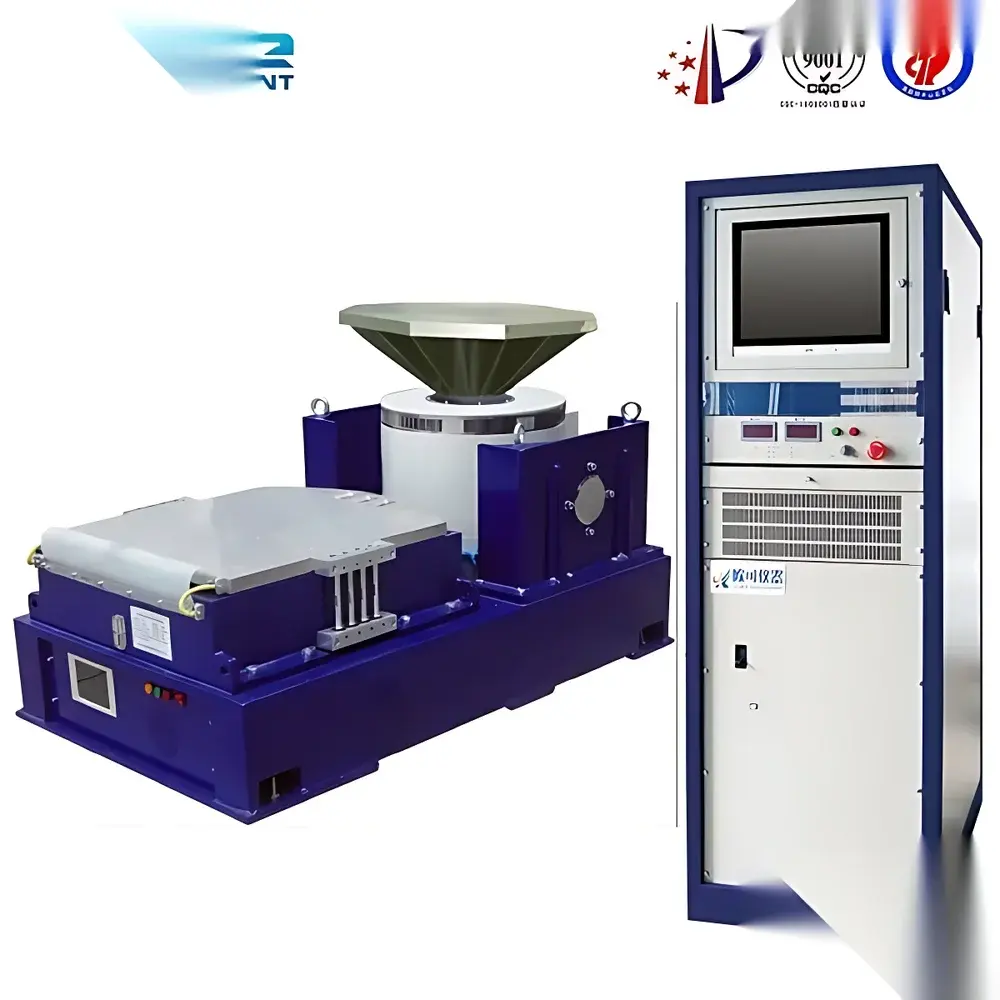
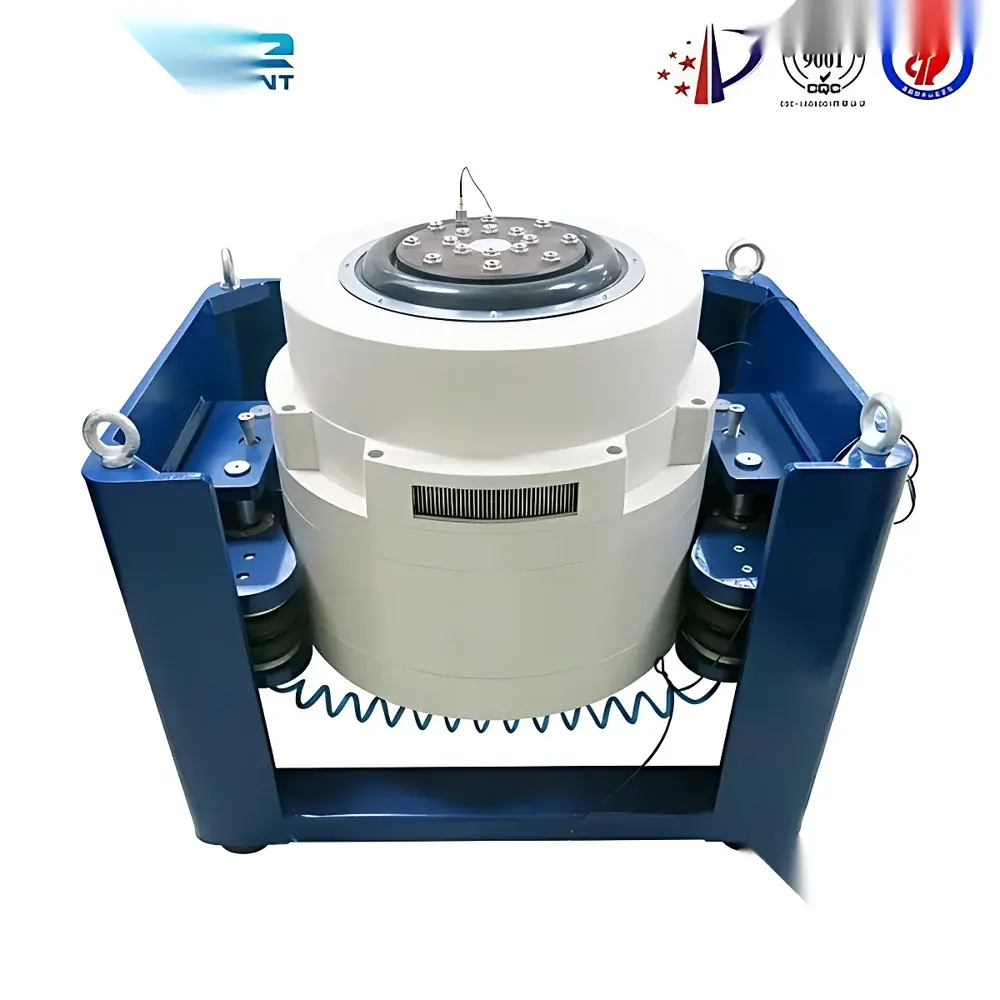
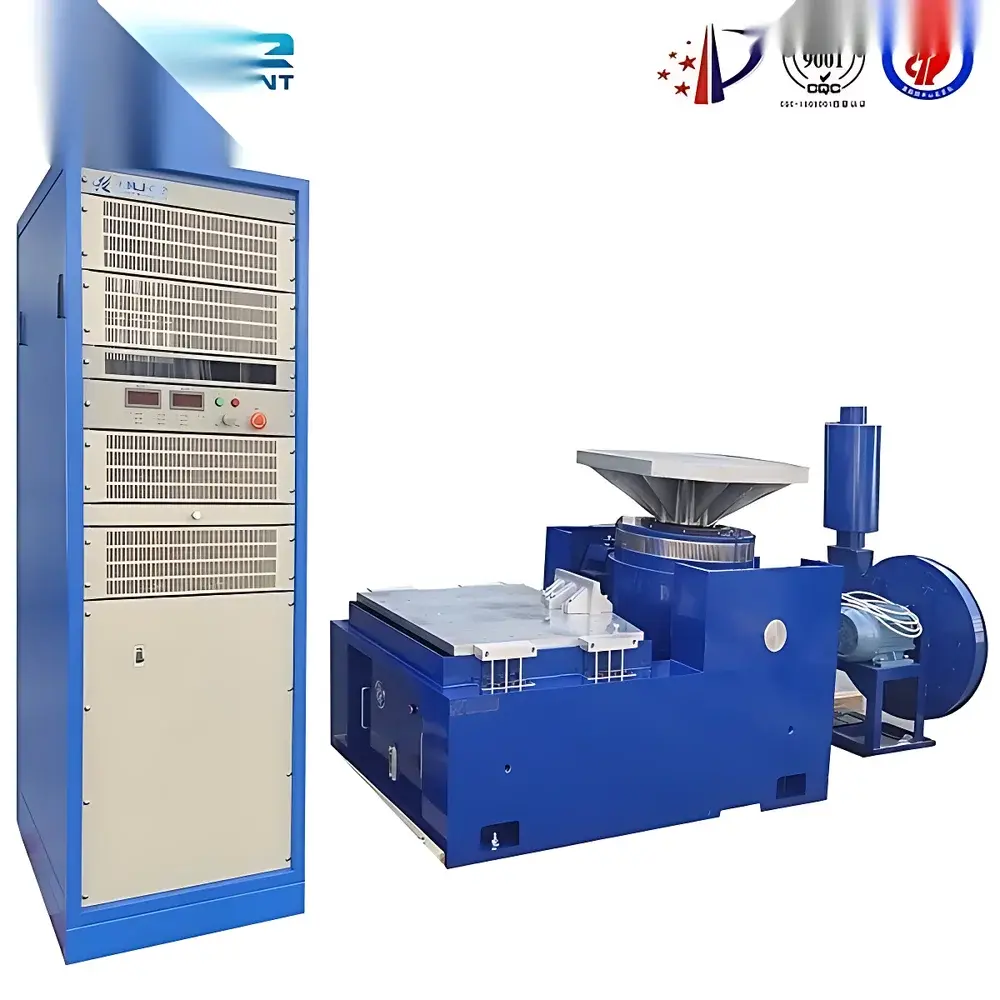
Electromagnetic Vibration Testing System – Domestic Manufacturer Model EMV-6000 Series
| Key | Brand: Other Brands |
|---|---|
| Origin | Imported |
| Manufacturer Type | General Distributor |
| Price | USD 21,000 (approx.) |
| Frequency Range | 1–5000 Hz (±0.1%) |
| Max Load Capacity | 100 kg |
| Max Sinusoidal Force | 2000 kgf |
| Table Size | 500 × 500 × 6 mm |
| Table Mounting | 25 × M10 threaded holes + 16 hook slots |
| Acceleration Range | 0–20 g (0–196 m/s²) |
| Displacement (p-p) | 0–5 mm |
| Programmable Segments | 15 |
| Sweep Modes | Linear, Logarithmic, Resonance Tracking, Random, Road Simulation, Multi-Axis Coupled |
| Control Resolution | 0.01 Hz frequency, 0.01 mm displacement, 0.01 g acceleration |
| Power Supply | 220 V ±20%, 50/60 Hz |
| Rated Power | 2.2 kW |
| Cooling | Natural Air Cooling |
Overview
The EMV-6000 Series Electromagnetic Vibration Testing System is a high-fidelity, multi-axis electromagnetic shaker engineered for rigorous physical property validation in R&D laboratories, quality assurance departments, and certification testing facilities. Based on Lorentz-force actuation principles, the system delivers precise, repeatable inertial excitation across single- and multi-degree-of-freedom configurations—enabling controlled mechanical stress application to evaluate structural integrity, fatigue life, resonance behavior, and dynamic response of components and assemblies. Unlike hydraulic or electrodynamic shakers with limited bandwidth or thermal drift constraints, this system leverages air-cooled voice-coil actuators and real-time digital signal processing to maintain traceable amplitude and phase fidelity from 1 Hz to 5000 Hz. Its architecture supports both open-loop waveform replay and closed-loop acceleration/velocity/displacement feedback control, conforming to fundamental requirements outlined in ISO 10816, ASTM D4728, and IEC 60068-2-6 for vibration testing of electronic equipment, automotive modules, aerospace subassemblies, and packaging systems.
Key Features
- Multi-modal excitation capability: Independent or coupled uniaxial (X/Y/Z), biaxial (e.g., X–Y, Y–Z), triaxial (X–Y–Z), and full 6-DOF synchronized motion—configured via intuitive front-panel interface or remote Ethernet command.
- Comprehensive waveform generation: Sinusoidal (half/full cycle), swept-sine (linear/logarithmic), random (PSD-defined), road profile simulation (ISO 8608, SAE J2452), and programmable multi-segment profiles (15-step sequences with independent frequency, amplitude, acceleration, and dwell time per segment).
- High-resolution parameter control: Frequency resolution down to 0.01 Hz; displacement (p–p) adjustable from 0 to 5 mm; acceleration tunable from 0 to 20 g (0–196 m/s²); force output up to 2000 kgf peak sinusoidal thrust.
- Robust test table design: 500 mm × 500 mm aluminum alloy surface with 25 × M10 threaded mounting holes (10 mm pitch, 12 mm depth) and 16 peripheral hook slots (70 mm long, 12 mm wide) for fixture anchoring and load restraint.
- Stabilized mechanical platform: Reinforced 50 cm × 50 cm × 45 cm base frame with enhanced mass inertia and damping isolation—reducing parasitic resonances and improving low-frequency stability by >100% versus standard configurations.
- Digital controller with real-time monitoring: Integrated DSP-based controller supports simultaneous acquisition of acceleration, velocity, displacement, and drive current; data logging at up to 50 kHz sampling rate; USB/Ethernet connectivity for SCPI-compliant remote operation.
Sample Compatibility & Compliance
The EMV-6000 accommodates specimens ranging from small PCBs and MEMS sensors (<100 g) to automotive ECUs, battery packs, and industrial enclosures (up to 100 kg). Fixture design adheres to ASTM E1492 guidelines for mass ratio (test article ≤ 30% moving mass) and center-of-gravity alignment. The system meets mechanical safety standards per ISO 12100 and electrical safety per IEC 61000-6-2/-6-4. Optional calibration certificates traceable to NIST or PTB standards are available upon request. For regulated industries—including medical device (FDA 21 CFR Part 820), aerospace (AS9100), and pharmaceutical (USP )—the controller supports audit-ready event logging, user access levels, and electronic signature functionality compliant with FDA 21 CFR Part 11 when paired with validated software.
Software & Data Management
The system ships with VIBRO-CONTROL Suite v4.x—a Windows-based application supporting offline test plan creation, real-time spectrum analysis (FFT, PSD, Kurtosis), time-history playback, and automated report generation (PDF/CSV/XLSX). All raw sensor data is stored in IEEE-compliant .tdms format with embedded metadata (timestamp, channel ID, calibration coefficients, operator ID). Software includes built-in compliance templates for MIL-STD-810H Method 514.7, ISO 16750-3, and EN 60068-2-64. Remote API (TCP/IP + SCPI) enables integration into LabVIEW, Python (PyVISA), or MES/QMS platforms. Audit trail records all parameter changes, start/stop events, and calibration actions with ISO/IEC 17025-aligned timestamps.
Applications
- Resonance detection and modal analysis of printed circuit boards and solder joint reliability assessment under harmonic sweep.
- Environmental stress screening (ESS) of avionics hardware per DO-160 Section 8.
- Random vibration qualification of electric vehicle battery modules per GB/T 31467.3 and UN ECE R100.
- Road-induced fatigue testing of automotive interior components using synthesized ISO 8608 class C/D spectra.
- Shock response spectrum (SRS) synthesis and transient event replication for defense electronics.
- Package integrity evaluation per ISTA 3A and ASTM D999 protocols.
FAQ
What standards does this system support out of the box?
It natively implements test profiles defined in ISO 10816-3, ASTM D4728, IEC 60068-2-6, and MIL-STD-810H Method 514.7. Custom PSDs and time histories can be imported for proprietary or client-specific specifications.
Can the system perform closed-loop control using external accelerometers?
Yes—via analog input channels (±10 V, IEPE-compatible), the controller accepts real-time feedback from third-party triaxial accelerometers for acceleration-controlled random or swept-sine tests.
Is the 5000 Hz upper limit achievable at full stroke and maximum load simultaneously?
No—maximum frequency depends on payload mass and required displacement/acceleration. At 100 kg, the usable bandwidth is typically 1–2000 Hz for 5 mm p–p; above 2000 Hz, displacement must be reduced per the constant-velocity or constant-acceleration limits of the actuator.
Does the system include factory calibration documentation?
Each unit ships with a Certificate of Conformance and a traceable calibration report (per ISO/IEC 17025) covering force, acceleration, and displacement transducers, valid for 12 months from shipment.
What maintenance is required for long-term reliability?
Annual verification of coil resistance, suspension linearity, and amplifier gain stability is recommended. No routine lubrication or consumables are required—the air-cooled design eliminates oil changes or filter replacements.



