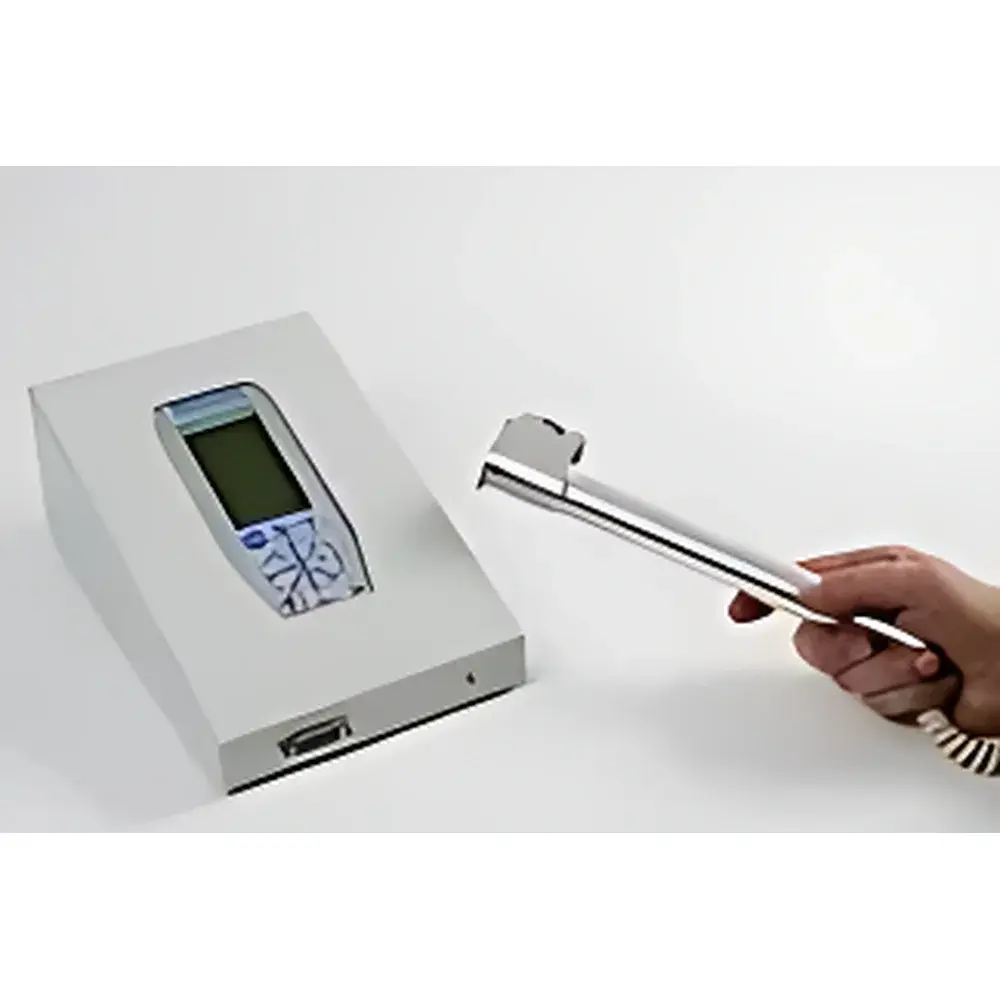
ELECTROVONFREY EVF3 Nociception Analyzer by Bioseb
| Origin | France |
|---|---|
| Manufacturer Type | Authorized Distributor |
| Origin Category | Imported Instrument |
| Model | EVF3 |
| Pricing | Available Upon Request |
Overview
The ELECTROVONFREY EVF3 Nociception Analyzer is a precision electronic von Frey filament-based instrument engineered for objective, quantitative assessment of mechanical allodynia and hyperalgesia in rodent models. Developed by Bioseb (France), the EVF3 operates on the principle of calibrated force application via a motorized, feedback-controlled probe tip that delivers incremental, reproducible mechanical stimuli to the plantar surface of the hind paw. Unlike traditional manual von Frey filaments, the EVF3 eliminates inter-operator variability through closed-loop force regulation and real-time digital transduction, enabling consistent stimulus delivery across longitudinal studies and multi-site preclinical trials. The system is designed for use in neuroscience, pain pharmacology, and translational research settings where high intra- and inter-subject reproducibility is required under GLP-aligned experimental protocols.
Key Features
- Motor-driven, digitally controlled probe with active force feedback ensures precise stimulus delivery within ±0.2 g accuracy across the full 0–500 g range
- High-resolution force sensing at 0.1 g increments, supporting fine-grained threshold determination in both naïve and sensitized animals
- Integrated temperature compensation (0–50 °C) maintains measurement stability across standard vivarium environmental conditions
- Onboard non-volatile memory stores up to 100 complete test sessions—including timestamp, animal ID, stimulus sequence, and response latency—without external PC dependency
- Ergonomic handheld design with intuitive tactile interface and LED status indicators enables rapid deployment in cage-side or dedicated testing arenas
- Compliant with ISO 14155:2020 guidelines for biomedical device usability in preclinical research environments
Sample Compatibility & Compliance
The EVF3 is validated for use in adult mice (C57BL/6, BALB/c, CD-1) and rats (Sprague-Dawley, Wistar) weighing 18–300 g. Its low-mass probe tip (diameter: 0.5 mm) minimizes tissue deformation artifacts while maintaining sufficient contact area for reliable detection of withdrawal reflexes. All firmware and hardware components conform to CE marking requirements under Directive 2014/30/EU (EMC) and 2014/35/EU (LVD). Data acquisition workflows support alignment with FDA 21 CFR Part 11-compliant systems when paired with Bioseb’s optional EVF-Link software suite, including electronic signature capability, audit trail logging, and user access control.
Software & Data Management
While the EVF3 functions autonomously for basic threshold determination, it interfaces seamlessly with Bioseb’s EVF-Link v3.2 software via USB-C for advanced data export and analysis. The software supports batch processing of multiple subjects, automated calculation of 50% paw withdrawal threshold (PWT) using the Dixon up-down method, and generation of customizable reports compliant with journal submission standards (e.g., Pain, Journal of Neuroscience, European Journal of Pain). Raw force-time curves, response latencies, and operator annotations are stored in .csv and .xlsx formats. Audit trails record all parameter changes, user logins, and data exports—meeting GLP documentation requirements for regulatory submissions.
Applications
- Preclinical evaluation of opioid and non-opioid analgesics in inflammatory (CFA), neuropathic (CCI, SNI), and chemotherapy-induced peripheral neuropathy (CIPN) models
- Longitudinal monitoring of nociceptive sensitization during disease progression in autoimmune (EAE) or metabolic (diabetic neuropathy) models
- Pharmacokinetic–pharmacodynamic correlation studies requiring precise temporal resolution of antinociceptive onset and duration
- Validation of genetic knockouts or CRISPR-modified lines exhibiting altered mechanosensory transduction pathways (e.g., PIEZO2, TRPA1, Nav1.7)
- Standardized endpoint assessment in contract research organization (CRO) service offerings aligned with ICH S5(R3) and OECD TG 429 guidance
FAQ
What calibration standards does the EVF3 comply with?
The EVF3 undergoes factory calibration traceable to national metrology institutes (LNE, France) per ISO/IEC 17025:2017. Users may perform field verification using NIST-traceable deadweight standards (0.1–500 g).
Can the EVF3 be used for non-rodent species?
It is optimized for murine and rat models; use in larger species (e.g., rabbits, minipigs) requires validation of probe geometry and force range against established behavioral endpoints.
Is firmware update supported in the field?
Yes—updates are delivered via Bioseb’s secure portal and installed using the EVF-Link software; each release includes version-controlled changelogs and regulatory impact assessments.
How is data integrity ensured during power interruption?
All measurements are written to flash memory immediately upon completion; unsaved session buffers are retained in volatile RAM with battery-backed retention for up to 72 hours.
Does the system support integration with third-party video tracking platforms?
Yes—the EVF3 provides TTL-compatible trigger output synchronized with stimulus onset, enabling precise alignment with EthoVision XT, Noldus, or ANY-maze event timelines.
Related Products