
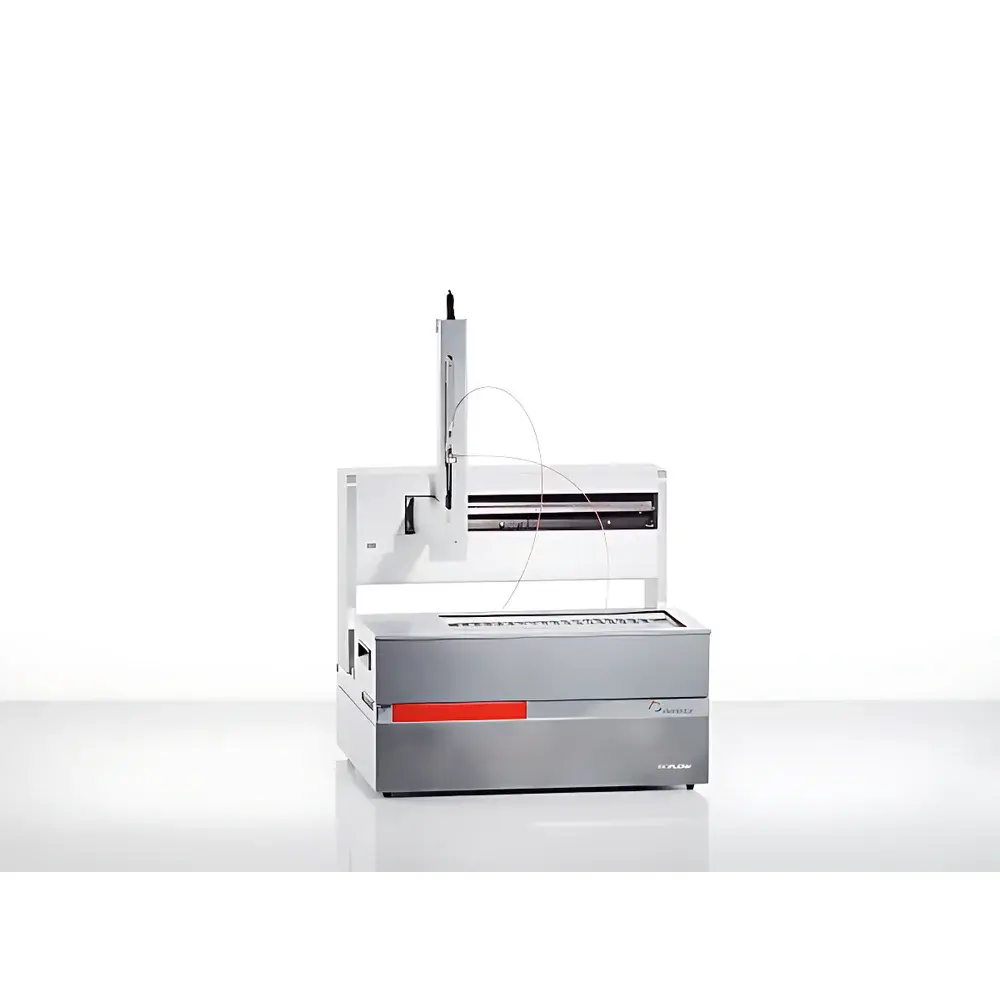
Elementar isoFLOW Multi-Functional Gas Interface Platform
| Brand | Elementar |
|---|---|
| Origin | United Kingdom |
| Manufacturer Type | Authorized Distributor |
| Origin Category | Imported |
| Model | isoFLOW |
| Instrument Type | Dedicated Continuous-Flow Sample Introduction System & Interface Components |
| Isotopic Precision | δ¹³C < 0.006‰, δ¹⁵N < 0.006‰ |
| Elemental Coverage | C/H/O/N/S |
| Mass Range | 1–96 Da |
| Resolution | >110 m/Δm (10% valley separation) |
| Sensitivity | <800 (M/I, m/z 44, DI) |
Overview
The Elementar isoFLOW is a high-performance, fully automated continuous-flow interface platform engineered for precise isotopic ratio analysis by isotope ratio mass spectrometry (IRMS). Designed to bridge sample preparation and IRMS detection, the isoFLOW operates on the principle of gas-phase compound-specific isotope analysis (CSIA), where analytes are converted—via combustion, pyrolysis, or acid digestion—into discrete, chromatographically separable gases (e.g., CO₂, N₂, CO, H₂, SO₂, NO) prior to ionization and mass discrimination measurement. Its core architecture integrates dynamic thermal control, ultra-low dead-volume fluidics, and real-time pressure stabilization to ensure quantitative transfer and minimal isotopic fractionation across the entire analytical pathway. The system is purpose-built for laboratories requiring trace-level isotopic fidelity in environmental, geochemical, food authenticity, clinical, and hydrological research—where reproducibility at the sub-0.01‰ level is non-negotiable.
Key Features
- UltiTrap™ Technology: A dynamically heated, cryogen-free gas chromatographic trap enabling both sub-ambient (down to –40 °C) and high-temperature GC separation—critical for resolving co-eluting species such as CO₂ and N₂O without isotopic memory or carryover.
- Modular, Field-Upgradeable Design: Supports interchangeable reactor modules (e.g., vario PYRO cube® for pyrolysis, vario TOC cube® for total organic carbon oxidation) and configurable inlet valves, ensuring long-term adaptability to evolving method requirements.
- High-Capacity Automated Sampling: Equipped with either a 180-position heated sample carousel (for temperature-sensitive carbonate or liquid injections) or a 220-position ambient carousel—both compatible with standard 12 mL Exetainer®-style septum vials.
- Microbore Multi-Core Injection Needle: Patented needle geometry minimizes sample dispersion and cross-contamination while maximizing transfer efficiency for volumes as low as 50 µL—essential for precious or low-yield samples.
- Real-Time Pressure & Flow Regulation: Integrated piezoresistive transducers and proportional mass flow controllers maintain stable carrier gas delivery (<±0.1 mL/min) across variable backpressures, directly supporting ISO 13877 and ASTM D7657 compliance.
Sample Compatibility & Compliance
The isoFLOW accommodates solid, liquid, and gaseous samples—including carbonates, soils, plant tissues, blood plasma, beverages, and dissolved inorganic carbon (DIC) extracts—via standardized chemical conversion protocols. It is validated for use with Elementar’s vario ISOTOPE select™ and IonOS IRMS platforms and fully compliant with ISO 13877 (determination of δ¹³C and δ¹⁵N in soils), ISO 21241 (δ²H and δ¹⁸O in water), and USP for method validation in regulated environments. All hardware and software components support GLP/GMP audit trails, including full electronic signature capability and 21 CFR Part 11–compliant data integrity controls within lyticOS.
Software & Data Management
Controlled exclusively via lyticOS—a dedicated, Windows-based instrument management suite—the isoFLOW provides end-to-end automation from vial selection and injection sequence definition to real-time chromatogram monitoring and peak integration. lyticOS features method templating, automatic baseline correction, internal standard normalization (e.g., CO₂ reference gas calibration), and direct export to third-party statistical packages (e.g., R, MATLAB) and LIMS systems via ASTM E1384-compliant ASCII or XML formats. Audit logs record every parameter change, user action, and system event with timestamped, immutable entries—ensuring full traceability required for regulatory submissions.
Applications
- Geochemistry & Paleoclimatology: High-precision δ¹³C and δ¹⁸O measurements in foraminifera, speleothems, and marine sediments to reconstruct past atmospheric CO₂ and ocean circulation patterns.
- Food Authenticity & Traceability: Detection of adulteration in honey, wine, olive oil, and dairy products via multi-element (C+N+O+S) isotopic fingerprinting aligned with EU Regulation No. 2019/1793.
- Clinical & Metabolic Research: Quantitative assessment of substrate utilization kinetics using ¹³C-breath tests and ¹⁵N-labeled amino acid tracers under controlled metabolic conditions.
- Hydrology & Environmental Forensics: Dual-isotope (δ²H/δ¹⁸O) characterization of water sources and nitrate pollution tracing (δ¹⁵N/δ¹⁸O of NO₃⁻) in groundwater systems.
- Biogeochemical Cycling: Compound-specific δ¹³C analysis of volatile organic compounds (VOCs) and greenhouse gases (CH₄, N₂O) to constrain microbial pathway activity in soils and sediments.
FAQ
Can the isoFLOW be coupled with non-Elementar IRMS instruments?
Yes—via standard 1/8″ Swagelok® interfaces and analog/digital I/O signals; however, full lyticOS synchronization and automated tuning require native integration with Elementar’s IonOS or isoprime precisION platforms.
What maintenance intervals are recommended for the UltiTrap™ module?
UltiTrap™ requires no consumables; routine verification includes quarterly GC column conditioning and annual calibration of temperature sensors per ISO/IEC 17025 guidelines.
Is lyticOS validated for FDA-regulated laboratories?
Yes—lyticOS v4.2+ includes 21 CFR Part 11 modules with role-based access control, electronic signatures, and encrypted audit trail storage meeting FDA and EMA expectations for GxP environments.
Does the system support simultaneous multi-element analysis in a single run?
Yes—through sequential reactor switching and multi-gas detection strategies, enabling concurrent δ¹³C, δ¹⁵N, δ¹⁸O, and δ³⁴S determination in one analytical sequence when paired with appropriate conversion reactors.
How is isotopic memory minimized during high-throughput runs?
By combining UltiTrap™’s active thermal desorption, inertized stainless-steel flow paths, and automated solvent flush cycles between injections—validated to reduce carryover to <0.001% (measured at m/z 44).




