
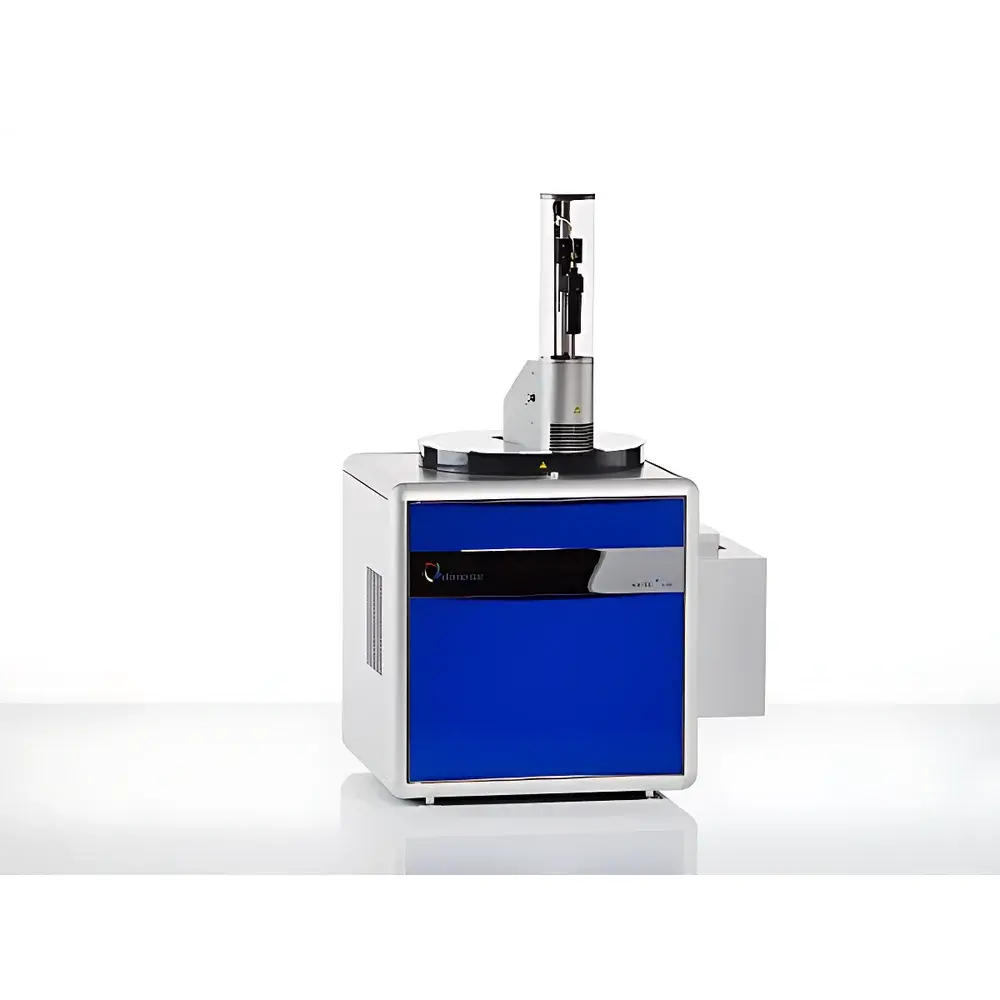
Elementar soli TOC cube Total Organic Carbon Analyzer for Solid Samples
| Brand | Elementar |
|---|---|
| Origin | Germany |
| Model | soli TOC cube |
| Instrument Type | Laboratory TOC Analyzer |
| Detection Principle | Non-Dispersive Infrared (NDIR) Absorption |
| Oxidation Method | High-Temperature Catalytic Combustion |
| Detection Limit | 2 ppb C |
| Repeatability | <1.5% RSD |
| Compliance | DIN 19539 (2022), DIN 15936 (2008) |
| Sample Throughput | Up to 92 samples unattended |
| Carbon Quantification Range | 0.001–100 wt% C |
| Heating Control | Direct crucible-proximal temperature monitoring with programmable ramp rates and hold times |
| Gas Switching | On-the-fly carrier gas switching during thermal program for selective ROC/TIC separation |
| Ash Removal | Integrated automatic ash removal module |
| Sample Form | Solids (soil, sludge, sediment, compost, waste, biomass) |
Overview
The Elementar soli TOC cube is a dedicated high-precision total organic carbon (TOC) analyzer engineered specifically for solid matrices—designed to meet the rigorous demands of environmental laboratories, regulatory testing facilities, and academic research groups focused on soil health, waste characterization, and contaminated land assessment. Unlike conventional aqueous TOC analyzers, the soli TOC cube employs high-temperature catalytic combustion coupled with non-dispersive infrared (NDIR) detection to quantify carbon species in heterogeneous solid samples without dissolution or extraction. Its core measurement principle relies on thermally driven differentiation of carbon fractions: total carbon (TC), total inorganic carbon (TIC), total organic carbon (TOC = TC − TIC), and refractory organic carbon (ROC)—the latter representing thermally stable carbon resistant to oxidation below defined thresholds. This capability enables compliance with both legacy (DIN 15936) and current (DIN 19539:2022) German standards for solid-phase TOC determination, supporting method validation under GLP and ISO/IEC 17025 frameworks.
Key Features
- Programmable temperature-controlled combustion: Precise, crucible-proximal temperature sensing ensures accurate thermal profiling across ramp rates (0.1–50 °C/min) and dwell times (0–120 min), eliminating furnace-zone lag and enabling reproducible fractionation of carbon forms.
- Dual-mode carbon speciation: Supports both acidification-based TOC (per DIN 15936) and thermal-programmed TOC/ROC/TIC quantification within a single analytical sequence—no hardware reconfiguration required.
- Automated ash removal: Integrated ceramic crucible cleaning cycle removes residual mineral ash between runs, minimizing cross-contamination and extending catalyst lifetime.
- 92-position robotic autosampler: Enables fully unattended operation with gravimetric sample loading directly into reusable alumina crucibles—ideal for batch analysis of soils, sediments, and municipal sludges.
- On-the-fly carrier gas switching: Dynamic helium-to-oxygen gas switching during thermal ramps isolates CO₂ evolution profiles from ROC and TIC, improving resolution and reducing integration ambiguity.
- NDIR detector with 2 ppb C detection limit: Optimized optical path and signal stabilization algorithms ensure robust low-level quantification across wide dynamic range (0.001–100 wt% C).
Sample Compatibility & Compliance
The soli TOC cube accepts untreated solid samples up to 5 g mass—including clay-rich soils, activated sludge, fly ash, compost, biochar, and industrial waste—with no pretreatment beyond homogenization and weighing. Its design conforms to DIN 19539:2022 (“Determination of total organic carbon in solid materials — Thermal oxidation and NDIR detection”) and remains fully compatible with DIN 15936:2008 (“Determination of organic carbon in soils — Acidification and combustion”). Method equivalence to ISO 10694:1995 (soil carbon) and ASTM D7573-22 (solid waste TOC) is supported through documented validation protocols. All instrument operations—including method parameters, calibration logs, and raw chromatograms—are timestamped and user-attributed, satisfying audit requirements for FDA 21 CFR Part 11-compliant data integrity when deployed in regulated environments.
Software & Data Management
Control and evaluation are performed via Elementar’s proprietary cubeControl software, which provides full method scripting, real-time thermal profile visualization, automated peak integration with manual override, and customizable reporting templates aligned with DIN/ISO formatting conventions. Raw data files (.cdf) are stored in vendor-neutral formats, exportable to LIMS-compatible CSV or Excel. Audit trails record all parameter changes, user logins, calibration events, and result modifications—enabling traceability per GLP and GMP documentation standards. Software updates are delivered through secure, version-controlled channels with full change-log documentation.
Applications
- Soil carbon sequestration monitoring for climate mitigation projects and agricultural sustainability reporting
- Regulatory compliance testing of landfill leachate solids, dredged sediments, and contaminated site remediation endpoints
- Quality control of compost maturity and stability assessments (e.g., C/N ratio verification)
- Characterization of biochar feedstock and product carbon persistence (ROC as proxy for long-term stability)
- Waste-to-energy feedstock screening and incineration residue analysis
- Research on black carbon dynamics in atmospheric deposition and peatland biogeochemistry
FAQ
Does the soli TOC cube require acid digestion prior to analysis?
No—acidification is optional and only used when performing the DIN 15936-compliant direct subtraction method. For thermal-programmed analysis, no chemical reagents are needed.
Can the instrument differentiate black carbon from other organic forms?
Yes—by defining custom temperature thresholds (e.g., 350–600 °C for ROC), the soli TOC cube isolates thermally recalcitrant carbon fractions associated with soot and charred material.
What maintenance intervals are recommended for the combustion catalyst?
Under typical use (≤200 solid samples/week), the platinum-based catalyst requires replacement every 12–18 months; performance is continuously monitored via system suitability checks and CO₂ response stability.
Is method transfer possible from older Elementar TOC systems?
Yes—cubeControl supports import of legacy method files from vario TOC select and enviro TOC platforms, with automated parameter mapping and validation prompts.
How is calibration verified across the full 0.001–100% C range?
Calibration uses certified reference materials (CRMs) traceable to NIST SRM 2710a (soil), BCR-142R (sludge), and in-house sucrose/Na₂CO₃ mixtures, with multi-point linearity verification and daily system suitability testing (SST) using benzoic acid.
Related Products







