
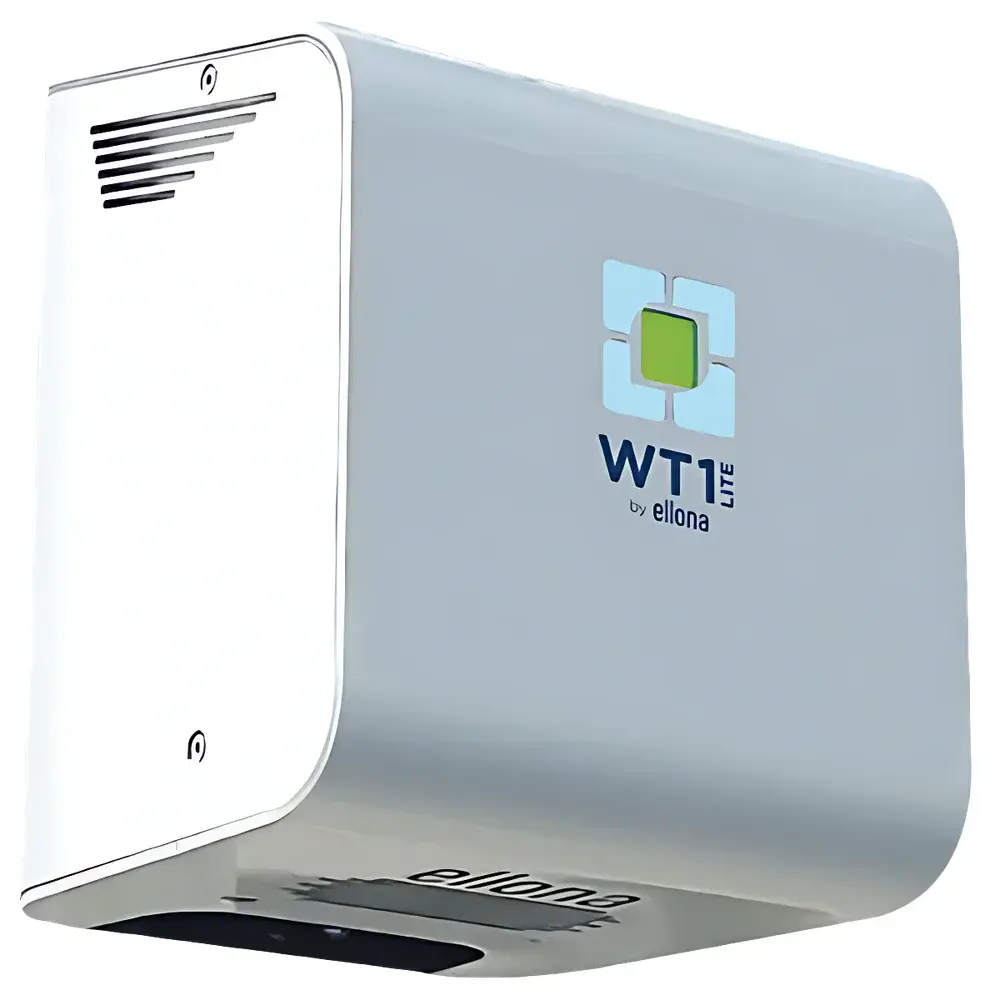
Ellona WT1 Lite Perimeter Hazard Monitoring System
| Brand | Ellona |
|---|---|
| Origin | France |
| Manufacturer Type | Authorized Distributor |
| Origin Category | Imported |
| Model | WT1 Lite |
| Pricing | Available Upon Request |
Overview
The Ellona WT1 Lite Perimeter Hazard Monitoring System is an engineered environmental sensing platform designed for real-time, multi-parameter surveillance at facility boundaries and urban perimeters. Based on open-loop dynamic fluid sampling architecture and calibrated electrochemical/optical transduction principles, the system continuously acquires synchronized physical, chemical, and perceptual data streams to support early hazard identification, source localization, and regulatory compliance in semi-enclosed or open-air industrial and smart city deployments. Unlike laboratory-grade analyzers, the WT1 Lite prioritizes field robustness, modular scalability, and low-maintenance operation—making it suitable for long-term unattended deployment at fence-line monitoring points, landfill perimeters, wastewater treatment plant boundaries, and municipal odor-sensitive zones.
Key Features
- Multi-sensor integration: Supports up to four concurrently active, independently addressable probe modules mounted on a single base unit—each configured for directional sampling (e.g., north/south/east/west quadrants)
- Targeted gas detection: Electrochemical sensors for CO₂ (0–5,000 ppm range) and CH₄ (0–100% LEL), with temperature- and humidity-compensated signal processing
- Aerosol characterization: Optical particle counter (OPC) capable of size-resolved quantification across PM₁, PM₂.₅, PM₄, PM₁₀ mass concentrations (μg/m³), compliant with ISO 2591-1 dust measurement conventions
- Vibration pattern analysis: Integrated triaxial MEMS accelerometer (±2 g range, 10 Hz–1 kHz bandwidth) for detecting mechanical disturbances associated with pipeline leaks, structural anomalies, or unauthorized intrusion
- Odor intelligence module: Combines metal-oxide semiconductor (MOS) sensor array output with proprietary pattern recognition algorithms to estimate odor intensity (OUE/m³), classify dominant odor families (e.g., sulfidic, amine, volatile organic), and triangulate approximate emission direction using differential response timing across spatially separated probes
- Flexible connectivity: Dual-mode communication via Ethernet (RJ45, TCP/IP), USB host interface for local data dump or firmware updates, and optional LTE-M/NB-IoT cellular modem (SIM card slot) for remote telemetry in low-infrastructure zones
Sample Compatibility & Compliance
The WT1 Lite operates under ambient outdoor conditions (−20 °C to +50 °C, IP65-rated enclosure). It complies with EN 14181 (QAL2/QAL3 requirements for automated monitoring systems), meets CE marking directives for EMC and RoHS, and supports audit-ready data logging aligned with ISO 17025 traceability frameworks. Sensor calibrations are performed using NIST-traceable reference gases and aerosol standards; calibration certificates are provided with each delivery batch. The system is compatible with third-party GIS platforms and integrates with existing SCADA or EMS infrastructure via Modbus TCP or MQTT protocols.
Software & Data Management
The embedded firmware includes time-synchronized timestamping (NTP-synced RTC), configurable alarm thresholds (per parameter), and local 32 GB SD card storage (72+ hours of raw 10-second interval data at full sensor load). Remote configuration and diagnostics are accessible through a secure HTTPS web interface supporting role-based user accounts. All data exports conform to CSV and JSON formats with ISO 8601 timestamps and SI units. For regulated environments, optional software add-ons provide 21 CFR Part 11-compliant electronic signatures, audit trail logging, and data integrity validation—fully compatible with GLP/GMP-aligned quality management systems.
Applications
- Fence-line air quality monitoring for petrochemical refineries, composting facilities, and anaerobic digestion plants
- Smart city environmental intelligence networks—deployed at traffic corridors, construction sites, and municipal waste transfer stations
- Early warning systems for landfill gas migration and biogas leakage detection
- Odor impact assessment near residential buffers, hospitals, and educational campuses
- Regulatory reporting support for local environmental agencies requiring continuous perimeter emissions documentation (e.g., EU Industrial Emissions Directive Annex I installations)
FAQ
What is the maximum distance over which the WT1 Lite can localize an odor source?
Localization accuracy depends on probe spacing and atmospheric stability; typical triangulation error is ≤15° azimuthal deviation within a 100 m radius under neutral boundary layer conditions.
Can the system operate without cellular connectivity?
Yes—the unit functions autonomously with local data logging and Ethernet/USB access; cellular is optional for remote telemetry only.
Are sensor modules field-replaceable?
All probe modules use standardized M12 connectors and hot-swappable firmware profiles; replacement requires no tools or recalibration.
Does the system support integration with third-party weather stations?
Yes—via RS-485 or analog 4–20 mA inputs; meteorological data (wind speed/direction, temperature, RH) is automatically fused into odor dispersion modeling.
What maintenance intervals are recommended?
Electrochemical sensors require annual verification against certified gas standards; optical particle counters need quarterly lens cleaning; firmware updates are issued biannually via secure OTA channel.
Related Products







