
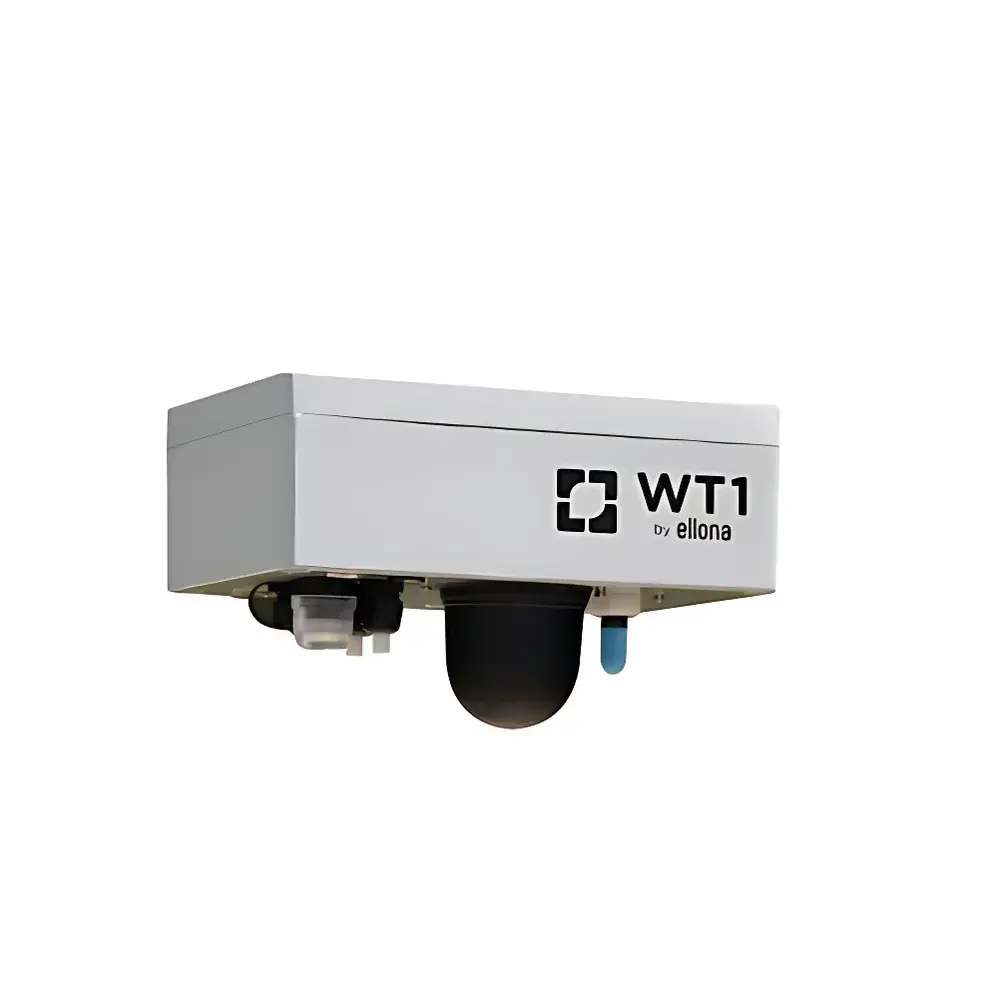
Ellona WT1 Pro Perimeter Hazard Monitoring System
| Brand | Ellona |
|---|---|
| Origin | France |
| Manufacturer Type | Authorized Distributor |
| Origin Category | Imported |
| Model | WT1 Pro |
| Pricing | Upon Request |
Overview
The Ellona WT1 Pro Perimeter Hazard Monitoring System is an industrial-grade, outdoor-deployable environmental surveillance platform engineered for continuous, real-time detection of airborne chemical hazards and nuisance odors at facility boundaries. Based on multi-sensor fusion architecture, the system integrates electrochemical (EC) and metal-oxide semiconductor (MOS) gas sensing technologies with optical particle counting to deliver simultaneous, dynamic quantification of hydrogen sulfide (H₂S), ammonia (NH₃), volatile organic compounds (VOCs), odor units (OU/m³), and particulate matter (PM₁–PM₁₀). Designed for perimeter monitoring in wastewater treatment plants, composting facilities, landfills, chemical manufacturing sites, and food processing units, the WT1 Pro operates under ISO 14001 and ISO 9001-aligned operational frameworks—supporting environmental compliance, community engagement, and process optimization through trace-level (ppb–ppm) gas analytics and time-resolved emission profiling.
Key Features
- Real-time dual-channel EC sensor array for calibrated, drift-compensated measurement of H₂S and NH₃ concentrations—with optional expansion to CO, NO₂, Cl₂, or SO₂ via certified EC modules
- Four independent MOS sensors configured for broad-spectrum VOC screening and odor fingerprinting; each channel supports user-defined alarm thresholds and source attribution logic
- Integrated optical particle counter measuring PM₁, PM₂.₅, and PM₁₀ mass concentrations with size-resolved output (0.3–10 µm range)
- Autonomous power management: rechargeable LiFePO₄ battery (72 Wh) coupled with integrated monocrystalline solar panel (15 W), enabling >48 h of uninterrupted operation without grid connection
- Onboard data logging with 72-hour buffer capacity (1-min resolution); local storage retains full-resolution time-series during GPRS or radio-link outages
- Sub-1 km licensed ISM-band radio telemetry (868 MHz EU band) + fallback GPRS/4G LTE connectivity; remote firmware updates and configuration push via secure TLS-encrypted channel
- Zero-touch deployment: auto-configuration upon first boot using GPS-derived site metadata; plug-and-play sensor initialization with embedded calibration certificate validation
- Self-diagnostic routines including sensor health monitoring, baseline drift tracking, and automatic zero/span verification using internal reference gas pulses (optional)
Sample Compatibility & Compliance
The WT1 Pro is validated for unattended outdoor operation across ambient temperature ranges from −30 °C to +60 °C and relative humidity up to 95% non-condensing. Its IP65-rated enclosure meets IEC 60529 requirements for dust and water ingress protection. Sensor response characteristics conform to EN 14181 (QAL3) for automated monitoring systems and support data traceability per ISO/IEC 17025:2017 clause 7.7. The system’s data integrity architecture—including immutable timestamps, cryptographic hash logging, and audit trail generation—aligns with GLP principles and facilitates regulatory reporting under EU Industrial Emissions Directive (IED 2010/75/EU) and US EPA Method TO-15/TO-17 workflows. Optional NIST-traceable calibration certificates are available for each EC sensor module.
Software & Data Management
Ellona Cloud Platform provides web-based access to live dashboards, historical trend analysis, georeferenced plume mapping, and automated alerting (SMS/email/webhook). All raw sensor outputs—including voltage signals, temperature-compensated resistance values, and particle count histograms—are archived in HDF5 format with metadata tagging (sensor ID, firmware version, GPS coordinates, calibration epoch). The platform implements role-based access control (RBAC), 256-bit AES encryption at rest and in transit, and full audit logs compliant with FDA 21 CFR Part 11 Annex 11 requirements. Advanced analytics include PCA-based odor source separation, wind-rose–correlated emission attribution, and machine-learning–assisted threshold adaptation based on seasonal baseline shifts.
Applications
- Regulatory-compliant fence-line monitoring for odorant emissions under local air quality ordinances and national odor management guidelines (e.g., VDI 3940, DIN 3740)
- Early-warning detection of process upsets in anaerobic digesters, sludge dewatering lines, or biogas upgrading units
- Community complaint correlation: time-synchronized comparison of measured OU/m³ profiles with citizen-reported odor events
- Performance validation of biofilters, activated carbon beds, and thermal oxidizers via pre-/post-treatment concentration gradients
- Long-term trend analysis for environmental impact assessments (EIAs) and sustainability reporting (GRI 305, CDP Climate Change)
- Supporting ISO 50001 energy management systems by correlating odor control energy use with real-time emission load
FAQ
What gases does the standard WT1 Pro configuration detect?
The base system detects H₂S and NH₃ via electrochemical sensors and provides semi-quantitative VOC/odor profiling using four MOS channels. Optional EC modules extend detection to CO, NO₂, Cl₂, SO₂, O₃, and HCl.
Can the WT1 Pro operate without cellular coverage?
Yes—integrated 868 MHz radio enables peer-to-peer mesh networking up to 2 km line-of-sight; data is stored locally and synced automatically when connectivity resumes.
How often does the system require calibration?
Factory-calibrated sensors maintain accuracy for 6 months under typical conditions; automated zero checks occur every 24 h, and full span calibration is recommended annually or after exposure to saturation-level concentrations.
Is meteorological data integrated into the system?
Yes—onboard temperature, relative humidity, barometric pressure, and optional external anemometer/wind vane inputs are fused with chemical data for dispersion modeling and source localization.
Does the system support third-party SCADA integration?
Yes—Modbus TCP, OPC UA, and MQTT protocols are natively supported; JSON and CSV export formats enable compatibility with PI System, Ignition, and Siemens Desigo CC platforms.
Related Products







