
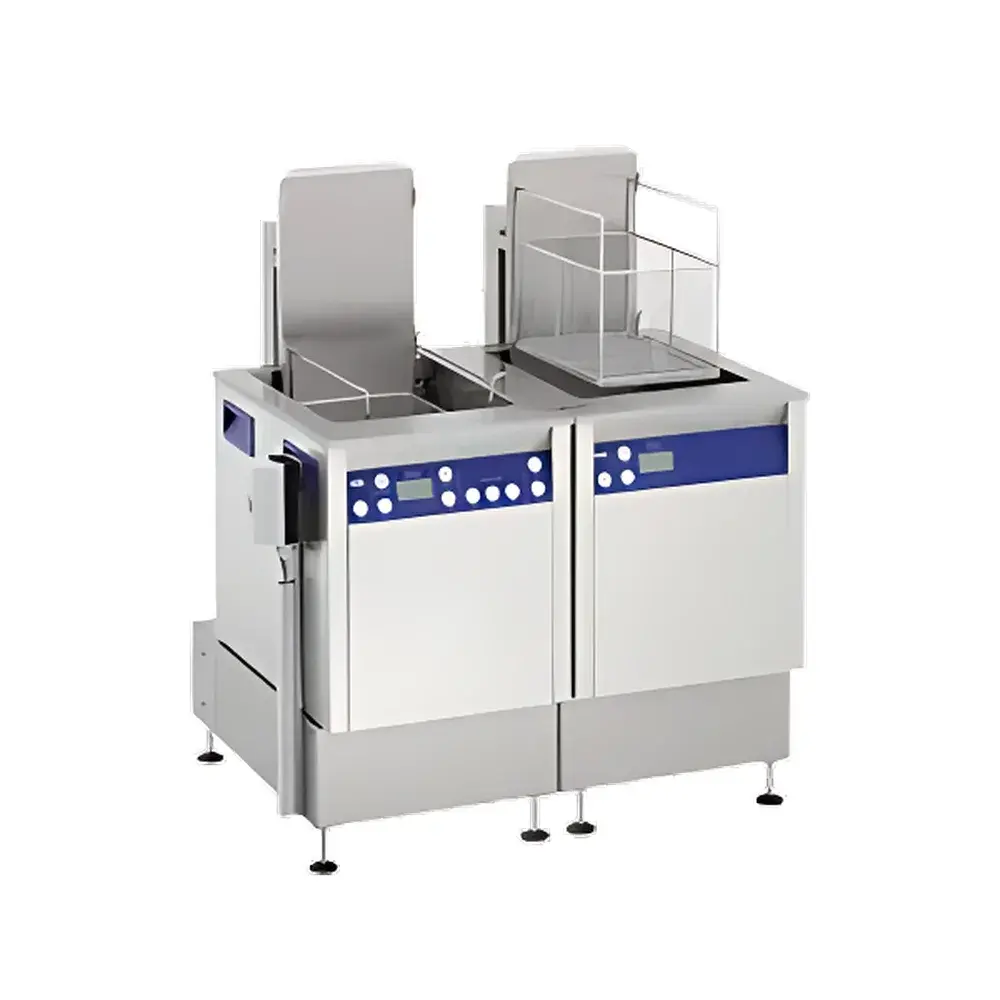
Elma Flex2 Dual-Body Upgradable Ultrasonic Cleaner
| Brand | Elma |
|---|---|
| Origin | Germany |
| Model | Flex2 |
| Type | General-purpose ultrasonic cleaner |
| Working volume range | 30–162 L |
| Ultrasonic frequency options | 35 kHz |
| Ultrasonic power output | 600–2000 W |
| Programmable timer, temperature control, and power adjustment | Yes |
| Sweep, Pulse, and Degas modes | Yes |
| Stainless steel tank and transducer construction | Yes |
| Compliance | DIN EN ISO 9001 certified |
Overview
The Elma Flex2 Dual-Body Upgradable Ultrasonic Cleaner is an industrial-grade, modular cleaning platform engineered for laboratories and production environments requiring high-reproducibility, multi-stage cleaning workflows. Based on proven piezoelectric transduction technology operating at precisely controlled ultrasonic frequencies (35 kHz, dual-frequency 25/45 kHz, or high-resolution 35/130 kHz), the Flex2 leverages cavitation physics to remove particulate, organic, and oily contaminants from complex geometries—including microchannels, threaded components, optical surfaces, and assembled electronic subassemblies. Unlike single-tank systems, its dual-body architecture separates ultrasonic cleaning and post-rinse stages—enabling sequential, contamination-free processing without manual transfer. Designed and manufactured in Germany under strict DIN EN ISO 9001 quality management protocols, the Flex2 integrates seamlessly into GLP-compliant and regulated manufacturing environments where traceability, process validation, and repeatable cleaning efficacy are mandatory.
Key Features
- Dual-chamber configuration: Independent ultrasonic cleaning and rinse tanks with sealed inter-tank transfer pathways to prevent cross-contamination
- Multi-frequency capability: Selectable 35 kHz for robust macro-cleaning, 25/45 kHz for balanced particle removal and surface preservation, or 35/130 kHz for ultra-fine contaminant dislodgement on delicate substrates
- Intelligent energy modulation: Sweep mode homogenizes acoustic field distribution across the tank volume; Pulse mode delivers transient peak power (up to 150% nominal) for tenacious residue removal; Degas mode rapidly evacuates dissolved gases prior to critical cleaning cycles
- Full-parameter digital interface: LCD touchscreen displays real-time values for time, temperature (range: ambient to 90 °C), frequency selection, power level (0–100%), and cycle stage; stores up to five user-defined programs with timestamped execution logs
- Modular expansion architecture: Standardized mounting interfaces support optional add-ons including infrared drying modules, HEPA-filtered forced-air dryers, oil–water separation units, and automated drain/pump systems with level-sensing feedback
- Robust mechanical design: 316L stainless steel tank and transducer housing; IP54-rated electronics enclosure; reinforced tank base with vibration-damping mounts for long-term operational stability
Sample Compatibility & Compliance
The Flex2 accommodates a broad spectrum of sample types—from fragile semiconductor wafers and medical device components to heavy-duty engine parts and aerospace fasteners. Its variable frequency and programmable intensity ensure compatibility with aluminum, titanium, glass, ceramics, polymers (e.g., PTFE, polyimide), and plated or anodized surfaces without erosion or pitting. All models comply with EU Machinery Directive 2006/42/EC and EMC Directive 2014/30/EU. The control software supports audit-trail generation per FDA 21 CFR Part 11 requirements when paired with Elma’s optional secure login and electronic signature module. Cleaning validation documentation aligns with ASTM F2792 (Standard Guide for Validation of Ultrasonic Cleaning Processes) and ISO 13485:2016 Annex A for medical device manufacturing.
Software & Data Management
Elma’s proprietary CleanControl™ firmware enables full-cycle parameter logging—including start/stop timestamps, temperature ramp profiles, ultrasonic duty cycles, and error codes—with export via USB or Ethernet to CSV or XML formats. Optional network integration allows centralized monitoring across multiple Flex2 units via SNMP or OPC UA protocols. All stored programs include metadata fields for operator ID, batch number, and material lot tracking—supporting full traceability in regulated QC/QA labs. Firmware updates are delivered via signed binary packages verified through SHA-256 checksums, ensuring integrity and version control.
Applications
The Flex2 serves mission-critical cleaning functions across precision manufacturing and analytical laboratories: removal of polishing compounds from optical lenses (ISO 10110-7 compliant); degreasing of printed circuit board assemblies prior to conformal coating; decontamination of reusable surgical instruments per EN ISO 15883-1; cleaning of fuel injector nozzles in automotive R&D; preparation of catalyst-coated electrodes for electrochemical testing; and pre-analysis cleaning of environmental sampling filters. Its scalability—from 30 L benchtop units to 162 L floor-standing configurations—supports both R&D prototyping and validated production-line deployment.
FAQ
Does the Flex2 support automated liquid handling integration?
Yes—via RS-485 Modbus RTU or optional Ethernet/IP interface, enabling synchronization with robotic arms, liquid dispensers, and PLC-based production lines.
Can the dual tanks operate independently with different chemistries?
Yes—each chamber has isolated fluid circulation, independent heating, and separate ultrasonic generators, permitting simultaneous use of alkaline cleaners and neutral rinses.
Is validation documentation provided for GMP environments?
Elma supplies IQ/OQ protocol templates, calibration certificates for integrated PT100 sensors, and transducer performance verification reports upon request.
What maintenance intervals are recommended for sustained performance?
Transducer inspection every 12 months; tank integrity check every 24 months; ultrasonic generator capacitor replacement every 60,000 operational hours.
Are custom frequency combinations available beyond standard offerings?
Yes—Elma’s engineering team can configure bespoke frequency pairings (e.g., 40/80 kHz) for specialized applications under NDA-supported development agreements.
Related Products



