
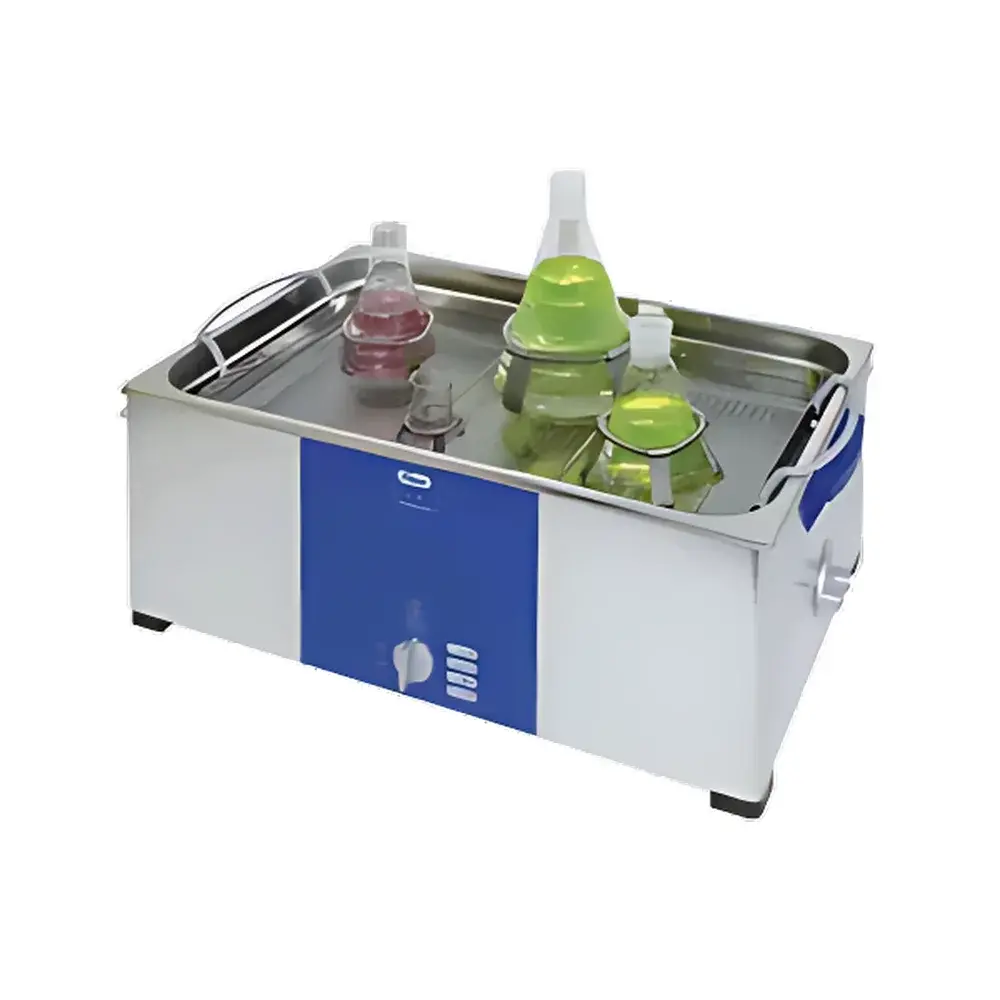
Elma S150 High-Energy Ultrasonic Cleaner
| Brand | Elma |
|---|---|
| Origin | Germany |
| Model | S150 |
| External Dimensions (W×D×H) | 568 × 340 × 224 mm |
| Internal Tank Dimensions (W×D×H) | 505 × 300 × 100 mm |
| Basket Mesh Size | 9 × 1 mm |
| Working Volume | 14 L |
| Ultrasonic Frequency | 37 kHz |
| Ultrasonic Power Output | 300 W |
| Net Weight | 10.0 kg |
| Timer Range | 1–30 min (LED display) |
| Sweep Function | Yes |
| Degas Mode | Yes |
| Normal Mode (for mixing, dissolution, emulsification, extraction) | Yes |
| Tank Material | Cavitation-resistant stainless steel (AISI 316L grade) |
| Energy Concentration Design | Flat-bottom tank with 100 mm liquid height optimized for high-intensity acoustic coupling |
Overview
The Elma S150 High-Energy Ultrasonic Cleaner is an engineered laboratory-grade cleaning system developed by ELMA Schmidbauer GmbH, a German manufacturer with over six decades of expertise in ultrasonic technology. Designed around the principle of high-intensity cavitation generation in a constrained acoustic field, the S150 leverages a flat-bottomed stainless-steel tank (505 × 300 × 100 mm internal) and precisely tuned 37 kHz transducers to deliver exceptional energy density—optimized for applications requiring rapid solvent degassing, efficient solid-phase extraction, accelerated dissolution of recalcitrant compounds, and reproducible sample homogenization. Unlike conventional ultrasonic cleaners with deeper tanks and diffuse energy distribution, the S150’s 100 mm nominal liquid height enables focused acoustic pressure amplitude, resulting in enhanced cavitation collapse intensity and improved mass transfer kinetics. This architecture supports both routine cleaning of precision components (e.g., HPLC vials, optical lenses, microfluidic chips) and advanced wet-chemistry protocols where controlled energy input is critical.
Key Features
- High-energy cavitation design: 300 W nominal ultrasonic power output at 37 kHz, coupled with a shallow 100 mm working depth to maximize acoustic energy density per unit volume.
- Sweep frequency modulation: Dynamically varies transducer excitation ±0.5 kHz around 37 kHz to eliminate standing wave nodes and ensure uniform energy distribution across the entire tank volume—critical for consistent treatment of multi-position sample racks.
- Degas mode: Dedicated low-power, high-duty-cycle cycle for rapid removal of dissolved gases from solvents (e.g., acetonitrile, methanol, water), minimizing bubble interference during subsequent analytical or preparative steps.
- Normal mode: Programmable operation for mixing, dissolution, emulsification, and liquid–liquid or solid–liquid extraction; supports time-controlled protocols from 1 to 30 minutes with real-time LED countdown and setpoint confirmation.
- Cavitation-resistant tank construction: Interior formed from AISI 316L stainless steel—electropolished and passivated—to withstand prolonged exposure to aggressive solvents (e.g., chlorinated hydrocarbons, strong alkalis) and repeated thermal cycling without pitting or erosion.
- Integrated mesh basket: Precision-welded 9 × 1 mm aperture stainless-steel basket included as standard, enabling simultaneous processing of multiple small-volume containers while maintaining acoustic transparency and mechanical stability.
Sample Compatibility & Compliance
The S150 accommodates a broad range of sample formats including glassware (vials, cuvettes, chromatography columns), metallic components (sensors, calibration standards), polymer substrates (microtiter plates, PDMS devices), and delicate instrumentation parts. Its design conforms to key international laboratory safety and performance benchmarks: IEC 61000-6-3 (EMC emission limits), IEC 61000-6-2 (immunity to electrical disturbances), and DIN EN 61010-1 (safety requirements for electrical equipment used in laboratory environments). While not classified as a medical device, its operational parameters support GLP-compliant workflows when integrated into documented cleaning validation protocols—particularly for residue removal verification in pharmaceutical QC labs (aligned with USP and ASTM D2601-20 guidelines).
Software & Data Management
The S150 operates via a dedicated front-panel control interface with tactile buttons and a dual-line LED display showing both preset and elapsed time. It does not incorporate onboard data logging, network connectivity, or PC interface capabilities. However, its timer functionality meets basic traceability requirements for routine cleaning SOPs: each cycle records start time and duration, and the device retains no persistent memory beyond active session parameters. For regulated environments requiring audit trails, external time-stamped documentation (e.g., electronic lab notebook entries or LIMS-integrated work orders) is recommended to satisfy FDA 21 CFR Part 11 expectations for manual process verification.
Applications
- Rapid degassing of HPLC mobile phases and GC solvents prior to filtration and system priming.
- Accelerated dissolution of poorly soluble APIs or reference standards in method development.
- Cleaning of reusable chromatographic hardware—including guard columns, injection needles, and autosampler vial inserts—without mechanical abrasion.
- Preparation of nanoparticle dispersions and colloidal suspensions via ultrasonic-assisted deagglomeration.
- Extraction of analytes from solid matrices (e.g., plant tissues, soil samples) using solvent-assisted ultrasonic extraction (SAE) protocols compliant with ISO 13877:2017.
- Maintenance cleaning of optical components, MEMS devices, and semiconductor wafers where particle-free surfaces are essential.
FAQ
Is the S150 suitable for cleaning delicate optical components such as quartz cuvettes or coated lenses?
Yes—the 37 kHz frequency and controlled energy delivery minimize surface erosion risk while ensuring effective particulate removal; however, use only low-surface-tension, non-corrosive solvents (e.g., IPA/water mixtures) and avoid prolonged exposure (>10 min) without monitoring.
Can the S150 be used for cell lysis or DNA shearing applications?
No—it is not designed or validated for biological macromolecular fragmentation; dedicated high-frequency (≥130 kHz) or probe-type sonicators with calibrated amplitude control are required for reproducible nucleic acid or protein processing.
Does the unit include temperature control or heating capability?
No—the S150 is a non-heating model; bath temperature rises passively during extended operation (<5 °C increase over 30 min under standard load), but no thermostatic regulation is provided.
What maintenance is required to sustain optimal cavitation performance?
Regular inspection of transducer mounting integrity, quarterly descaling of the tank interior using citric acid solution (10% w/v, 40 °C, 15 min), and replacement of the mesh basket if visible deformation or wire breakage occurs.
Is the S150 compatible with flammable solvents?
Only in well-ventilated fume hoods with explosion-proof electrical infrastructure; the unit lacks intrinsic safety certification (ATEX/IECEx) and must not be operated in uncontrolled volatile organic compound (VOC) environments.



