
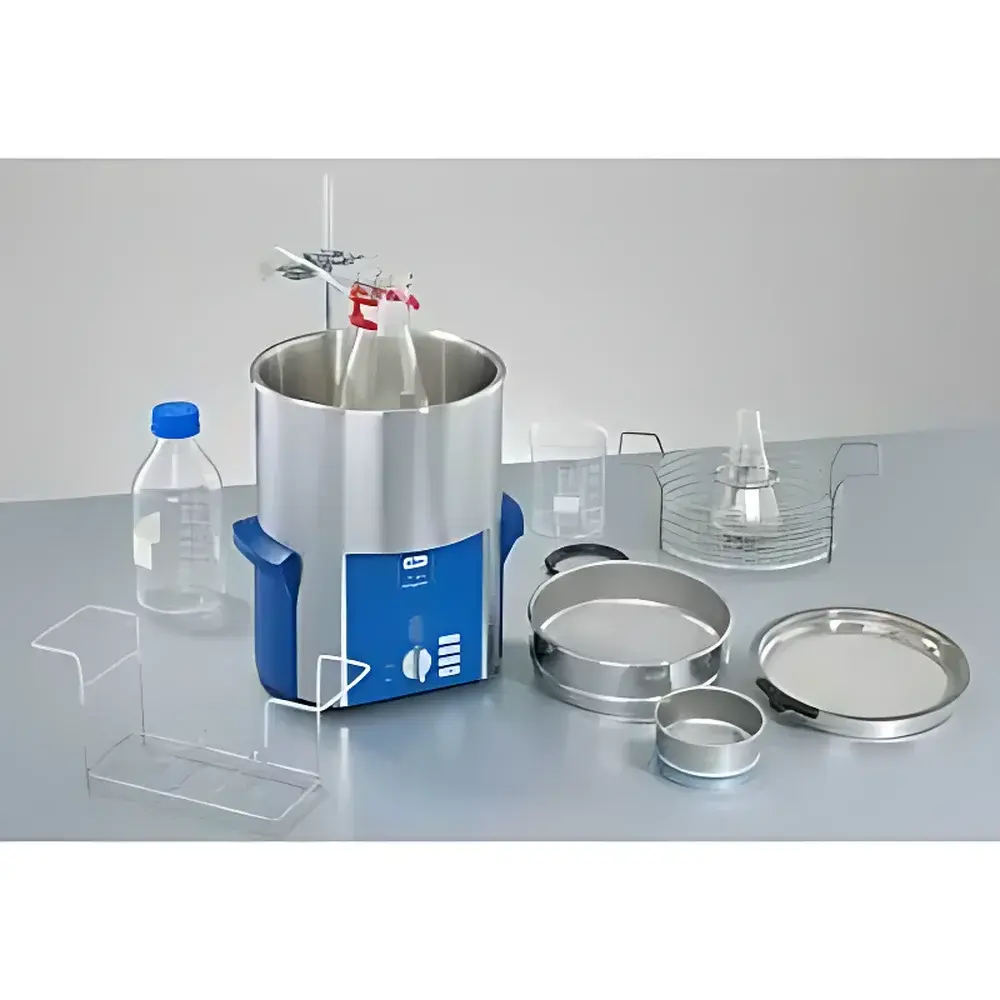
Elma S50R Ultrasonic Cleaner
| Brand | Elma (Germany) |
|---|---|
| Origin | Germany |
| Model | S50R |
| Type | General-Purpose Ultrasonic Cleaner |
| Tank Volume | 5.3 L |
| Internal Dimensions | Ø240 mm × 130 mm (H) |
| External Dimensions | Ø260 mm × 350 mm (H) |
| Basket Dimensions | Ø220 mm × 70 mm (H) |
| Ultrasonic Frequency | 37 kHz |
| Timer Range | 1–30 min (plus continuous mode with auto-shutdown after 12 h) |
| Power Consumption | 150 W |
| Weight | 5.0 kg |
| Protection Class | IP20 |
| Compliance | CE (Low Voltage Directive 2006/95/EC & EMC Directive 2004/108/EC) |
Overview
The Elma S50R Ultrasonic Cleaner is a compact, microprocessor-controlled laboratory-grade ultrasonic cleaning system engineered for precision applications in analytical sample preparation, HPLC solvent conditioning, and fine-mesh filtration maintenance. Utilizing high-efficiency piezoelectric transducers operating at a stable 37 kHz frequency, the S50R generates controlled cavitation within aqueous or compatible organic media to remove particulate contaminants, adsorbed organics, and entrapped air bubbles from delicate surfaces. Its 5.3 L stainless steel tank—constructed from cavitation-resistant grade 316 stainless steel—is optimized for reproducible energy distribution and minimal standing-wave interference. Designed and manufactured in Germany under DIN EN ISO 9001-certified quality management systems, the S50R reflects Elma’s six-decade heritage in ultrasonic process engineering and its commitment to robust, application-specific instrumentation for regulated laboratory environments.
Key Features
- Three pre-programmed, application-optimized cleaning modes: Sieve Clean (for mesh screens up to Ø200 mm, including airflow sieves), Degas (for rapid degassing of HPLC-grade solvents prior to filtration or system priming), and Sample Prep (supporting dissolution, homogenization, emulsification, and dispersion protocols)
- Microprocessor-based digital control with dual LED display showing set time and real-time countdown
- Adjustable timer (1–30 minutes) plus continuous operation mode with automatic shutdown after 12 hours for unattended use
- Ergonomic design with side-mounted polypropylene handles and rear-mounting interface for secure integration into lab benchtop setups or modular rack systems
- Removable power cord with standard IEC C13 connector; IP20-rated enclosure suitable for dry, indoor laboratory conditions
- Corrosion- and cavitation-resistant tank with seamless welds and rounded internal corners to prevent particle entrapment
Sample Compatibility & Compliance
The S50R accommodates a wide range of sample carriers—including stainless steel, titanium, and PTFE-coated sieves; glass vials; quartz cuvettes; and ceramic filters—without risk of surface pitting or acoustic shadowing. Its fixed 37 kHz frequency ensures consistent cavitation intensity across the tank volume, enabling reliable cleaning validation for routine QC/QA workflows. The device complies fully with European CE marking requirements under the Low Voltage Directive (2006/95/EC) and Electromagnetic Compatibility Directive (2004/108/EC). While not inherently GLP/GMP-validated, its deterministic timing, repeatable transducer output, and non-volatile operational parameters support traceable documentation in accordance with ISO/IEC 17025-accredited laboratories. It is routinely deployed in settings requiring adherence to ASTM D2603 (ultrasonic cleaning verification), USP (particulate matter testing), and ISO 13485-aligned medical device component cleaning processes.
Software & Data Management
The Elma S50R operates as a standalone instrument without embedded software or network connectivity. All operational parameters are configured via front-panel push-button controls, and no firmware updates or data logging capabilities are provided. This architecture ensures long-term functional stability, eliminates cybersecurity exposure, and aligns with laboratories prioritizing hardware-level reliability over digital feature creep. For audit-trail compliance, users may document operating conditions (mode selected, duration, bath temperature if externally monitored, and lot numbers of cleaning solutions) manually or via integrated LIMS entries. No FDA 21 CFR Part 11 electronic signature functionality is included, consistent with its classification as a Class I general-purpose laboratory device.
Applications
- Routine cleaning and verification of analytical sieves used in pharmaceutical granulometry (e.g., USP sieve series), cement fineness testing, and powder flow characterization
- Pre-conditioning of mobile phase solvents for HPLC, UHPLC, and LC-MS systems to eliminate dissolved gas-induced baseline noise and pump cavitation
- Dispersion of nanomaterials (e.g., carbon nanotubes, metal oxides) and preparation of colloidal suspensions for DLS or TEM analysis
- Decontamination of reusable pipette tips, microcentrifuge tubes, and small-volume reaction vessels prior to trace-metal analysis
- Supporting ASTM E1291 (ultrasonic cleaning of optical components) and ISO 14644-1 cleanroom component maintenance protocols
FAQ
Is the S50R suitable for cleaning delicate optical lenses or MEMS devices?
The S50R is not recommended for direct immersion of uncoated optics or microelectromechanical systems due to the absence of frequency modulation or sweep-mode capability. For such applications, Elma’s higher-tier models with adjustable frequency ranges (e.g., Elmasonic P series) are advised.
Can the unit be operated with elevated temperature baths?
No—the S50R lacks integrated heating elements and is rated only for ambient-temperature operation. For heated ultrasonic cleaning, consider the Elma Transsonic T series or similar thermostatically controlled variants.
What cleaning solutions are compatible with the S50R?
Aqueous alkaline, neutral, or mildly acidic formulations are acceptable. Avoid halogenated solvents (e.g., chloroform, carbon tetrachloride) and strong oxidizers (e.g., concentrated nitric acid), which may accelerate tank corrosion or degrade transducer bonding materials.
Does the S50R include a degassing validation protocol?
It does not provide automated validation. However, solvent degassing efficacy can be verified gravimetrically or by measuring dissolved oxygen content pre- and post-treatment using an inline DO probe.
How often should the tank be descaled or maintained?
In hard-water environments, periodic descaling with diluted citric acid (5% w/v, 30 min soak) is recommended every 2–4 weeks. Always rinse thoroughly and inspect transducer mounting surfaces for mineral buildup before reuse.
Related Products



