
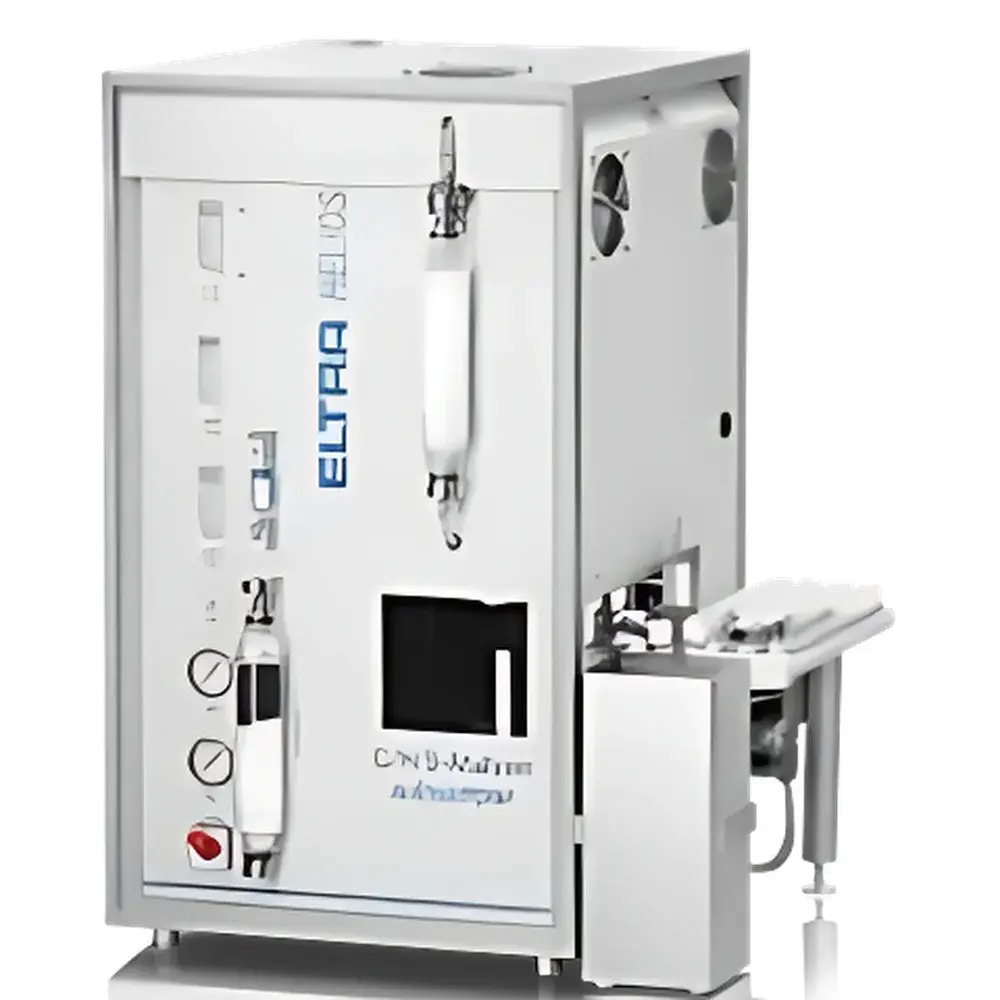
ELTRA CS-580A Carbon and Sulfur Analyzer
| Brand | ELTRA |
|---|---|
| Origin | Germany |
| Model | CS-580A |
| Heating System | Resistance Furnace |
| Measurement Range | 0.005–100 wt% (C and S) |
| Analysis Time | 60–120 s |
| Combustion Furnace Power Supply | 230 V, 50/60 Hz |
| Max. Heating Power | 2000 W |
| Compliance | DIN EN 15936 (for TOC analysis) |
| Optional Modules | TIC module, Acid-Resistant Autosampler (36- or 130-position), Dual IR Cells per Element |
Overview
The ELTRA CS-580A Carbon and Sulfur Analyzer is a high-performance combustion-based elemental analyzer engineered for precise, simultaneous quantification of total carbon (C) and total sulfur (S) in solid and non-volatile liquid samples. Operating on the principle of high-temperature combustion (up to 1500 °C) followed by infrared (IR) absorption spectroscopy, the instrument converts sample-bound carbon and sulfur into CO2 and SO2, respectively. These gaseous species are then measured using up to four independent, temperature-stabilized non-dispersive infrared (NDIR) detectors—two dedicated per element—to ensure linearity and accuracy across an exceptionally broad dynamic range (0.005–100 wt%). The CS-580A is designed for routine laboratory environments requiring regulatory compliance, method robustness, and reproducible data under GLP and GMP frameworks. Its architecture supports both standalone operation and integration into enterprise-level analytical workflows via standardized digital interfaces.
Key Features
- Simultaneous dual-element analysis (C and S) with configurable single- or dual-IR cell setups per element to optimize sensitivity and dynamic range
- Resistance-heated combustion furnace (230 V, 50/60 Hz) delivering stable, controllable thermal profiles up to 2000 W maximum power
- Analysis cycle time of 60–120 seconds—including combustion, gas conditioning, and IR detection—enabling throughput of up to 30 samples per hour
- Flexible sample introduction: manual loading or automated analysis via optional 36- or 130-position autosamplers; acid-resistant plastic crucible carriers available for corrosive matrices
- DIN EN 15936-compliant Total Organic Carbon (TOC) measurement capability; optional Total Inorganic Carbon (TIC) module enables carbonate-speciation workflows
- Modular hardware design supporting field-upgradable configurations—including high-concentration sulfur cells and extended-range IR optics
Sample Compatibility & Compliance
The CS-580A accommodates a wide spectrum of heterogeneous, high-matrix samples without pre-dilution or derivatization. Typical sample masses range from 50 mg to 500 mg, enabling reliable quantification in challenging materials such as coal, coke, limestone, gypsum, rubber, soil, fly ash, tobacco, biomass, industrial slags, and polymer composites. Its robust gas-cleaning system—comprising copper oxide catalysts, desiccants, and halogen scrubbers—ensures interference-free IR detection even in sulfur-rich or chloride-laden samples. The analyzer meets critical international standards including DIN EN 15936 (TOC in soils and sediments), ASTM D5373 (C/S in coal and coke), and ISO 11725 (determination of C and S in iron and steel). Data integrity is maintained through audit-trail-enabled software compliant with FDA 21 CFR Part 11 requirements for electronic records and signatures.
Software & Data Management
ELTRA’s proprietary WinCS software provides intuitive method setup, real-time signal monitoring, and automated calibration management. Each analysis generates timestamped, metadata-rich results—including peak area integrals, baseline correction logs, and diagnostic flags for combustion efficiency and gas flow stability. Export options include CSV, TXT, and XML formats compatible with LIMS platforms (e.g., LabWare, Thermo SampleManager) and statistical analysis tools (e.g., JMP, Minitab). The software supports user-defined report templates with configurable fields (sample ID, operator, date/time, uncertainty estimates), batch processing, and trend analysis over time. All raw detector signals and calibration curves are archived locally with version-controlled backups, fulfilling long-term data retention mandates under ISO/IEC 17025 and EU Annex 11 guidelines.
Applications
- Quality control of metallurgical feedstocks (iron ore, ferroalloys, scrap metal) per ISO 4935 and ASTM E1019
- Environmental testing of soils, sediments, and waste materials for regulatory reporting (EPA Method 9060A, ISO 10694)
- R&D in cement and construction materials for carbon sequestration studies and clinker optimization
- Fuel characterization in energy sector labs—coal rank assessment, coke reactivity index (CRI), and sulfur emission modeling
- Pharmaceutical excipient screening where residual carbon/sulfur impurities affect stability or catalytic activity
- Geological survey labs performing bulk geochemical profiling of carbonate-rich rock formations
FAQ
What sample types require acid-resistant autosampler configuration?
Samples containing hydrochloric, hydrofluoric, or nitric acid residues—such as digested environmental soils, etched metal alloys, or spent catalysts—necessitate the acid-resistant 130-position autosampler with chemically inert plastic crucible holders.
Can the CS-580A quantify carbonate-bound carbon separately from organic carbon?
Yes—when equipped with the optional TIC module, the instrument performs sequential acidification and purging to isolate inorganic carbon, enabling accurate TOC = TC – TIC calculations per ISO 8245 and EPA 415.1 protocols.
Is method validation support provided for regulated industries?
ELTRA supplies IQ/OQ documentation templates, certified reference material (CRM) compatibility lists (e.g., NIST SRM 278, BCR-380), and traceable calibration procedures aligned with ISO/IEC 17025 clause 7.7.
How is carryover minimized during high-sulfur sample analysis?
The system employs programmable post-combustion purge cycles, high-efficiency ceramic filters, and automatic baseline reset algorithms that detect and compensate for residual SO2 adsorption in optical cells.
Does the analyzer support remote diagnostics and firmware updates?
Yes—via secure Ethernet connection, authorized service engineers can initiate remote troubleshooting, performance verification, and controlled firmware upgrades without onsite intervention.





