
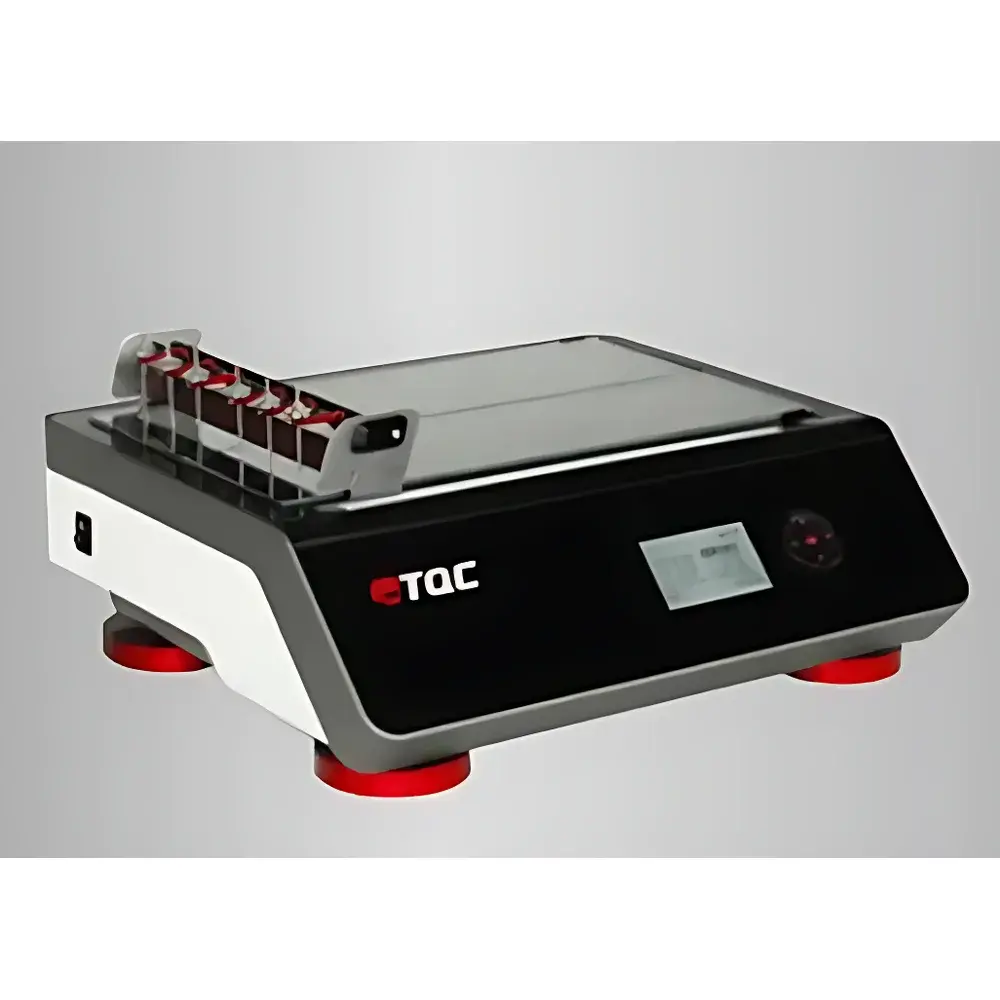
TQC新型干燥时间记录仪
| Key | Brand: TQC |
|---|---|
| Origin | Netherlands |
| Model | DV-6000 |
| Operating Temperature | −20 °C to +70 °C (non-condensing) |
| Dry Time Range | 1 min to 200 h |
| Timing Accuracy | < ±1% of set time |
| Track Length | 300 mm |
| Number of Tracks | 6 |
| Probe Diameter | 2 mm |
| Probe Radius | 1 mm |
| Glass Bed Configuration | 2 × triple-track beds (305 mm × 100 mm × 3 mm) or 6 × narrow single-track beds (305 mm × 25 mm × 3 mm) |
| Dimensions (W×D×H) | 335 mm × 400 mm × 190 mm |
| Weight | 9.5 kg |
| Power Supply | 24 V DC adapter (max. 40 W) |
| Display | 128 × 64 pixel backlit monochrome LCD (70 mm × 40 mm), heated for low-temperature operation |
| Interface | Illuminated tactile keypad with 3-level functional hierarchy |
| Enclosure Materials | Anodized aluminum, tempered glass front panel, stainless steel hardware, nylon components, powder-coated steel chassis |
| Compliance | ASTM D5895, ISO 9117-4, DIN EN 14022 |
Overview
The TQC DV-6000 Digital Dry Time Recorder is a precision-engineered instrument designed for objective, repeatable quantification of film formation kinetics in liquid coatings, inks, adhesives, and related formulations. It operates on the Beck-Koller (BK) principle — a standardized mechanical probing method where a calibrated needle traverses a freshly applied sample at defined intervals, detecting surface resistance changes associated with progressive solvent evaporation and polymer network development. Unlike subjective thumb tests or optical methods, the DV-6000 delivers discrete, timestamped stage transitions (e.g., surface dry, tack-free, hard dry) based on measurable mechanical resistance thresholds. Its fully digital architecture eliminates analog drift, ensuring traceable, audit-ready results across laboratory, QC, and R&D environments. The device is purpose-built for compliance with internationally recognized drying assessment standards, including ASTM D5895 (Standard Test Method for Determining Dry Time of Organic Coatings by Mechanical Means), ISO 9117-4 (Paints and varnishes — Determination of drying time — Part 4: Mechanical methods), and DIN EN 14022 (Adhesives — Determination of open time and setting time).
Key Features
- Dual-range programmability: Configurable dry time measurement from 1 minute (suitable for fast-drying systems such as nail lacquers and UV-curable inks) up to 200 hours (enabling evaluation of slow-cure architectural paints and high-solids epoxy systems).
- Heated graphical LCD display (128 × 64 pixels): Maintains legibility and response fidelity across ambient temperatures from −20 °C to +70 °C; integrated backlight ensures visibility under low-light conditions.
- Six independent parallel tracks: Accommodates simultaneous multi-formulation testing or replicate measurements per sample batch, improving statistical robustness without sequential delays.
- Reusable tempered glass substrate system: Two triple-track (305 mm × 100 mm × 3 mm) beds are supplied standard; optional narrow-bed adapters (305 mm × 25 mm × 3 mm) support specialized applications including micro-volume screening and high-viscosity adhesives.
- Oil-free linear drive mechanism: Eliminates viscosity-dependent performance degradation at sub-zero temperatures and prevents contamination of sensitive coating surfaces.
- Intelligent tactile interface: Three-tier illuminated keypad provides context-aware button activation — only functionally relevant keys illuminate, reducing operator error and accelerating workflow.
- Hardened glass front panel: Chemically strengthened surface resists abrasion and chemical etching; facilitates rapid cleaning between samples while protecting underlying electronics and display.
- Low-voltage safety architecture: Powered exclusively via certified 24 V DC external adapter (max. 40 W), compliant with IEC 61000-6-3 EMC requirements and eliminating risk of mains voltage exposure in wet-lab environments.
Sample Compatibility & Compliance
The DV-6000 supports a broad spectrum of material classes — including solvent-borne and water-based architectural paints, industrial primers, automotive clearcoats, pressure-sensitive adhesives, screen printing inks, and cosmetic nail enamels. Its BK-compliant probe geometry (2 mm diameter, 1 mm radius tip) ensures consistent contact area and force distribution across substrates ranging from smooth aluminum panels to textured wood composites. All test protocols align with regulatory frameworks requiring documented drying behavior: ASTM D5895 mandates mechanical probe methodology for QC release in North America; ISO 9117-4 is referenced in EU CE marking dossiers for decorative coatings; DIN EN 14022 governs adhesive open-time validation under German and broader European harmonized standards. The instrument’s timing accuracy (< ±1% of set value) satisfies GLP data integrity requirements and supports 21 CFR Part 11–compliant electronic record retention when paired with validated TQC DataLink software.
Software & Data Management
While the DV-6000 operates as a standalone benchtop unit, it integrates seamlessly with TQC DataLink v3.x — a Windows-based desktop application enabling automated result export (CSV, PDF, XML), trend analysis across batches, and audit trail generation. DataLink enforces user access control, electronic signatures, and immutable timestamping, fulfilling FDA 21 CFR Part 11 and EU Annex 11 expectations for regulated laboratories. Raw probe actuation logs, stage transition timestamps, and environmental metadata (operator ID, sample ID, ambient temperature/humidity if externally logged) are stored in encrypted local databases. Exported reports include full traceability to calibration certificates, firmware revision history, and instrument serial number — essential for ISO/IEC 17025 accreditation audits.
Applications
- Coating Development: Accelerates formulation optimization by correlating resin chemistry, solvent blend volatility, and additive package efficacy with empirically derived drying profiles.
- Quality Control: Validates batch-to-batch consistency against internal specifications or customer-facing dry time claims (e.g., “touch-dry in 30 min”, “recoat-ready in 4 h”).
- Regulatory Submissions: Generates standardized datasets required for EPA VOC compliance documentation, REACH registration dossiers, and CPSC labeling approvals.
- Adhesive Manufacturing: Quantifies open time, handling strength onset, and final bond development for PSA tapes, laminating adhesives, and structural epoxies.
- Academic Research: Supports mechanistic studies on film coalescence, diffusion-controlled drying, and humidity-dependent cure kinetics in controlled-environment chambers.
FAQ
Does the DV-6000 require annual recalibration?
Yes — TQC recommends annual verification against traceable timing standards and mechanical probe geometry gauges. Calibration certificates are issued per ISO/IEC 17025-accredited procedures.
Can the instrument be used inside a climate-controlled chamber?
Yes — its −20 °C to +70 °C operational range and 24 V DC power architecture allow safe integration into environmental test chambers; ensure proper cable routing and condensation management.
Is the glass bed compatible with aggressive solvents like xylene or MEK?
Tempered borosilicate glass substrates resist chemical attack from common organic solvents; however, prolonged exposure to strong alkalis or hydrofluoric acid is not recommended.
How is probe wear monitored and compensated?
Each probe includes a laser-etched serial number and dimensional certification; TQC provides a probe inspection template and replacement protocol aligned with ISO 9117-4 Annex B.
Does the DV-6000 support custom drying stage definitions?
Yes — users may define up to six user-named stages beyond the standard BK classifications (e.g., “sandable”, “masking-ready”) via firmware configuration menus.






