
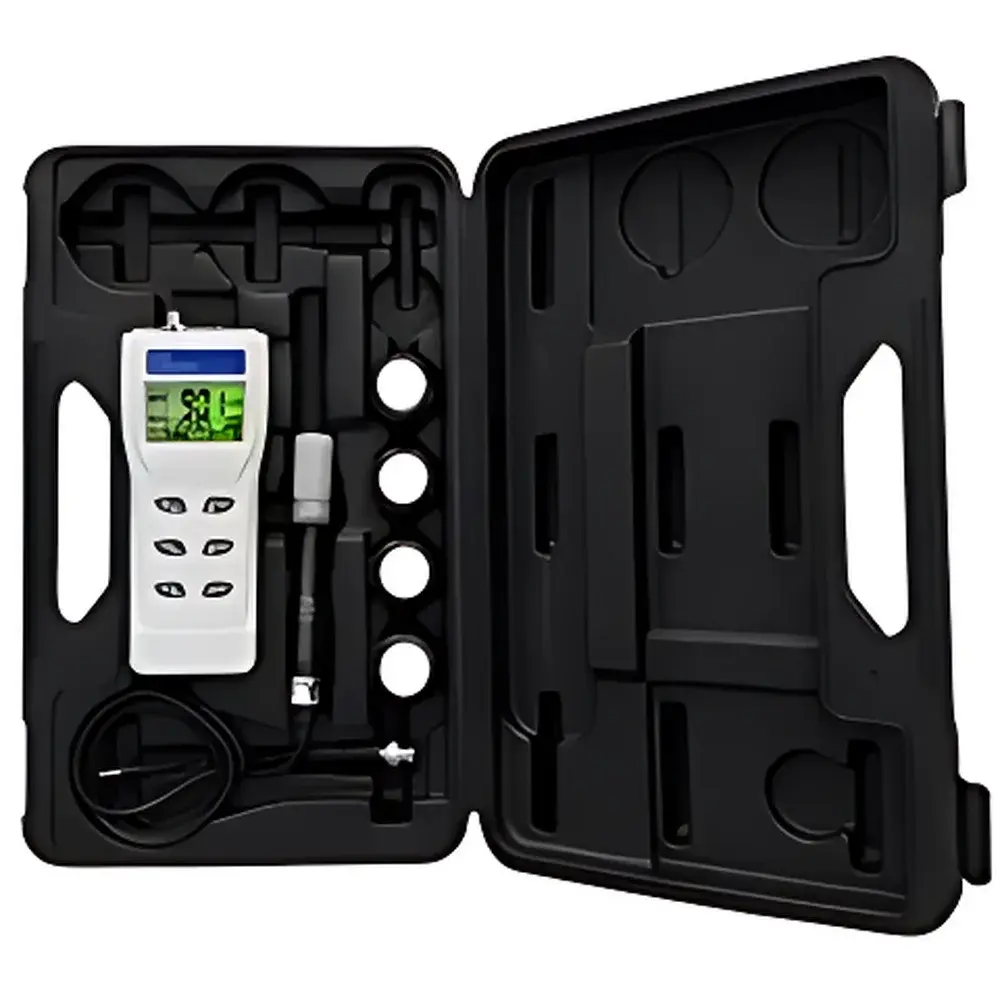
EMS Advanced pH Meter Model 72088-01
| Brand | EMS (Electron Microscopy Sciences) |
|---|---|
| Origin | USA |
| Instrument Type | Portable |
| Measurement Modes | pH, mV, ORP, Temperature (°C/°F) |
| pH Range | 0.00–14.00 |
| pH Resolution | 0.01 |
| pH Accuracy | ±0.02 |
| mV Range | –499 to +499 mV |
| mV Accuracy | ±0.1 mV (–199.9 to +199.9 mV), ±1 mV otherwise |
| ORP Range | –199.9 to +199.9 mV |
| ORP Accuracy | ±0.1 mV (–199.9 to +199.9 mV), ±1 mV otherwise |
| Temperature Range | –5 to 80 °C / 23 to 176 °F |
| Temperature Resolution | 0.1 °C / 0.1 °F |
| Temperature Accuracy | ±1 °C / ±2 °F |
| Calibration | Up to 5-point NIST-traceable calibration (pH 4.01, 7.00, 10.01 buffers + custom points) |
| Temperature Compensation | Automatic (ATC) or Manual (MTC) |
| Probe Interface | Standard BNC |
| Data Output | USB port (requires external USB-A to micro-B cable and EMS-provided software) |
| Power | 4 × AAA batteries (approx. 200 hours continuous operation) |
| Weight | 184 g (instrument only) |
| Dimensions (L×W×H) | 356 × 229 × 70 mm (carrying case) |
Overview
The EMS Advanced pH Meter Model 72088-01 is a field-deployable, multi-parameter electrochemical analyzer engineered for high-fidelity pH, redox potential (ORP), and temperature measurements in diverse environmental, industrial, and academic settings. Based on potentiometric measurement principles, the instrument detects the voltage difference between a pH-sensitive glass electrode and a stable reference electrode—converted via the Nernst equation into precise pH values. Its robust architecture supports rigorous use in laboratories, wastewater treatment plants, aquaculture facilities, soil testing sites, and educational fieldwork. Designed in compliance with fundamental electrochemical metrology standards—including ASTM D1293 (Standard Test Method for pH of Water) and ISO 7888 (Water quality — Determination of pH)—the meter delivers traceable accuracy without requiring benchtop infrastructure.
Key Features
- High-resolution dual-display LCD with backlight: Simultaneously shows primary parameter (pH/mV/ORP), secondary temperature reading (°C or °F), real-time timestamp, and battery status—even at low power.
- Five-point NIST-traceable calibration capability: Supports automatic recognition of standard buffers (pH 4.01, 7.00, 10.01) and allows up to two user-defined calibration points for non-standard applications.
- Intelligent temperature compensation: Auto-compensates using integrated thermistor (ATC) or accepts manual input (MTC); eliminates systematic error from thermal drift across aqueous samples.
- BNC-compatible probe interface: Accepts any industry-standard pH or ORP electrode, including double-junction, gel-filled, or refillable configurations—enabling method flexibility and sensor lifecycle management.
- USB data logging interface: Enables direct transfer of time-stamped measurement records (including date/time, parameter value, temperature, and calibration status) to Windows-based systems using EMS-supplied software compliant with FDA 21 CFR Part 11 audit trail requirements.
- Field-optimized ergonomics: Weighing only 184 g (instrument body), powered by four AAA cells with >200-hour operational life, and housed in an IP65-rated impact-resistant carrying case (356 × 229 × 70 mm).
Sample Compatibility & Compliance
The EMS Advanced pH Meter is validated for aqueous and mildly buffered solutions, including natural waters, process streams, nutrient media, and extracted soil leachates. It is not intended for non-aqueous solvents, highly viscous suspensions, or strong oxidizing/reducing agents that may degrade glass membrane integrity. All calibration and measurement protocols align with GLP documentation practices. The included buffer set (pH 4.01, 7.00, 10.01, and deionized water) is certified to NIST SRM traceability and supplied in 40 mL HDPE bottles with lot-specific certificates of analysis. Device firmware supports calibration verification logs and pass/fail thresholds per USP and EP 2.2.3 guidelines.
Software & Data Management
Data acquisition is managed through EMS’s proprietary PC application (v3.2+), which supports CSV export, customizable report templates, and automated calibration history archiving. Software enforces electronic signature workflows, session-level audit trails, and immutable record timestamps—meeting minimum requirements for GMP-aligned QC environments. Raw data files include embedded metadata: instrument ID, operator ID (user-defined), probe serial number, ambient temperature, and calibration deviation metrics. No cloud connectivity or third-party platform dependencies are implemented; all processing occurs locally to preserve data sovereignty.
Applications
- Environmental monitoring: Real-time pH and ORP profiling in rivers, lakes, wetlands, and stormwater outfalls per EPA Method 150.1.
- Food & beverage QA: Batch verification of rinse water, brine solutions, and fermentation broth stability.
- Academic instruction: Electrochemistry labs demonstrating Nernstian behavior, buffer capacity, and junction potential effects.
- Aquaculture & hydroponics: Daily tracking of nutrient solution acidity and oxidation-reduction balance to prevent microbial bloom or metal precipitation.
- Industrial pretreatment: Monitoring neutralization efficiency in electroplating effluent streams prior to discharge compliance testing.
FAQ
What calibration buffers are required for routine operation?
The meter requires NIST-traceable pH 4.01, 7.00, and 10.01 buffers for standard two- or three-point calibration. Deionized water (≤1 µS/cm) is recommended for electrode rinsing—not calibration.
Does the instrument support automatic electrode diagnostics?
No. While slope and offset values are displayed post-calibration, the device does not perform impedance or asymmetry potential diagnostics. Users must visually inspect electrode condition and replace membranes per manufacturer service intervals.
Can this meter be used with non-EMS pH probes?
Yes. Any BNC-terminated pH or ORP electrode meeting ANSI/ISA-5.1 signal compatibility (±400 mV output range, ≤1 GΩ source impedance) is functionally interoperable.
Is temperature compensation mandatory during pH measurement?
Temperature compensation is strongly recommended for quantitative work. Uncorrected measurements deviate by ~0.03 pH units per °C away from 25 °C due to inherent Nernst slope variation.
How is data integrity ensured during USB transfer?
All exported datasets include cryptographic hash verification (SHA-256) in the header metadata, and software logs every export event with user ID, timestamp, and file checksum—supporting ALCOA+ data governance principles.




