
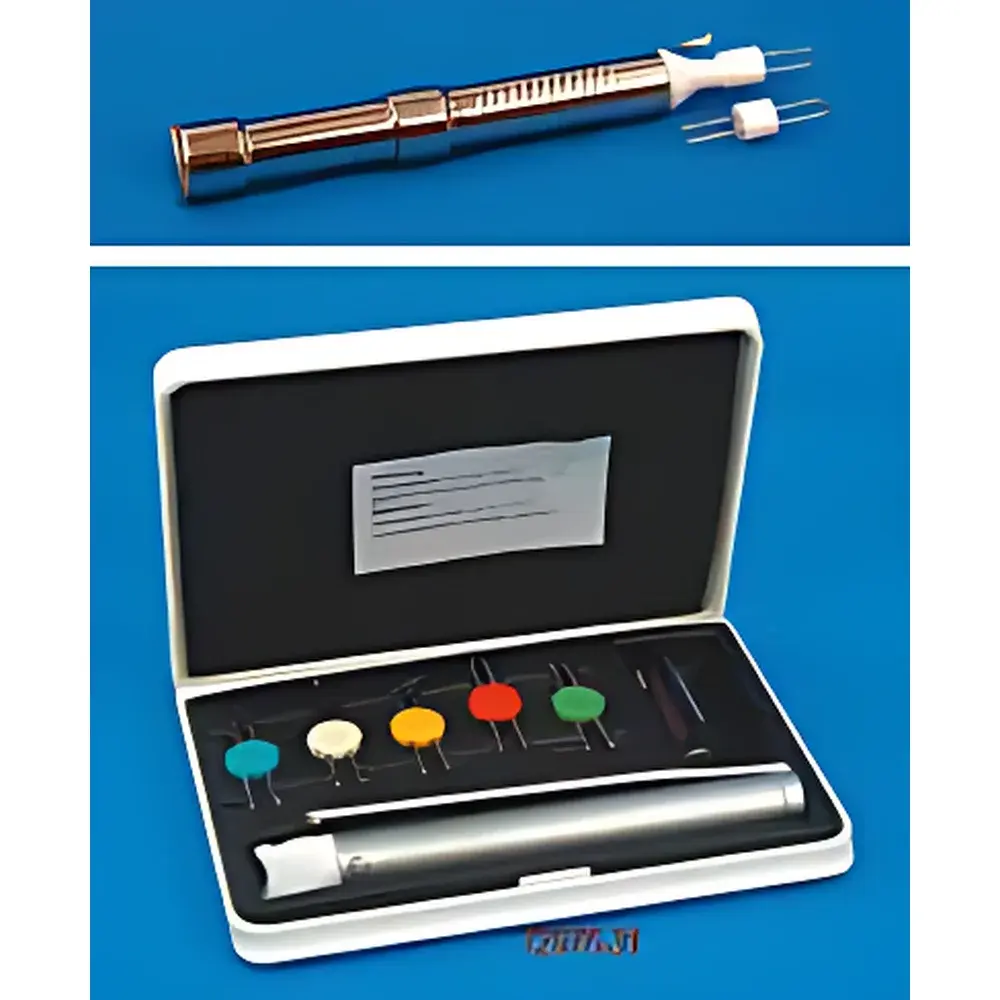
EMS Electron Microscopy Sciences Handheld Hot Wire Igniter (Low/Medium/High-Temperature Models)
| Brand | EMS/Electron Microscopy Sciences |
|---|---|
| Origin | USA |
| Distributor Type | Authorized Distributor |
| Import Status | Imported |
| Model Variants | Low-Temp, Medium-Temp, High-Temp |
| Temperature Range | 300–1000°C |
| Temperature Accuracy | ±1°C |
| Heating Time | ≤3 min (0 to setpoint) |
| Power Source | 1× or 2× AA batteries |
| Construction | Stainless steel housing with interchangeable tungsten alloy heating tips |
| Sterilization | Autoclavable (tip only, per manufacturer guidelines) |
Overview
The EMS Electron Microscopy Sciences Handheld Hot Wire Igniter is a compact, battery-powered thermal ignition device engineered for precise, on-demand localized heating in sterile and field-limited laboratory environments. Unlike conventional benchtop heating plates or furnaces, this instrument operates on resistive Joule heating principles—applying controlled current through a high-melting-point tungsten alloy wire tip to achieve rapid, repeatable thermal output. Its modular architecture separates the ergonomic stainless-steel handle from thermally isolated, application-specific heating tips, enabling safe handling during operation and minimizing heat transfer to the user. Designed primarily for flame-free ignition, sample spot-heating, loop sterilization, and micro-scale thermal activation in biosafety cabinets or cleanrooms, it eliminates open-flame hazards while maintaining compatibility with ISO 14644-1 Class 5–7 environments. The three calibrated temperature tiers—Low (300–350°C), Medium (500–520°C), and High (up to 1000°C)—are achieved via fixed-resistance tip geometries and regulated battery voltage delivery, ensuring stable thermal output without external controllers or AC infrastructure.
Key Features
- Triple-tier temperature capability: Selectable low-, medium-, or high-temperature variants optimized for distinct thermal protocols—e.g., microbial loop sterilization (≥350°C), polymer cross-linking initiation (≥500°C), or ceramic sintering preheating (≥1000°C).
- Interchangeable tungsten alloy tips: Chemically inert, oxidation-resistant tips withstand repeated thermal cycling; compatible with autoclaving (121°C, 15 psi, 20 min) when detached from the handle.
- Battery-operated portability: Operates on one or two standard AA alkaline cells—enabling use inside laminar flow hoods, biosafety cabinets, gloveboxes, or remote field labs where AC power is unavailable or prohibited.
- Stainless steel construction: Fully corrosion-resistant housing meets ASTM F899 standards for surgical-grade stainless alloys; non-porous surface supports routine decontamination with 70% ethanol or hydrogen peroxide vapor.
- Rapid thermal response: Achieves target temperature in ≤3 minutes with ±1°C accuracy across full range—validated per ISO/IEC 17025 calibration traceability using NIST-traceable thermocouple probes.
Sample Compatibility & Compliance
The igniter is routinely employed for sterilizing platinum/nichrome inoculation loops, activating catalytic surfaces, annealing microelectrodes, and initiating thermal decomposition in TGA pre-screening workflows. Tip geometry permits contact-based heating of samples ≤3 mm in diameter—including biological specimens on agar slants, semiconductor wafers, glass capillaries, and MEMS devices. It complies with USP requirements for aseptic processing equipment qualification and supports GLP-compliant documentation when used with EMS-certified calibration logs. While not classified as medical device under FDA 21 CFR Part 820, its design adheres to IEC 61010-1 safety standards for laboratory electrical equipment. CE marking applies to EU-distributed units (per EMC Directive 2014/30/EU and RoHS 2011/65/EU).
Software & Data Management
This is a manually operated, analog thermal tool with no embedded firmware, digital interface, or data logging capability. Temperature selection is hardware-determined by tip resistance and battery configuration—eliminating software validation requirements under FDA 21 CFR Part 11. All operational parameters are documented in the EMS Technical Datasheet (Rev. 4.2, 2023) and included with each shipment as printed calibration certificates traceable to NIST SRM 1750a. Users maintain manual logbooks per ISO/IEC 17025 clause 7.7.1 for tip usage cycles, battery replacement dates, and sterilization events.
Applications
- Microbiology: Rapid sterilization of inoculation loops and needles without flame—reducing aerosol generation and improving BSL-2 containment integrity.
- Materials Science: Localized annealing of nanowire contacts, thermal triggering of shape-memory alloys, and pre-sintering of ceramic pastes on substrates.
- Electronics Manufacturing: Reflow soldering of ultra-miniature SMD components (<0402 size) where hot-air stations lack spatial precision.
- Forensic & Environmental Labs: Thermal desorption of trace organics from filter media prior to GC-MS analysis—avoiding solvent contamination.
- Education: Demonstrating exothermic redox reactions (e.g., thermite initiation) and kinetic studies of solid-state phase transitions in undergraduate labs.
FAQ
Is the heating tip autoclavable?
Yes—the tungsten alloy tip may be autoclaved independently at 121°C, 15 psi for 20 minutes. The handle assembly must never be autoclaved.
What battery life can be expected per set?
Approximately 8–12 hours of intermittent use (5–10 sec activations) with fresh alkaline AA cells; performance declines below 1.2 V per cell.
Can multiple tips be used interchangeably on one handle?
Yes—handles are mechanically and electrically compatible across all three temperature variants; tip selection determines operating range.
Does EMS provide calibration services?
Yes—EMS offers annual NIST-traceable calibration (certified per ISO/IEC 17025) through its North American service centers; certificate includes uncertainty budget and drift analysis.
Is there a CE Declaration of Conformity available?
Yes—available upon request from EMS Technical Support; covers electromagnetic compatibility and low-voltage safety compliance.



