EMS62 Multi-Channel Plant Stem Flow Measurement System
| Origin | Europe |
|---|---|
| Manufacturer Type | Authorized Distributor |
| Origin Category | Imported |
| Model | EMS62 |
| Price Range | USD 13,500 – 27,000 |
Overview
The EMS62 Multi-Channel Plant Stem Flow Measurement System is a precision-engineered instrument designed for continuous, non-destructive quantification of sap flow in woody and herbaceous plant stems using the Stem Heat Balance (SHB) principle. As specified in the Chinese Forestry Industry Standard LY/T 1952–2011 (“Methods for Long-Term Fixed Observation of Forest Ecosystems”), the SHB method relies on controlled thermal input and thermodynamic equilibrium modeling to derive mass-based sap flux density (kg·h⁻¹·cm⁻²) with high reproducibility under field conditions. Unlike thermal dissipation or heat pulse techniques, the EMS62 maintains a constant temperature differential (ΔT = 2 K or 4 K) between upper and lower thermocouple probes via active feedback control—ensuring that conductive heat loss remains stable and quantifiable. This eliminates reliance on ambient temperature drift correction and enables direct calculation of sap flow from dynamic heating power modulation (mW·K⁻¹), rather than indirect inference from thermal gradients. The system is optimized for stems with diameters between 6 mm and 20 mm—including young trees, shrub branches, fruiting spurs, and agricultural crops—making it especially suitable for physiological studies requiring high spatial resolution across heterogeneous canopies or breeding trials.
Key Features
- Compliant with LY/T 1952–2011, the official Chinese forestry standard for sap flow monitoring in long-term ecological observatories
- Active feedback-controlled ΔT stabilization (2 K or 4 K preset) ensures consistent thermal boundary conditions across diurnal and seasonal environmental variation
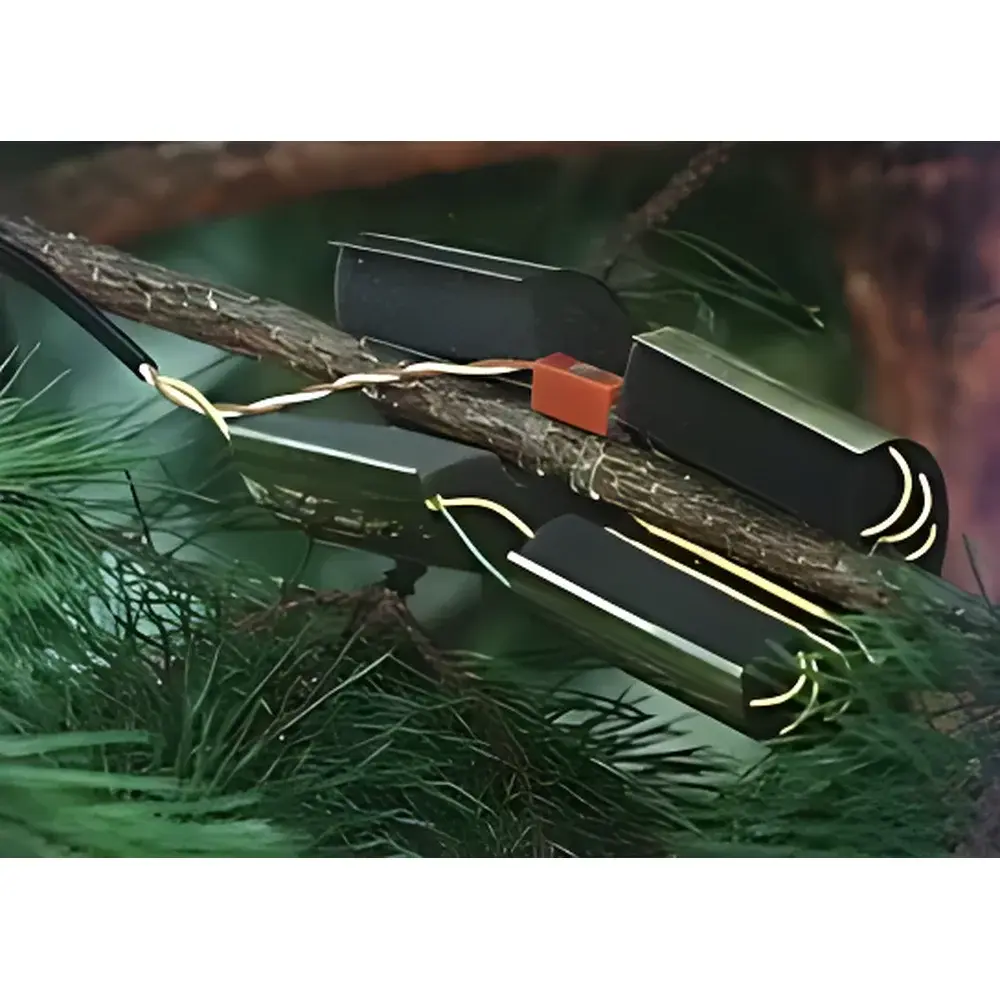
- Modular sensor design with flexible, low-profile elastomeric heating elements minimizes mechanical stress on delicate stems and accommodates irregular surface topography
- Integrated radiation-shielded housing and thermal insulation reduce convective and radiative interference—validated for operation in full sun, rain, and sub-zero ambient conditions (–10 °C to +40 °C)
- Self-contained 8-channel data logger with 0.03% full-scale accuracy, 512 KB internal memory (~220,000 readings), and configurable sampling intervals (10 s to 2 min)
- Expandable architecture supporting 12- and 16-channel configurations for synchronized multi-point monitoring within individual plants or across experimental plots
- Native compatibility with auxiliary environmental sensors—including air temperature/humidity, PAR, net radiation, and volumetric soil water content—for coupled eco-physiological analysis
Sample Compatibility & Compliance
The EMS62 is validated for use on intact, living stems ≥6 mm and ≤20 mm in diameter, requiring a minimum measurement length of 20 cm for accurate axial heat integration. It has been applied across diverse species including Salix psammophila, Acer saccharum, Zea mays, Malus domestica, and Ulmus minor, as documented in peer-reviewed literature (e.g., Urban & Dvořák, 2014; Pei et al., 2019). All hardware components meet IP67 ingress protection standards for dust and water resistance. Data acquisition firmware supports audit-trail logging and timestamped metadata embedding—facilitating GLP-aligned experimental documentation. While not certified to ISO/IEC 17025, the system’s traceable calibration protocol (based on Joule heating equivalence and NIST-traceable thermocouples) satisfies requirements for publication-grade physiological data in journals such as Trees, PLoS ONE, and Ecological Modelling.
Software & Data Management
The proprietary Windows-compatible software provides end-to-end workflow support: sensor configuration, real-time visualization, baseline drift correction, sap flux derivation (kg·h⁻¹·cm⁻²), and export to CSV, Excel, or MATLAB-native formats. Baseline calibration routines account for natural diurnal variations in stem thermal capacitance and ambient conductive loss—enabling robust zero-flow reference establishment without manual intervention. Raw thermal power signals (mW·K⁻¹) and derived sap flow time series are stored with embedded GPS coordinates, sensor ID, and environmental metadata. Software updates are distributed via secure HTTPS download from the manufacturer’s EU-hosted portal. No cloud dependency or subscription model is required; all processing occurs locally to ensure data sovereignty and compliance with institutional IT policies.
Applications
- Quantifying whole-plant transpiration dynamics in response to drought, VPD, and irrigation scheduling in horticultural and agronomic research
- Assessing hydraulic architecture and xylem vulnerability curves in tree breeding programs
- Validating stomatal conductance models (e.g., Penman–Monteith parameterization) under controlled and field conditions
- Monitoring early-stage biotic stress responses—including Dutch elm disease progression and pathogen-induced embolism (Čermák et al., 2004; Urban & Dvořák, 2014)
- Scaling sap flux measurements from branch-level to stand-level water use in forest hydrology and carbon–water coupling studies
- Supporting FAO-recommended crop water productivity assessments in semi-arid agroecosystems
FAQ
What is the minimum and maximum stem diameter supported by the EMS62 sensor?
The EMS62 is available in two size variants: 6–12 mm and 12–20 mm nominal stem diameters. A minimum 20 cm stem length is required for valid heat integration.
Does the system require external power during long-term deployment?
No—each sensor node operates on a 12 V DC lead-acid battery (included), enabling unattended operation for >3 months when sampled at 5-minute intervals.
Can I integrate soil moisture or atmospheric sensors with the EMS62 data logger?
Yes—the 8-channel logger features analog inputs compatible with industry-standard 0–2.5 V or 4–20 mA sensors, including Campbell Scientific, Decagon, and Delta-T devices.
Is the software compliant with FDA 21 CFR Part 11 or EU Annex 11 requirements?
While not formally validated for regulated pharmaceutical applications, the software supports user authentication, electronic signatures, and immutable audit logs—providing foundational capabilities for GLP/GMP-aligned environmental physiology studies.
How is calibration performed, and is traceability documented?
Calibration is based on electrical power equivalence (Joule heating) and verified using NIST-traceable thermocouples; certificate of conformance and procedure documentation are supplied with each shipment.