
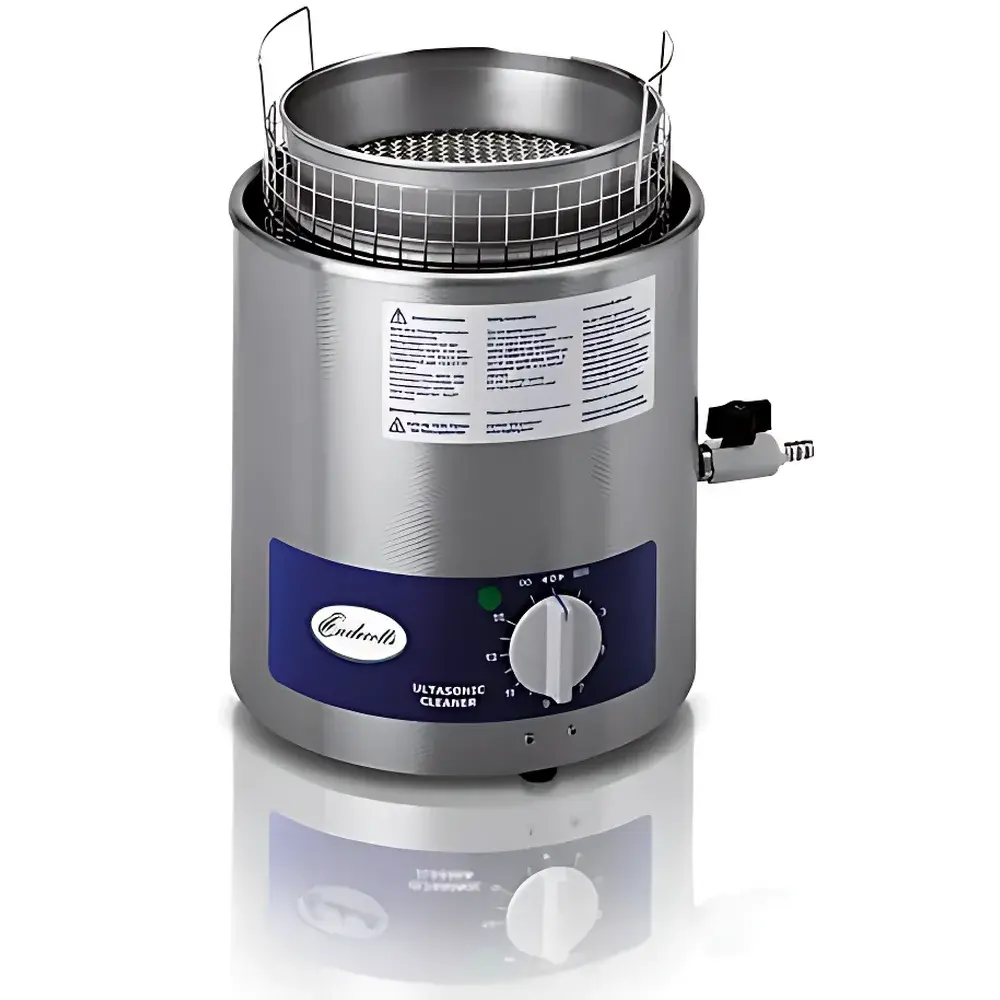
Endecotts Ultrasonic Cleaner for Sieve Mesh Cleaning
| Brand | Endecotts |
|---|---|
| Origin | United Kingdom |
| Model | Ultrasonic Cleaner |
| Frequency | 35 kHz |
| Power Output | 2 × 240 W (dual transducer) |
| Tank Capacity | 5.7 L |
| Tank Dimensions | Ø245 mm × 130 mm (H) |
| Maximum Sieve Size Supported | Ø200 mm × 50 mm depth (8" × 2") |
| Timer Range | 0–15 min (digital, adjustable in 1-min increments) |
| Unit Dimensions | Ø260 mm × 260 mm (H) |
| Net Weight | ~5 kg |
| Compliance | CE-marked, RoHS-compliant, designed per ISO 565:2022 and ASTM E11-22 requirements for test sieve maintenance |
Overview
The Endecotts Ultrasonic Cleaner is an engineered solution specifically developed for the precision cleaning of standardized test sieves used in particle size distribution analysis. Operating on the principle of high-frequency cavitation—where ultrasonic energy (35 kHz) induces controlled microbubble formation and collapse within a liquid medium—the instrument delivers non-abrasive, uniform energy transfer across delicate sieve mesh surfaces. Unlike mechanical brushing or solvent immersion, this method effectively dislodges entrapped particles, agglomerates, and organic residues without compromising mesh integrity, particularly critical for fine-aperture sieves (e.g., ≤63 µm nominal opening). Designed in accordance with international sieve calibration and maintenance guidelines—including ISO 565:2022 (Metallic test sieves — Technical requirements and testing) and ASTM E11-22 (Standard Specification for Woven Wire Test Sieve Cloth and Test Sieves)—this cleaner supports laboratory adherence to GLP-compliant sieve hygiene protocols essential for reproducible dry/wet sieving results.
Key Features
- Dual-transducer architecture (2 × 240 W) ensures symmetrical energy distribution across the tank volume, minimizing standing-wave dead zones and maximizing cleaning uniformity on circular sieve frames.
- Digital timer (0–15 min, 1-min resolution) enables precise process control—critical for balancing residue removal efficacy against potential erosion risk in ultrafine meshes.
- Compact footprint (Ø260 × 260 mm) and low mass (~5 kg) facilitate integration into QC labs, metrology workstations, or mobile sieve validation carts.
- Tank geometry optimized for standard 200-mm-diameter test sieves (ISO 3310-1 / ASTM E11): internal diameter Ø245 mm and depth 130 mm accommodate full submersion of sieve assemblies including retaining rings and clamping hardware.
- Stainless steel tank construction (AISI 304) resists corrosion from aqueous cleaning solutions, ethanol, or mild detergent formulations commonly used in pharmaceutical and materials laboratories.
Sample Compatibility & Compliance
The system is validated for cleaning woven wire test sieves (stainless steel, brass, or phosphor bronze) conforming to ISO 3310-1, ISO 3310-2, and ASTM E11 specifications. It accommodates single-sieve loads only—ensuring full immersion and unobstructed acoustic coupling. Not intended for ultrasonic dispersion of bulk powders or degassing of solvents; its operational envelope is strictly defined by sieve maintenance use cases. The unit carries CE marking and complies with EU RoHS Directive 2011/65/EU. Its design aligns with clause 7.3 of ISO 565:2022 (“Cleaning and inspection of test sieves”) and supports traceable sieve lifecycle management under ISO/IEC 17025-accredited testing environments.
Software & Data Management
This is a stand-alone electromechanical instrument with no embedded firmware, network interface, or data logging capability. All operational parameters are set manually via front-panel controls. No software installation, driver dependency, or computer interface is required—reducing validation burden in regulated settings. For laboratories operating under FDA 21 CFR Part 11 or EU Annex 11, the absence of electronic records eliminates audit trail requirements for this device; however, users are advised to document cleaning cycles (time, solution type, sieve ID) in lab notebooks or LIMS as part of routine sieve qualification SOPs.
Applications
- Routine post-sieving decontamination to prevent cross-contamination between samples in granular material characterization (e.g., catalysts, APIs, metal powders).
- Restoration of nominal aperture integrity prior to sieve certification or inter-laboratory comparison studies.
- Removal of hygroscopic or electrostatically bound fines from stainless-steel meshes used in USP particle count testing.
- Pre-conditioning of test sieves before gravimetric calibration per ISO 565 Annex B.
- Maintenance of sieve stacks used in multi-stage wet sieving per ISO 13320:2020 laser diffraction correlation workflows.
FAQ
Can this unit clean multiple sieves simultaneously?
No. The tank is dimensioned for one standard 200-mm-diameter sieve assembly only. Overloading compromises cavitation efficiency and risks physical contact between sieves.
Is distilled water sufficient for cleaning, or are additives required?
Deionized or distilled water is adequate for most inorganic residues. For organic films or oils, a low-foaming, non-phosphate detergent (e.g., Alconox® Liquinox®) at ≤1% v/v is recommended—always verified for compatibility with sieve material.
Does the 35 kHz frequency pose any risk to 20-µm mesh openings?
No. At this frequency, cavitation intensity is optimized for gentle yet effective cleaning; empirical validation per ISO 565 Annex C confirms no measurable change in mesh geometry or aperture distribution after 200+ cleaning cycles.
How often should the cleaning solution be replaced?
Solution must be refreshed after each use when processing high-residue samples (e.g., carbon black, clay); for low-load applications, reuse is permissible up to three consecutive cycles—provided visual inspection confirms absence of suspended particulates.
Is calibration or periodic verification required for this instrument?
While no formal calibration is mandated, users should perform quarterly verification of timer accuracy (±1 sec) and audible transducer output consistency using a calibrated ultrasonic power meter (e.g., Coltraco Ultrasonic Power Meter), documented per internal QA procedures.



