
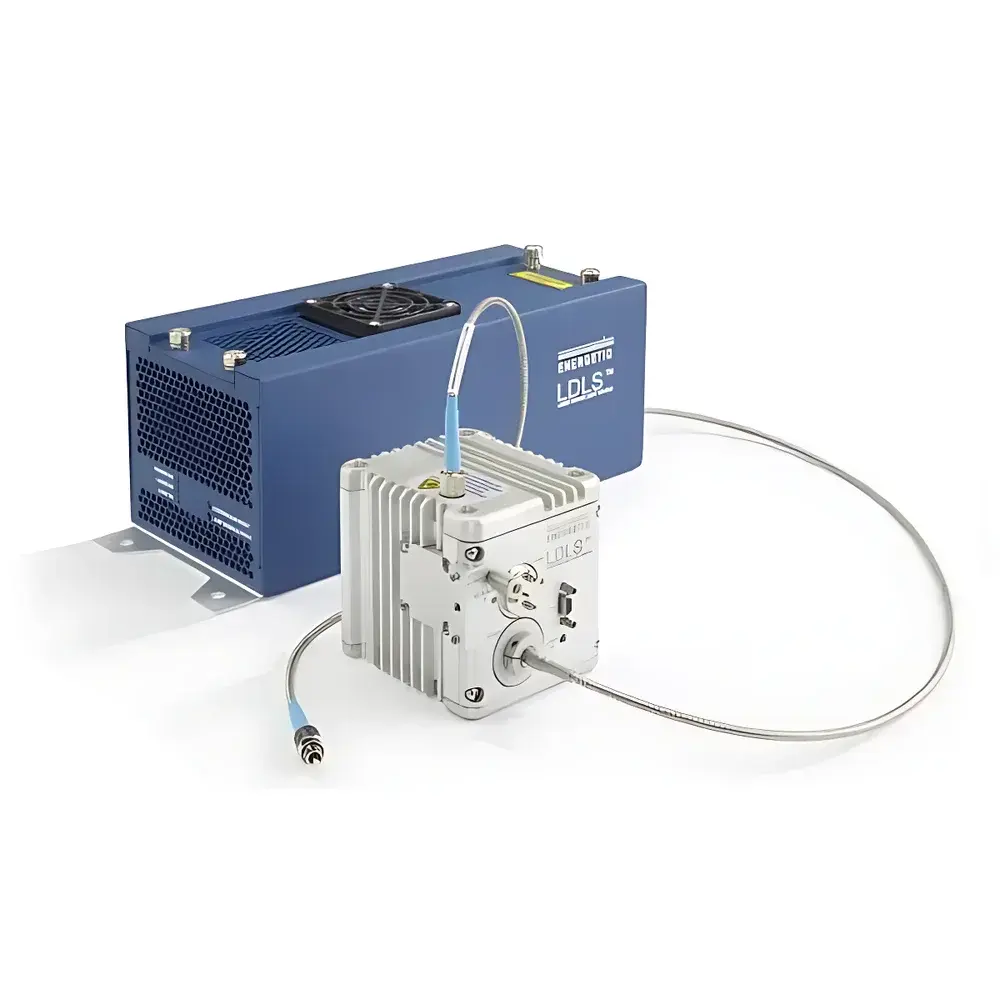
Energetiq EQ-99XFC Laser-Driven Light Source (LDLS™)
| Brand | Energetiq |
|---|---|
| Model | EQ-99XFC |
| Light Source Type | Laser-Driven Plasma Light Source |
| Spectral Range | 190–2100 nm |
| Output Power | ~80 mW |
| Spectral Radiance | ~60 µW/nm |
| Numerical Aperture | 0.22 NA |
| Lifetime | >9000 hrs (to 10% output degradation) |
| Output Coupling | FC-terminated fiber (core diameters: 100–600 µm |
| lengths | 1–2 m) |
| Lamp Size | 82 × 86 × 76 mm (lamp head) |
| Controller | 113 × 111 × 299 mm |
| Lamp Weight | 0.7 kg |
| Controller Weight | 1.4 kg |
| Spatial Stability | <0.5 µrad RMS angular drift |
| Power Stability | <0.2% RMS (short-term, 1 hr), <0.5% (long-term, 100 hrs) |
Overview
The Energetiq EQ-99XFC Laser-Driven Light Source (LDLS™) is a compact, high-brightness, broadband continuum source engineered for demanding optical metrology, spectroscopic analysis, and precision imaging applications. Unlike conventional electrode-based arc lamps (e.g., deuterium, xenon, or tungsten-halogen), the EQ-99XFC employs a fundamentally distinct physical mechanism: continuous-wave (CW) laser-induced plasma generation within a pressurized inert gas (typically xenon). A focused 1064 nm Nd:YAG laser beam ionizes and heats the gas to >20,000 K, producing a stable, sub-100 µm diameter plasma point source with blackbody-like spectral emission. This plasma geometry enables exceptional spatial coherence, minimal thermal drift, and intrinsic resistance to electrode erosion—directly addressing the primary failure modes of traditional lamps. The resulting output spans the deep ultraviolet (190 nm) through visible to near-infrared (2100 nm) with high radiance, low temporal noise, and uniform spectral power distribution—making it suitable for applications requiring traceable, repeatable, and calibration-stable illumination across wide spectral bands.
Key Features
- Laser-driven plasma technology eliminates electrodes, enabling >9000 hours of operational lifetime (to 10% radiant flux degradation) — significantly exceeding xenon arc lamps (typically 200–500 hrs) and deuterium lamps (500–2000 hrs).
- Sub-100 µm effective source size ensures high spatial coupling efficiency into optical fibers (standard FC connector) and microscope objectives, supporting diffraction-limited illumination in confocal and micro-spectroscopy systems.
- Ellipsoidal collector optics deliver >70% collection efficiency and maintain <0.2% RMS short-term power stability (1-hour measurement) and <0.5% long-term stability (100-hour operation) under constant current conditions.
- Fiber-coupled output with selectable core diameters (100–600 µm), numerical aperture (0.22 NA), and length (1–2 m) facilitates seamless integration into OEM instruments, process monitoring tools, and modular spectrometers.
- Deep-UV optimized fiber protection architecture minimizes solarization effects in fused silica fibers, preserving transmission integrity below 220 nm over extended use.
- Compact form factor (lamp head: 82 × 86 × 76 mm; controller: 113 × 111 × 299 mm) supports space-constrained benchtop and embedded system designs without compromising thermal management or electrical isolation.
Sample Compatibility & Compliance
The EQ-99XFC is compatible with standard UV-Vis-NIR optical components—including monochromators, spectrometers (e.g., Ocean Insight, Avantes, Horiba), CCD/CMOS detectors, and fiber-optic sensors—without requiring custom filtering or attenuation. Its spectral irradiance profile conforms to ISO 17025-compliant calibration workflows when used with NIST-traceable reference standards (e.g., SRM 2031, 2032). For regulated environments, the system supports GLP/GMP-aligned operation through external TTL-triggered shutter control and analog voltage monitoring of lamp current and temperature diagnostics. While not inherently 21 CFR Part 11 compliant, its digital I/O interface (RS-232, USB, analog monitor outputs) enables integration with validated LIMS or instrument control software that implements audit trail, electronic signature, and data integrity protocols per FDA guidance.
Software & Data Management
The EQ-99XFC operates via an embedded microcontroller with real-time feedback on plasma ignition status, laser diode temperature, and lamp head thermal load. Energetiq provides a Windows-compatible GUI application (EQ-Connect) for remote configuration of operating parameters—including laser power setpoint, interlock enable/disable, and fault logging. All operational data (uptime, thermal cycles, error codes) are timestamped and exportable as CSV for trend analysis. For automated platforms, ASCII command protocol over RS-232 or USB CDC allows integration with LabVIEW, Python (PySerial), MATLAB, or EPICS-based control systems. No proprietary drivers are required; communication adheres to standard serial framing with CRC-16 error checking.
Applications
- High-resolution UV-Vis-NIR absorption, reflectance, and fluorescence spectroscopy—particularly where spectral continuity and photometric repeatability are critical (e.g., semiconductor thin-film characterization, pharmaceutical excipient analysis).
- Fiber-optic sensor interrogation in industrial process monitoring, including real-time chemical composition tracking in petrochemical refining and environmental water quality assessment.
- Confocal and widefield fluorescence microscopy illumination, especially for multi-channel unmixing and lifetime-resolved imaging where source stability directly impacts signal-to-noise ratio.
- Calibration of hyperspectral imagers and pushbroom scanners used in remote sensing, agricultural phenotyping, and defense-related target identification.
- Photostability testing of OLED materials, organic photovoltaics, and photoresists under broadband UV exposure conditions.
- HPLC-UV detection systems requiring long-term baseline stability and minimal lamp-replacement downtime in regulated QC laboratories.
FAQ
What distinguishes LDLS technology from traditional xenon arc lamps?
LDLS replaces thermionic electrodes with a CW laser to generate plasma, eliminating electrode sputtering, cathode fall voltage instability, and spectral flicker—resulting in superior spatial stability, longer lifetime, and broader UV output.
Can the EQ-99XFC be operated in pulsed mode?
No—the system is designed exclusively for continuous-wave operation; pulse modulation requires external mechanical or acousto-optic shutters.
Is ozone generation a concern during deep-UV operation?
Yes—operation below 200 nm in ambient air produces ozone; recommended use in ventilated enclosures or nitrogen-purged optical paths.
How often does the EQ-99XFC require recalibration?
Annual radiometric recalibration is recommended for ISO 17025 compliance; however, inherent spectral stability reduces frequency of relative intensity calibration between measurements.
Does the system support OEM integration with custom form factors?
Yes—Energetiq offers engineering support for mechanical, thermal, and electrical customization of lamp head and controller interfaces under NDA.





