
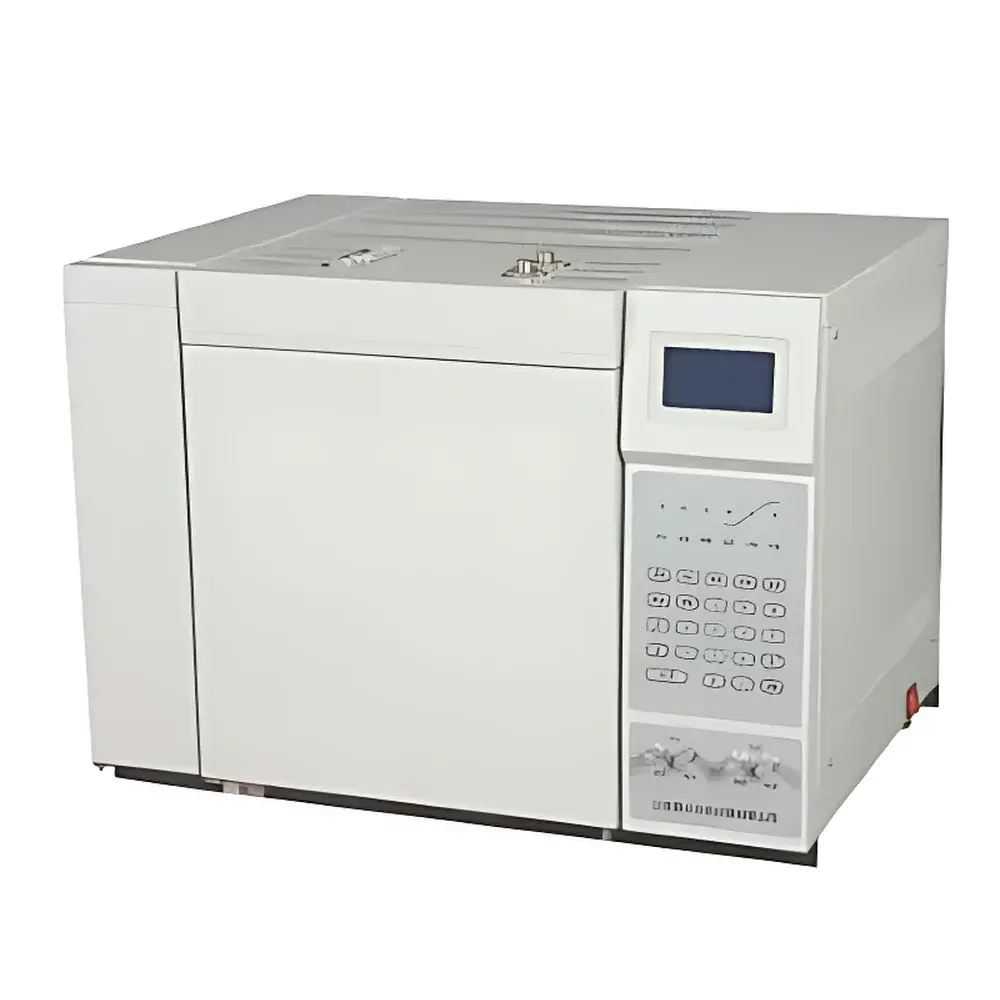
English Product Name
| Brand | Kyocera |
|---|---|
| Origin | Beijing, China |
| Manufacturer Type | Authorized Distributor |
| Instrument Category | Domestic (China-Made) |
| Model | SP6900 GC + JK-01 Auto-Headspace Sampler |
| Price Range | USD 7,000–14,000 |
| Primary Application | Residual Solvent Testing in Pharmaceutical APIs and Finished Dosage Forms |
| Detection Methods | Static Headspace GC-FID/TCD |
| Compliant With | USP <467>, ICH Q3C(R8), EP 2.4.24, ISO/IEC 17025 |
Overview
The Kyocera JK-01 Auto-Headspace Sampler coupled with the SP6900 Gas Chromatograph is a purpose-engineered analytical system for quantitative determination of residual organic solvents in pharmaceutical substances and products. Designed in full alignment with ICH Q3C(R8) and United States Pharmacopeia (USP) , this system implements static headspace sampling—where volatile analytes partition from the solid or liquid matrix into the gas phase above the sample at controlled temperature—followed by capillary or packed-column gas chromatographic separation and detection via Flame Ionization Detector (FID) or Thermal Conductivity Detector (TCD). The methodology eliminates labor-intensive liquid extraction or derivatization, reduces contamination risk, and delivers high reproducibility for Class 1 (e.g., benzene), Class 2 (e.g., methanol, ethanol, acetone, DMF), and Class 3 (e.g., ethanol, ethyl acetate) solvents. Its modular architecture supports method transfer across QC laboratories operating under GLP, GMP, or ISO/IEC 17025 quality systems.
Key Features
- Six independent temperature-controlled zones—including column oven, dual inlet ports, detector compartments, and auxiliary modules—enabling precise thermal management for complex multi-solvent methods.
- Column oven with five-segment programmable ramping (0.1–40 °C/min), operating range from ambient +5 °C to 400 °C, and temperature stability better than ±0.1 °C—critical for resolution of co-eluting solvents such as isopropanol and acetone.
- FID detection limit ≤1.0 × 10⁻¹¹ g/s and TCD sensitivity ≥4000 mV·mL/mg, supporting quantitation down to ICH Q3C permissible daily exposure (PDE) thresholds without preconcentration.
- JK-01 auto-headspace sampler featuring 12-position vial carousel, programmable sample heating (up to 180 °C, ±0.3 °C accuracy), valve oven and transfer line temperature control (±0.5 °C), and 1.0 mL fixed-loop injection—ensuring robust vapor-phase equilibration and minimal carryover.
- Full microprocessor-based control with backlit LCD interface, Chinese/English bilingual menu navigation, built-in self-diagnostic routines, and automatic shutdown on carrier gas failure or overtemperature events.
- Modular inlet configuration supporting both packed and fused-silica capillary columns; optional split/splitless, on-column, or gas sampling valves; and expandable detector bays for future ECD or NPD integration.
Sample Compatibility & Compliance
This system accommodates diverse pharmaceutical matrices—including active pharmaceutical ingredients (APIs), excipients, lyophilized powders, tablets, capsules, and sterile suspensions—without requiring solvent extraction or filtration. Sample vials are standard 10 mL or 20 mL crimp-top headspace vials with PTFE/silicone septa. All hardware and software functions adhere to regulatory expectations for data integrity: audit trails for method parameters and run logs, electronic signatures compliant with FDA 21 CFR Part 11 (when deployed with validated LIMS integration), and traceable calibration records per ISO/IEC 17025 requirements. Method validation documentation—including specificity, linearity (r² ≥0.999), LOD/LOQ, precision (RSD ≤5% for replicate injections), and robustness—can be generated using instrument-native reporting tools.
Software & Data Management
The SP6900 includes embedded chromatography data system (CDS) firmware supporting real-time peak integration, retention time locking, and customizable report templates aligned with pharmacopoeial formatting (e.g., USP Chapter Table 1 and Table 2). Raw data files (.dat or .cdf) are exportable in open formats compatible with third-party review platforms (e.g., OpenLab CDS, Chromeleon). The JK-01 sampler communicates via RS-232 or USB to synchronize timing with GC start commands, ensuring repeatable equilibration times and injection delays. All temperature setpoints, pressure parameters, and sequence logs are timestamped and stored locally with overwrite protection—facilitating internal audits and regulatory inspections.
Applications
- Quantitative analysis of residual solvents in API synthesis intermediates per ICH Q3C classification.
- Batch release testing of finished dosage forms including injectables, inhalers, and topical gels.
- Stability-indicating method development for forced degradation studies involving solvent-mediated hydrolysis or oxidation.
- Environmental monitoring of cleaning validation swab extracts in multiproduct manufacturing facilities.
- Academic and contract research organization (CRO) support for method transfer and interlaboratory comparison studies.
FAQ
Does this system meet USP and ICH Q3C(R8) requirements?
Yes—the hardware configuration, temperature precision, detection sensitivity, and headspace equilibration protocol are fully aligned with current pharmacopoeial monographs and regulatory guidance.
Can the SP6900 operate with both FID and TCD simultaneously?
Yes—its six-zone independent temperature control and dual-detector mounting capability allow concurrent FID/TCD operation for orthogonal confirmation of solvent identity and concentration.
Is method validation support included?
The instrument provides all necessary performance parameters (retention time repeatability, peak area RSD, baseline noise, detector response linearity) required for IQ/OQ/PQ and analytical method validation per ICH Q2(R2).
What maintenance intervals are recommended for routine operation?
Weekly septum replacement, monthly liner cleaning, quarterly detector optimization, and annual GC column reconditioning—documented in the included maintenance logbook and supported by Kyocera-certified field service engineers.
Is remote diagnostics available?
Yes—via secure Ethernet connection, authorized service personnel can initiate remote firmware updates, parameter verification, and fault-tree analysis while preserving local data sovereignty.




