
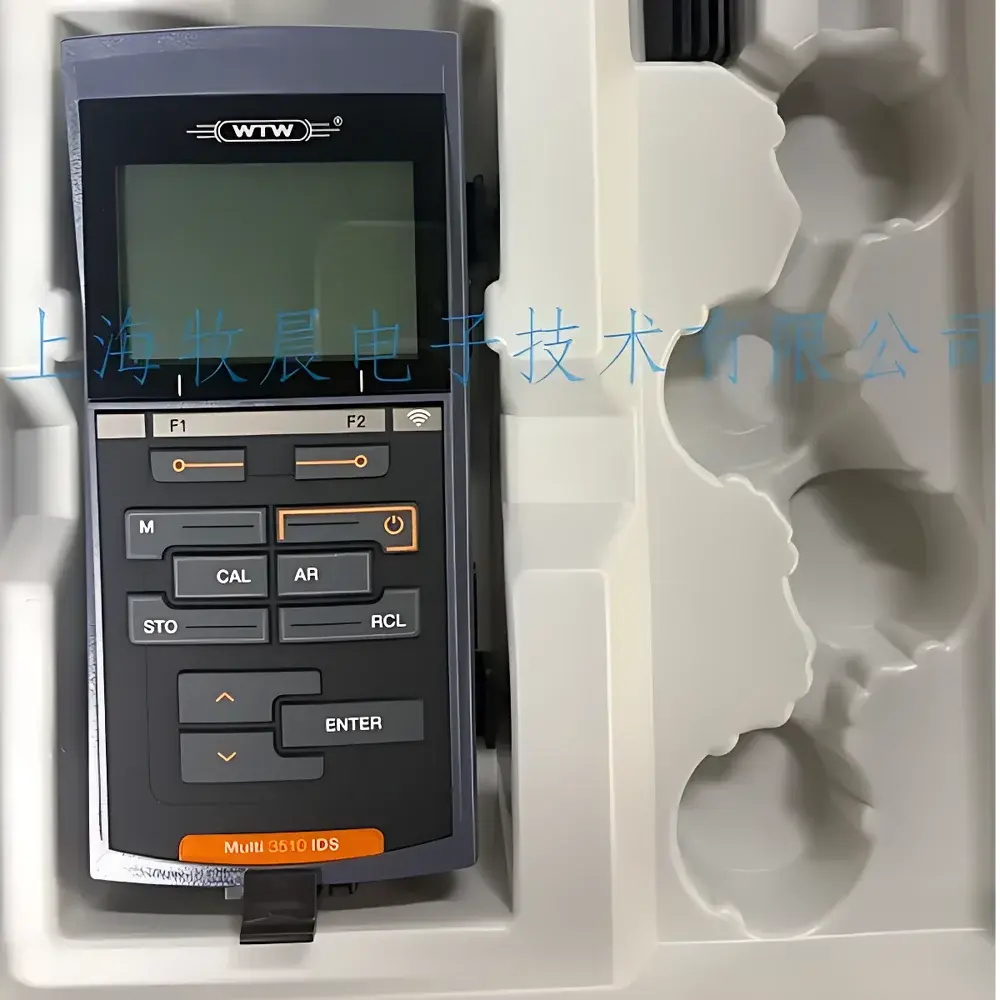
English Product Name
| Brand | WTW |
|---|---|
| Origin | Germany |
| Model | Multi 3510 IDS |
| Instrument Type | Portable / Handheld Water Quality Analyzer |
| Detection Principle | Electrochemical Sensing (pH, ORP, Conductivity, DO) & Optical Turbidity Measurement (Nephelometry) |
| Measured Parameters | pH, ORP, Dissolved Oxygen (DO), Oxygen Saturation (%), Partial Pressure of Oxygen (pO₂), Electrical Conductivity, Resistivity, Salinity, TDS, Turbidity (NTU/FNU) |
| Repeatability | <1% |
| Display | Graphical LCD |
| Data Storage | Up to 10,000 datasets (manual + automatic logging) |
| Protection Rating | IP67 |
| Power Supply | 4 × AA alkaline or 4 × 1.2 V NiMH rechargeable batteries |
| Interface | Micro-USB-B |
| Wireless Capability | Optional Bluetooth module for real-time probe telemetry |
| Probe Interface | Digital IDS (Intelligent Digital Sensor) interface with auto-recognition and embedded calibration memory |
Overview
The WTW Multi 3510 IDS is a field-deployable, intelligent multiparameter water quality analyzer engineered for high-reliability environmental monitoring in compliance with international water testing standards. Built on WTW’s proprietary IDS (Intelligent Digital Sensor) platform, the instrument operates via electrochemical transduction for pH, ORP, conductivity, and dissolved oxygen measurements — utilizing Clark-type optical fluorescence (FDO) for DO and robust glass/metal electrode architectures for pH and conductivity. Turbidity is measured using 860 nm LED nephelometry at 90° detection geometry, conforming to ISO 7027 and EPA Method 180.1. Its modular architecture supports single- or multi-probe configurations — including integrated deep-water MPP 910/930 IDS probes with pressure-compensated depth sensing up to 100 m — making it suitable for wastewater effluent monitoring, limnological surveys, marine outfall verification, landfill leachate characterization, and regulatory compliance sampling per ISO 5667, ASTM D1293, D3223, D5128, and EN 27888.
Key Features
- Digital IDS interface enabling plug-and-play recognition of all compatible sensors — no manual configuration required
- Embedded calibration memory within each probe: slope, offset, date, temperature coefficient, and sensor-specific calibration history are stored directly in the sensor electronics
- Graphical LCD display with intuitive menu navigation and real-time trend visualization for up to 3 parameters simultaneously
- IP67-rated enclosure ensuring operational integrity during immersion, rain exposure, or dusty field conditions
- Galvanically isolated analog front-end and shielded IDS cabling to eliminate ground-loop interference and ensure signal fidelity in electrically noisy environments (e.g., near pumps, inverters, or cathodic protection systems)
- Rechargeable NiMH battery pack with >100 hours of continuous operation; USB bus-powering enables extended use from portable power banks or lab bench supplies
- Micro-USB-B port supporting direct data export to PC, mass storage devices, or printers — compatible with WTW LabX software for audit-trail-enabled data management
- Optional Bluetooth 4.2 wireless module for live telemetry transmission to iOS/Android tablets or ruggedized field computers
Sample Compatibility & Compliance
The Multi 3510 IDS accommodates aqueous matrices across a broad physicochemical spectrum: freshwater (lakes, rivers, springs), wastewater (primary through tertiary effluents), brackish estuaries, seawater (up to 70 PSU), industrial process streams, and leachate from municipal landfills. All IDS probes comply with DIN EN ISO/IEC 17025 traceability requirements when used with certified reference materials. The FDO 925 optical DO sensor meets USP and EP 2.2.43 specifications for pharmaceutical water monitoring. Conductivity measurements adhere to ASTM D1125 and ISO 7888; turbidity readings satisfy ISO 7027 Class 1 performance criteria. Depth-compensated MPP 930 IDS operation includes automatic density and thermal expansion correction per IAPSO UNESCO algorithms — critical for accurate salinity and conductivity conversion in marine applications.
Software & Data Management
Data acquisition and post-processing are supported via WTW’s LabX Light software (Windows-based), which provides GLP-compliant electronic records including user authentication, full audit trail (per FDA 21 CFR Part 11), timestamped calibration logs, and customizable report templates aligned with ISO 17025 documentation requirements. Raw datasets export in CSV, PDF, or XML formats — compatible with LIMS integration. Field data can be synchronized wirelessly or via USB to secure network drives, enabling centralized QA/QC review by laboratory supervisors. Internal memory retains time-stamped measurement metadata: GPS coordinates (when paired with external GNSS receiver), operator ID, probe serial numbers, ambient temperature, atmospheric pressure, and calibration status flags.
Applications
- Regulatory field verification under EU Urban Waste Water Treatment Directive (91/271/EEC) and US Clean Water Act NPDES permitting
- In-situ profiling of stratified reservoirs and aquifers using MPP 930 IDS with depth-resolved DO/pH/conductivity/turbidity correlation
- Real-time monitoring of membrane bioreactor (MBR) influent/effluent quality during pilot-scale wastewater treatment trials
- Coastal zone management: salinity intrusion mapping, hypoxia event detection, and eutrophication assessment
- Drinking water distribution system integrity checks — rapid screening for chlorine residual interference, pipe corrosion indicators (ORP shifts), and particulate release (turbidity spikes)
- Environmental impact assessments (EIAs) for construction dewatering, dredging operations, or offshore wind farm installation
FAQ
Does the Multi 3510 IDS support GLP-compliant data handling?
Yes — when used with LabX Light software, the system enforces user login, electronic signatures, immutable audit trails, and calibration certificate linking per ISO/IEC 17025 and FDA 21 CFR Part 11 requirements.
Can IDS probes be calibrated in the field without connecting to a PC?
Yes — all calibration routines (single-/two-point pH, air/water DO, conductivity standardization) are fully executable on-device with guided prompts and real-time stability validation.
What is the maximum cable length supported for IDS probes?
The standard IDS cable length is 1.5 m, but extension cables up to 10 m are available with maintained signal integrity and temperature compensation accuracy.
Is the MPP 930 IDS suitable for long-term submerged deployment?
No — the MPP series is designed for intermittent profiling, not continuous mooring. For fixed-station applications, WTW recommends the IQ SENSOR NET platform with iSens probes and submersible junction boxes.
How does the instrument handle temperature compensation for conductivity in high-salinity samples?
The Multi 3510 IDS applies linear and non-linear (CaCl₂/NaCl-based) temperature compensation models selectable per sample type, with automatic salinity-driven algorithm switching above 10 mS/cm.







