
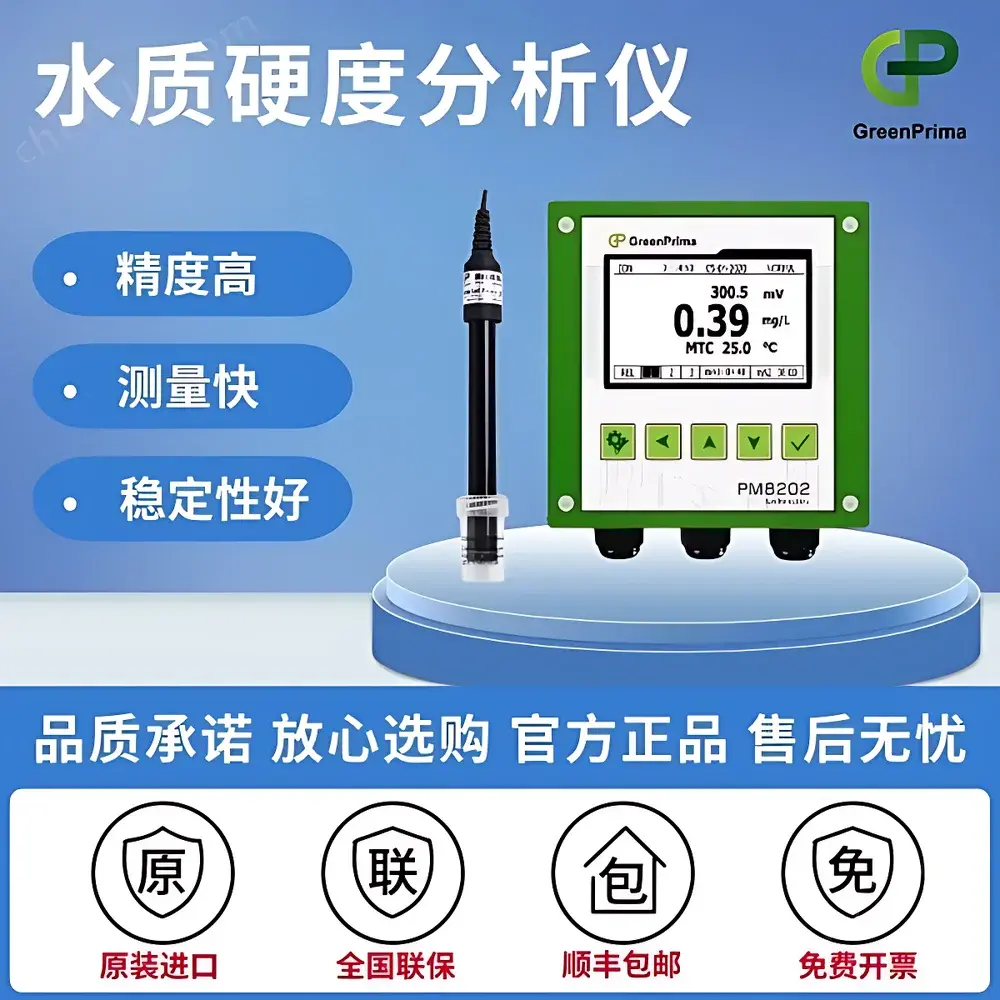
English Product Name
| Brand | GreenPrima |
|---|---|
| Origin | United Kingdom |
| Manufacturer Type | Original Equipment Manufacturer (OEM) |
| Import Status | Imported |
| Model | PM8202 I |
| Measurement Range | 0.00–20,000 ppm Ca²⁺ |
| Resolution | 0.0 / 0.1 / 1 ppm (selectable) |
| Accuracy | ±0.01 / ±0.1 / ±1 ppm (depending on range) |
| Temperature Compensation | –10 to 130 °C (manual or automatic |
| Operating Temperature | –10 to 70.0 °C |
| Storage Temperature | –20 to 70.0 °C |
| Display | Backlit large-dot-matrix LCD |
| Language Support | English & Chinese |
| Data Storage Capacity | 600,000 records |
| Power Supply | 90–260 VAC, 50/60 Hz or optional 24 VDC |
| Analog Outputs | Two isolated 4–20 mA outputs (max. loop resistance 500 Ω, accuracy ±0.1% FS, configurable for hardness or temperature) |
| Enclosure Rating | IP67-rated sealed housing |
| Electrode | BSENS740 calcium-selective electrode (solid-state, polymer membrane) |
Overview
The GreenPrima PM8202 I is a dedicated pharmaceutical-grade calcium hardness analyzer engineered for continuous, reagent-free monitoring of dissolved calcium ion concentration in ultrapure and process water systems. Unlike titrimetric or colorimetric methods, the PM8202 I employs potentiometric detection via a solid-state calcium-selective electrode (BSENS740), operating on the principle of ion activity measurement in aqueous solution under controlled ionic strength conditions. This electrochemical approach delivers stable, drift-resistant output with minimal calibration drift—critical for compliance with USP , EP 2.2.38, and ISO 8573-1 for pharmaceutical water quality assurance. Designed specifically for GMP-regulated environments, the instrument meets stringent requirements for traceability, environmental resilience, and long-term operational stability in clean utility systems including purified water (PW), water for injection (WFI), and steam condensate loops.
Key Features
- Calcium-selective electrode (BSENS740) with polymer membrane technology ensures high selectivity over magnesium, sodium, and potassium ions—reducing interference in low-conductivity pharmaceutical waters.
- IP67-rated, fully sealed enclosure with corrosion-resistant housing enables safe deployment in humid, washdown-prone areas such as cleanroom utilities corridors and HVAC condensate collection points.
- Configurable resolution (0.0 / 0.1 / 1 ppm) and multi-point accuracy specification support both low-level monitoring (e.g., ≤1 ppm in WFI) and broader-range applications (e.g., boiler feedwater up to 20,000 ppm).
- Integrated temperature compensation using either NTC30K or PT1000 sensors ensures accurate activity-to-concentration conversion across wide thermal gradients—from chilled PW distribution lines to hot condensate return streams.
- Dual isolated 4–20 mA analog outputs allow simultaneous transmission of calcium concentration and temperature data to DCS, SCADA, or LIMS platforms without signal crosstalk.
- Onboard data logging stores up to 600,000 timestamped records—including measured value, temperature, relay status, and system diagnostics—with export capability via USB or Modbus RTU (optional).
- Intuitive dual-language interface (English/Chinese) with backlit dot-matrix LCD supports rapid operator verification and alarm acknowledgment in multilingual manufacturing facilities.
Sample Compatibility & Compliance
The PM8202 I is validated for use with non-aggressive, low-turbidity aqueous matrices typical of pharmaceutical water systems: purified water (PW), water for injection (WFI), steam condensate, and clean-in-place (CIP) rinse water. It complies with key regulatory expectations for continuous water quality monitoring, including FDA Guidance for Industry: Process Validation (2011), EU Annex 1 (2022), and WHO Technical Report Series No. 970 (2012). The absence of chemical reagents, moving parts, or fluidic pathways eliminates risk of carryover, biofilm nucleation, or calibration drift associated with wet-chemistry analyzers—supporting ALCOA+ data integrity principles. Audit trail functionality (via external historian integration) satisfies 21 CFR Part 11 requirements when deployed with compliant software infrastructure.
Software & Data Management
While the PM8202 I operates autonomously via its embedded controller, it supports seamless integration into enterprise-level data ecosystems. Its RS485 port enables Modbus RTU communication for real-time parameter readout and configuration updates. Logged data can be retrieved via USB mass storage mode for offline trend analysis in Excel or statistical process control (SPC) tools. When connected to a validated historian (e.g., Siemens Desigo CC, Rockwell FactoryTalk Historian), the device contributes to electronic batch records and deviation investigations. All stored entries include UTC timestamps, sensor ID, and system event flags—enabling full traceability per GAMP 5 Category 3 software classification.
Applications
- Real-time calcium hardness surveillance in PW/WFI distribution loops to detect resin exhaustion or pretreatment failure.
- Monitoring of steam condensate return lines for scale precursor ingress in autoclave and SIP systems.
- Verification of rinse water quality during CIP validation cycles for bioreactors and filling lines.
- Supporting root cause analysis during OOS events related to particulate formation or filter fouling.
- Supplemental monitoring in HVAC humidification systems where calcium scaling compromises sterile air quality.
FAQ
Does the PM8202 I require daily calibration or frequent maintenance?
No. The BSENS740 electrode exhibits <1% drift per month under typical pharmaceutical water conditions and requires only quarterly verification against NIST-traceable calcium standards. No reagents, pumps, or tubing are involved.
Can the instrument operate in high-purity water with conductivity below 1 µS/cm?
Yes—when used with optional ionic strength adjuster (ISA) solution dosing or paired with a conductivity-based activity correction algorithm (available via firmware update).
Is the analog output certified for SIL2 applications?
The 4–20 mA outputs meet IEC 61508 functional safety requirements at SIL2 when integrated within a certified safety instrumented system (SIS); documentation package available upon request.
How is temperature compensation implemented?
Automatic compensation uses either factory-calibrated NTC30K or user-supplied PT1000 sensors, applying the extended Debye-Hückel equation to convert measured potential to activity-corrected concentration.
What cybersecurity protocols does the device support?
The base model features no network connectivity. Optional Ethernet module (PM-ETH-01) supports TLS 1.2 encrypted Modbus TCP and includes configurable firewall rules, MAC address filtering, and disabled default credentials—aligned with IEC 62443-3-3 Level 1 requirements.





