
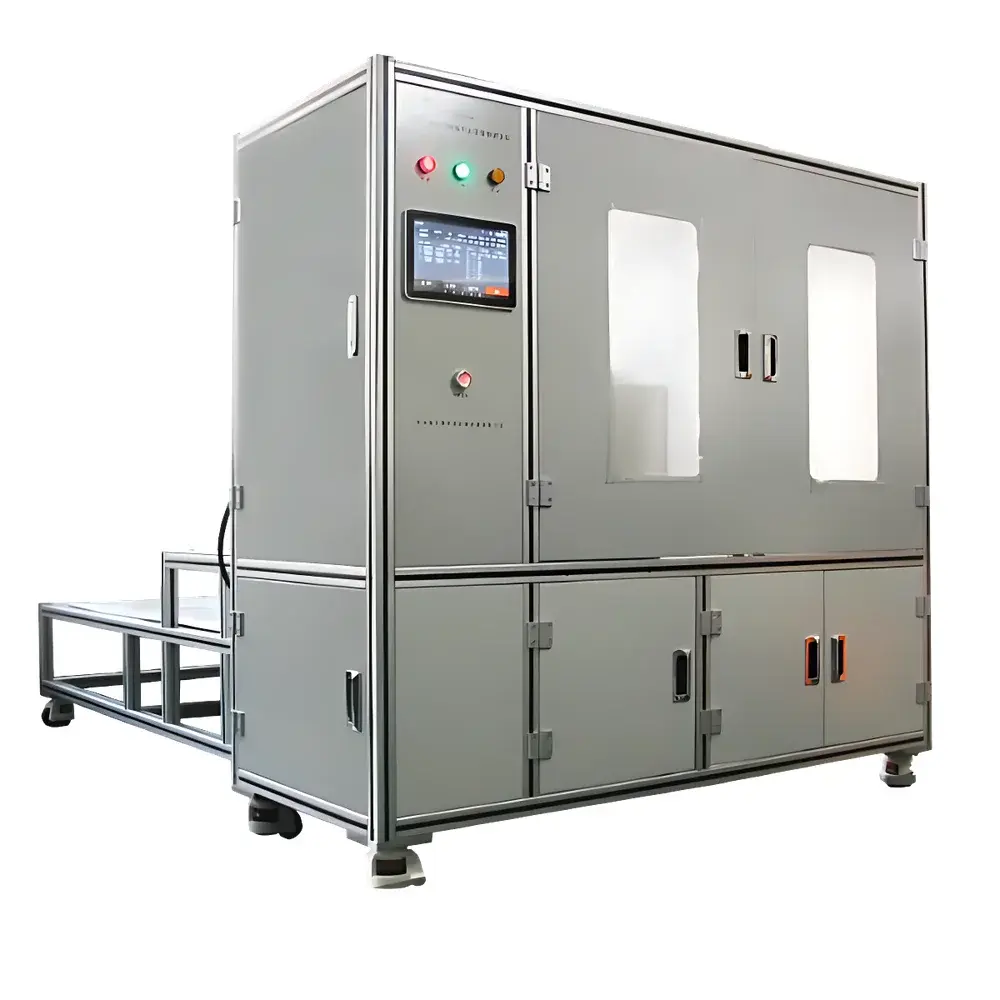
English Product Name
| Brand | Fuland (csfriend) |
|---|---|
| Origin | Hunan, China |
| Model | FDY-0808 |
| Application Category | Laboratory Instrument for EV Thermal Management Fluid Evaluation |
| Compliance Standard | GB/T 29743.2 Annex C |
| Temperature Range | 0–100 °C (±1 °C accuracy) |
| Flow Rate | ≥30 L/min (adjustable, resolution 0.1 L/min) |
| Pressure Range | 0–500 kPa |
| Maximum Runtime | 9999 h (programmable, supports 1064 h continuous test cycles) |
| Data Storage Capacity | >200 test records |
| Pump Type | High-Temperature Automotive Electronic Water Pump (head ≥11 m, inlet/outlet diameter 20 mm) |
| Test Components | Aluminum Battery Cold Plate (≥1 m²), Aluminum Motor Housing with Integrated Cooling Channels, Aluminum Electronic Control Cooling Module |
| Fluid Path Material | Stainless Steel Fittings with Visual Observation Window |
| Thermal Insulation | Multi-layer External Jacket (reduces surface temperature & external thermal radiation) |
Overview
The Fuland FDY-0808 Electric Vehicle Coolant Circulation Corrosion Test Rig is a purpose-built laboratory system engineered to simulate and accelerate corrosion mechanisms in electric vehicle (EV) thermal management circuits under controlled, dynamic flow conditions. Unlike static immersion tests, this rig replicates real-world coolant circulation dynamics—including variable flow rates, pressure gradients, and sustained elevated temperatures—enabling quantitative assessment of material compatibility between coolants and critical aluminum-based components (e.g., battery cold plates, motor housings, power electronics cooling modules). The system operates on a closed-loop recirculation principle, maintaining precise thermal and hydraulic boundary conditions per GB/T 29743.2 Annex C, the Chinese national standard for evaluating corrosion resistance of coolants used in new-energy vehicle cooling systems. Its architecture integrates fluid mechanics, electrochemical interface monitoring, and long-duration reliability testing into a single platform suitable for R&D laboratories, OEM validation centers, and coolant formulation houses requiring ISO/IEC 17025-aligned test reproducibility.
Key Features
- Programmable PID temperature control with auto-tuning capability and over-temperature cut-off protection (±1 °C stability across 0–100 °C range)
- High-fidelity flow regulation via automotive-grade electronic water pump (≥30 L/min at ≥11 m head; flow adjustable in 0.1 L/min increments)
- Integrated multi-parameter real-time display: temperature, system pressure (0–500 kPa), volumetric flow rate, and elapsed runtime
- Automated sequence control: programmable start/stop cycles up to 9999 hours; pre-configured 1064-hour test protocol compliant with GB/T 29743.2 Annex C
- Stainless steel fluid path with optical observation window for in-situ visual monitoring of coolant clarity, particulate formation, and color degradation
- Thermally insulated reservoir housing using low-conductivity composite jacketing—limits external surface temperature rise and minimizes radiative heat transfer
- Touchscreen HMI with intuitive workflow navigation; supports user-defined test profiles and parameter logging
- Onboard data storage (>200 test records) with timestamped temperature, pressure, and flow metadata for traceability
Sample Compatibility & Compliance
The FDY-0808 accommodates standardized aluminum alloy test specimens (e.g., AA3003, AA6061) mounted within its dedicated cold plate (≥1 m² active surface), motor housing, and electronic control module fixtures—all fabricated from high-purity aluminum with precisely machined internal coolant channels. It supports evaluation of ethylene glycol–water, propylene glycol–water, and organic acid technology (OAT) formulations under flowing conditions. The system is explicitly validated against GB/T 29743.2 Annex C, which defines accelerated corrosion test methodology for EV coolants, including prescribed flow velocity, temperature ramp profiles, and exposure duration. While not certified to ASTM D1384 or ISO 8502-8, its operational envelope aligns with key parameters referenced in those standards for copper/aluminum corrosion screening in circulating aqueous systems. All structural wetted parts comply with ISO 8501-1 surface preparation requirements prior to test initiation.
Software & Data Management
The embedded firmware provides non-volatile storage of ≥200 complete test sessions, each retaining time-stamped readings from all sensors (temperature, pressure, flow). Data export is supported via USB interface in CSV format for post-processing in third-party analysis tools (e.g., MATLAB, Python Pandas, or LIMS platforms). The system logs operator-initiated events (e.g., manual sample injection, emergency stop) with timestamps, satisfying basic GLP documentation requirements. Though not natively 21 CFR Part 11 compliant, audit trail functionality can be extended via external PC-based acquisition software when connected via RS-485 or Ethernet (optional interface module). Firmware updates are performed offline using signed binary files to ensure integrity and version control.
Applications
- Accelerated corrosion screening of next-generation EV coolants against aluminum alloys used in battery thermal plates
- Validation of inhibitor package efficacy under dynamic thermal cycling and shear stress
- Comparative evaluation of coolant aging behavior—pH drift, conductivity change, precipitate formation—under flow-induced oxidation
- Supporting OEM specification development (e.g., GB/T 29743 series, LV-124, GMW16600)
- Quality assurance testing for coolant batch release in manufacturing environments
- Research into galvanic coupling effects between dissimilar metals (e.g., Al/Cu joints) in multi-material cooling loops
FAQ
Does the FDY-0808 support automated data export to LIMS?
Yes—via USB mass storage mode, CSV-formatted datasets (including sensor timestamps and values) can be transferred for integration into laboratory information management systems.
Can test parameters be modified beyond the default 1064-hour cycle?
Absolutely—the programmable timer allows custom runtime configuration from 1 minute to 9999 hours, enabling flexibility for proprietary or extended durability protocols.
Is the aluminum cold plate customizable in size or geometry?
The standard unit includes a ≥1 m² flat-plate configuration per GB/T 29743.2; custom geometries (e.g., serpentine channels, finned surfaces) are available as OEM options upon request.
What maintenance intervals are recommended for the electronic water pump?
Fuland specifies 500 hours of continuous operation or 12 months (whichever occurs first) for pump inspection, bearing lubrication, and impeller clearance verification per the manufacturer’s service manual.
How is calibration traceability maintained for temperature and pressure sensors?
Each unit ships with factory calibration certificates referencing NIM (National Institute of Metrology, China) standards; field recalibration is supported using external Class A PT100 probes and deadweight pressure testers.
Related Products





