
English Product Name
| Brand | Jihepu |
|---|---|
| Origin | Shandong, China |
| Model | DLSB-20/20 |
| Temperature Range | −20 °C to ambient |
| Ambient Operating Conditions | 5–35 °C, ≤70% RH |
| Power Supply | 220 V AC / 50 Hz |
| Cooling Capacity | 3486 W |
| Compressor Power | 1103 W (1.5 HP) |
| Circulation Pump Power | 100 W |
| Flow Rate | 20–40 L/min |
| Head | 4–6 m |
| Max Pressure | ≤0.4 MPa |
| Tank Volume | ~21 L (Φ300 × 300 mm) |
| Control Accuracy | ±0.1 °C |
| Sensor Type | PT100 |
| Display | LCD with keypad interface |
| Refrigerant | R22 |
| Condenser | Air-cooled, 129 W, 11 m² heat exchange area, 2290 m³/h airflow |
| Cabinet Material | Powder-coated cold-rolled steel |
| Net Weight | 83 kg |
| Dimensions (W×D×H) | 590 × 670 × 975 mm (+500 mm vertical support rod) |
| Packaging | Wooden crate, 725 × 590 × 1120 mm, 110 kg |
Overview
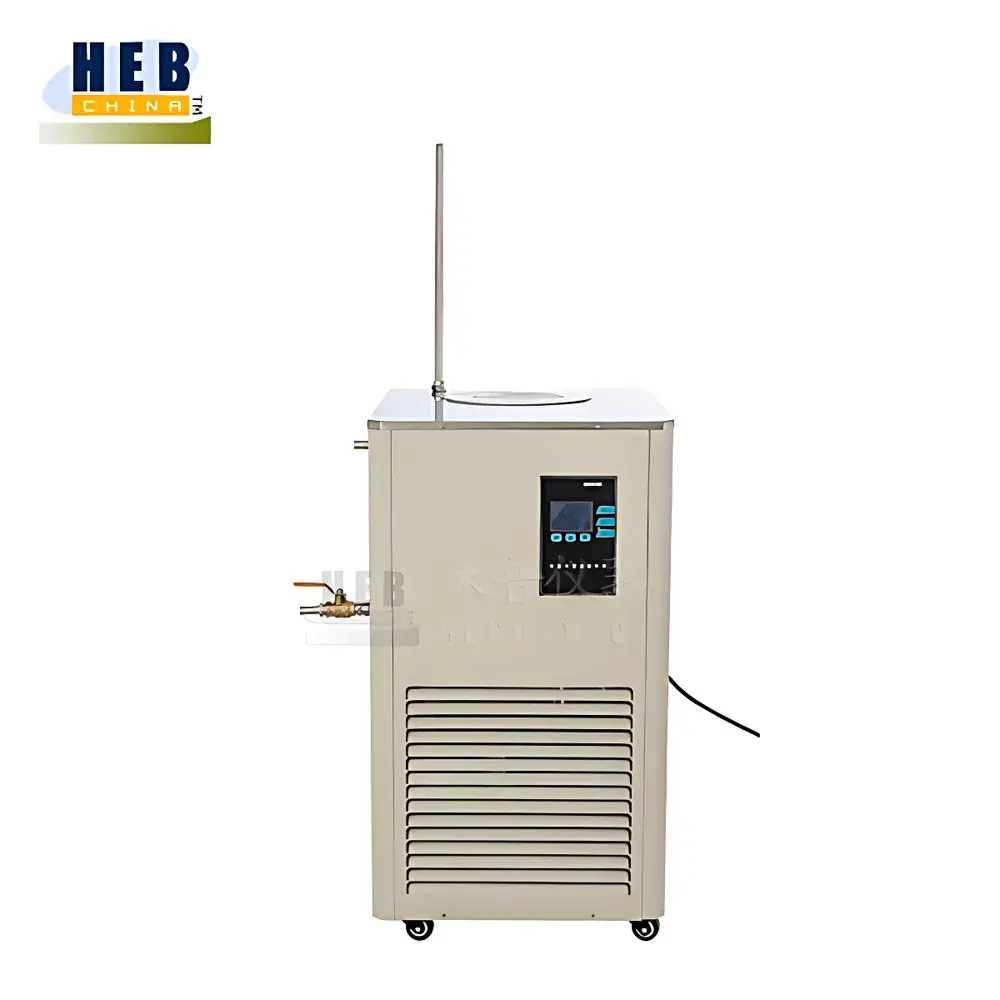
The Jihepu DLSB-20/20 Low-Temperature Circulating Chiller is a self-contained, air-cooled refrigeration system engineered for precise thermal management in laboratory-scale chemical synthesis, distillation, and condensation applications. It operates on the vapor-compression cycle using R22 refrigerant, circulating chilled fluid through an internal evaporator coil embedded in the stainless-steel-lined reservoir. A high-efficiency hermetic compressor (1.5 HP) drives refrigerant flow across a finned-tube air-cooled condenser (11 m² surface area, 2290 m³/h airflow), enabling stable operation at setpoints as low as −20 °C. The unit integrates a robust centrifugal circulation pump (20–40 L/min, 4–6 m head) with pressure-regulated output (≤0.4 MPa) and dual external ports—intake and return—for seamless integration into closed-loop systems such as jacketed reactors, rotary evaporators, and reflux condensers. Its temperature control architecture employs a PT100 platinum resistance thermometer coupled with PID logic, delivering ±0.1 °C stability under steady-state conditions. Designed for continuous duty in controlled indoor environments (5–35 °C, ≤70% RH), the chiller complies with IEC 61000-6-3 (EMC emissions) and IEC 61000-6-2 (immunity) standards.
Key Features
- Stable low-temperature operation from −20 °C to ambient, optimized for exothermic reaction control and solvent condensation
- Integrated 21 L reservoir with nickel-plated copper cooling coil (Φ12 mm) and corrosion-resistant powder-coated steel housing
- High-capacity air-cooled condenser with forced-air circulation (2290 m³/h) ensures consistent performance without external water supply
- LCD interface with tactile keypad enables intuitive setpoint entry, real-time monitoring of bath temperature, and status alerts for overcurrent, overheating, and compressor delay protection
- Dual 16 mm OD bayonet-style external ports (left-side intake, top return) facilitate rapid connection to jacketed vessels or condenser coils using standard silicone or fluoropolymer tubing
- Modular mechanical design supports benchtop or floor-standing configuration via optional vertical support rod (500 mm extension)
Sample Compatibility & Compliance
The DLSB-20/20 is compatible with common laboratory heat-transfer fluids including aqueous ethylene glycol solutions (20–50% v/v), silicone oils, and low-viscosity mineral oils—provided fluid compatibility with nickel-plated copper and EPDM seals is verified. It is not intended for use with flammable, corrosive, or particulate-laden media. The unit meets CE marking requirements for electrical safety (EN 61010-1) and electromagnetic compatibility (EN 61326-1). While not certified for GMP or FDA 21 CFR Part 11 environments, its analog control architecture and non-networked operation allow straightforward validation under GLP frameworks where audit trails are manually documented. All safety interlocks—including compressor thermal cutoff, motor overcurrent sensing, and delayed restart logic—are hardwired per EN 60204-1.
Software & Data Management
This model features standalone analog-digital hybrid control with no embedded firmware or network connectivity. Temperature logging requires external data acquisition via 0–5 V or 4–20 mA analog output (optional accessory). No proprietary software is supplied; users may integrate the chiller into SCADA or LIMS platforms using third-party DAQ hardware and open protocols (e.g., Modbus RTU via RS-485 adapter). Calibration records for the PT100 sensor and controller offset must be maintained per ISO/IEC 17025 guidelines when used in accredited testing laboratories.
Applications
- Temperature control of double-jacketed glass reactors during Grignard, lithiation, or nitration reactions
- Cooling condenser coils in rotary evaporation systems operating with low-boiling solvents (e.g., diethyl ether, dichloromethane)
- Maintaining sub-ambient bath temperatures for crystallization studies and polymer precipitation
- Providing auxiliary cooling to HPLC column ovens, spectrophotometer Peltier elements, or laser sources requiring thermal stabilization
- Direct immersion cooling of small-volume reaction vessels or analytical sample holders within the reservoir (max Φ250 mm diameter)
FAQ
What is the minimum recommended coolant viscosity for stable pump operation?
For optimal flow consistency and bearing lubrication, use fluids with kinematic viscosity below 50 cSt at the operating temperature. Glycol/water mixtures up to 50% concentration are validated.
Can this chiller be operated in a fume hood?
Yes—provided ambient temperature remains within 5–35 °C and airflow does not impede condenser heat dissipation. Avoid placement directly upstream of exhaust baffles.
Is R22 refrigerant serviceable under current environmental regulations?
R22 is subject to phase-out under the Montreal Protocol. Service technicians must hold Section 608 certification (EPA or equivalent) and use reclaimed or stockpiled R22; retrofitting to R404A or R407C requires compressor and oil compatibility verification.
Does the unit include a filtration system for the circulating fluid?
No built-in filter is provided. Users should install an in-line 5–10 µm particulate filter in the external loop if using reused or non-distilled coolants.
What is the expected service interval for compressor oil maintenance?
Under continuous operation at rated load, inspect oil level and clarity every 12 months; replace oil and drier cartridge after 3 years or 6000 operating hours, whichever occurs first.



