
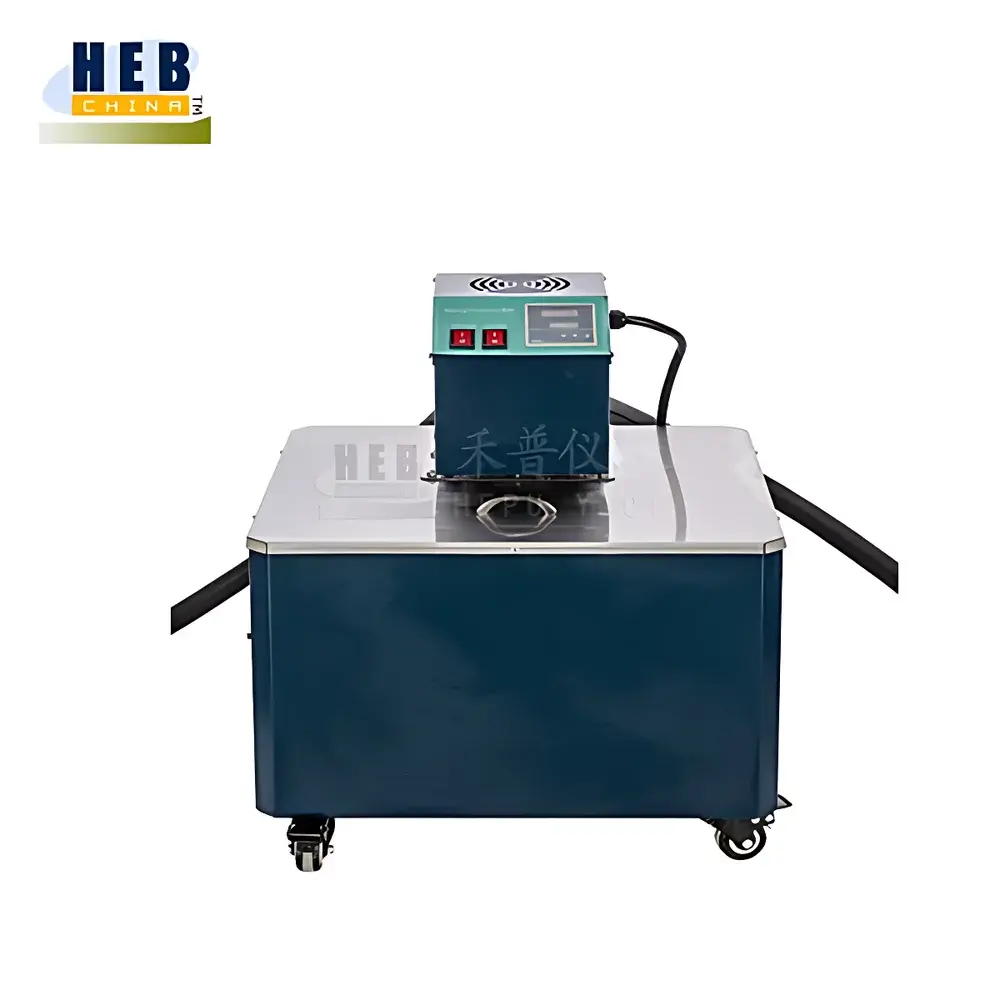
English Product Name
| Brand | JIHEPU |
|---|---|
| Origin | Shandong, China |
| Model | GY-50 |
| Bath Volume | 50 L |
| Temperature Range | 0–300 °C |
| Temperature Stability | ±1 °C |
| Circulation Type | Internal & External |
| Heating Power | 5 kW |
| Pump Flow Rate | 5–10 L/min |
| Pump Head | 8–12 m |
| Pump Power | 120 W |
| Sensor Type | PT100 |
| Display | Digital LCD |
| Construction | 304 Stainless Steel (Monolithic Inner Tank + Insulated Cavity) |
| Dimensions (W×D×H) | 630 × 500 × 630 mm |
| Net Weight | 36 kg |
Overview
The JIHEPU GY-50 High-Temperature Circulating Oil Bath is a precision-engineered thermal management system designed for sustained, uniform heating and external circulation of heat-transfer media—primarily silicone oil or high-temperature synthetic oils—in laboratory and pilot-scale chemical synthesis environments. Operating on the principle of forced convection via an integrated centrifugal circulation pump, the GY-50 delivers stable thermal energy across a wide operational range (0–300 °C), making it functionally compatible with jacketed glass reactors (e.g., double-layer borosilicate vessels), stainless steel or enamel-coated reaction kettles (30–50 L capacity), and other externally heated process equipment requiring precise jacket temperature control. Its monolithic 304 stainless steel construction—featuring a seamless inner tank and thermally insulated cavity—minimizes heat loss, enhances thermal retention efficiency, and ensures long-term structural integrity under repeated thermal cycling. Unlike open-bath configurations, the GY-50’s closed-loop design eliminates evaporative loss and oil degradation at elevated temperatures while maintaining leak-free operation up to maximum rated conditions.
Key Features
- Monolithic 304 stainless steel tank fabricated via deep-drawing process—no weld seams in contact zone, reducing corrosion risk and enabling rigorous cleaning protocols.
- Dual-mode circulation architecture supporting both internal recirculation (for bath homogeneity) and external loop delivery (for reactor jacket integration) via standardized 1/2″ BSP female threaded ports.
- High-power 5 kW heating element with optimized surface load distribution—enabling rapid ramp rates without localized overheating or thermal shock to the bath medium.
- PT100 Class A platinum resistance thermometer embedded in direct thermal contact with the oil mass—providing traceable, NIST-referenced temperature feedback to the PID controller.
- Intelligent digital temperature controller with LCD interface—supporting setpoint programming, real-time deviation monitoring, and over-temperature safety cutoff (hardware-limited at 310 °C).
- Integrated low-cavitation, high-temperature-rated circulation pump (120 W, 5–10 L/min flow, 8–12 m head)—rated for continuous operation at 300 °C using compatible synthetic heat-transfer fluids.
Sample Compatibility & Compliance
The GY-50 is engineered for compatibility with standard laboratory-grade heat-transfer oils meeting ASTM D4692 (Specifications for Synthetic Heat Transfer Fluids) and ISO 6743-12 (L-QB class). It supports jacketed reactor systems conforming to ISO 14040 (Life Cycle Assessment of Lab Equipment) and meets basic mechanical safety requirements per IEC 61010-1:2010 (Safety Requirements for Electrical Equipment for Measurement, Control, and Laboratory Use). While not certified for explosion-proof or hazardous-area use, its grounded chassis, double-insulated heating elements, and thermal cut-off relay provide protection against common electrical and thermal hazards encountered in non-classified lab environments. The unit complies with CE marking directives for electromagnetic compatibility (2014/30/EU) and low-voltage safety (2014/35/EU) when operated within specified ambient conditions (5–40 °C, <80% RH non-condensing).
Software & Data Management
The GY-50 operates as a standalone analog/digital hybrid instrument without embedded data logging or network connectivity. Temperature setpoints, real-time readings, and alarm status are displayed locally via the front-panel LCD. For integration into GLP/GMP-compliant workflows, optional RS485 Modbus RTU output (available upon request) enables connection to external SCADA or LIMS platforms for time-stamped temperature acquisition, audit trail generation, and remote supervision. When used in regulated environments, users are advised to implement manual logbook entries or third-party dataloggers compliant with FDA 21 CFR Part 11 requirements for electronic records and signatures.
Applications
- Temperature control of jacketed glass reactors during exothermic/endothermic organic synthesis (e.g., Grignard reactions, Friedel-Crafts acylation, hydrogenation).
- Pre-heating and thermal conditioning of catalyst slurries prior to introduction into fixed-bed or slurry-phase reactors.
- Calibration support for high-temperature viscosity measurements using rotational rheometers equipped with environmental chambers.
- Thermal aging studies of polymeric materials, adhesives, and coatings under controlled isothermal exposure (per ASTM D573 or ISO 188).
- Supporting distillation, reflux, and extraction processes requiring stable bath temperatures above 100 °C—where water baths are thermally inadequate.
FAQ
What types of heat-transfer fluids are recommended for use with the GY-50?
Silicone-based oils (e.g., Dow Corning 200 Fluid series) or aromatic synthetic heat-transfer fluids meeting ISO-L-QB specifications are recommended. Mineral oils are not advised above 200 °C due to oxidation and coking risks.
Can the GY-50 be used with water as the bath medium?
No. The GY-50 is specifically engineered for high-temperature oil circulation. Water is incompatible above 100 °C at ambient pressure and poses severe safety and corrosion risks in this configuration.
Is external temperature calibration possible?
Yes. The PT100 sensor is accessible for periodic verification using a calibrated reference thermometer traceable to national standards (e.g., NIST SRM 1750). Calibration procedures follow ISO/IEC 17025 guidelines for in-house equipment verification.
What maintenance intervals are recommended for the circulation pump?
Inspect pump seals and impeller clearance every 500 operating hours; replace high-temp fluorocarbon seals annually or after 2000 hours of cumulative use at >250 °C.
Does the GY-50 include over-temperature protection?
Yes. A redundant bimetallic thermal cut-off switch (independent of the main controller) interrupts power at 310 °C, providing fail-safe protection against uncontrolled thermal runaway.



