
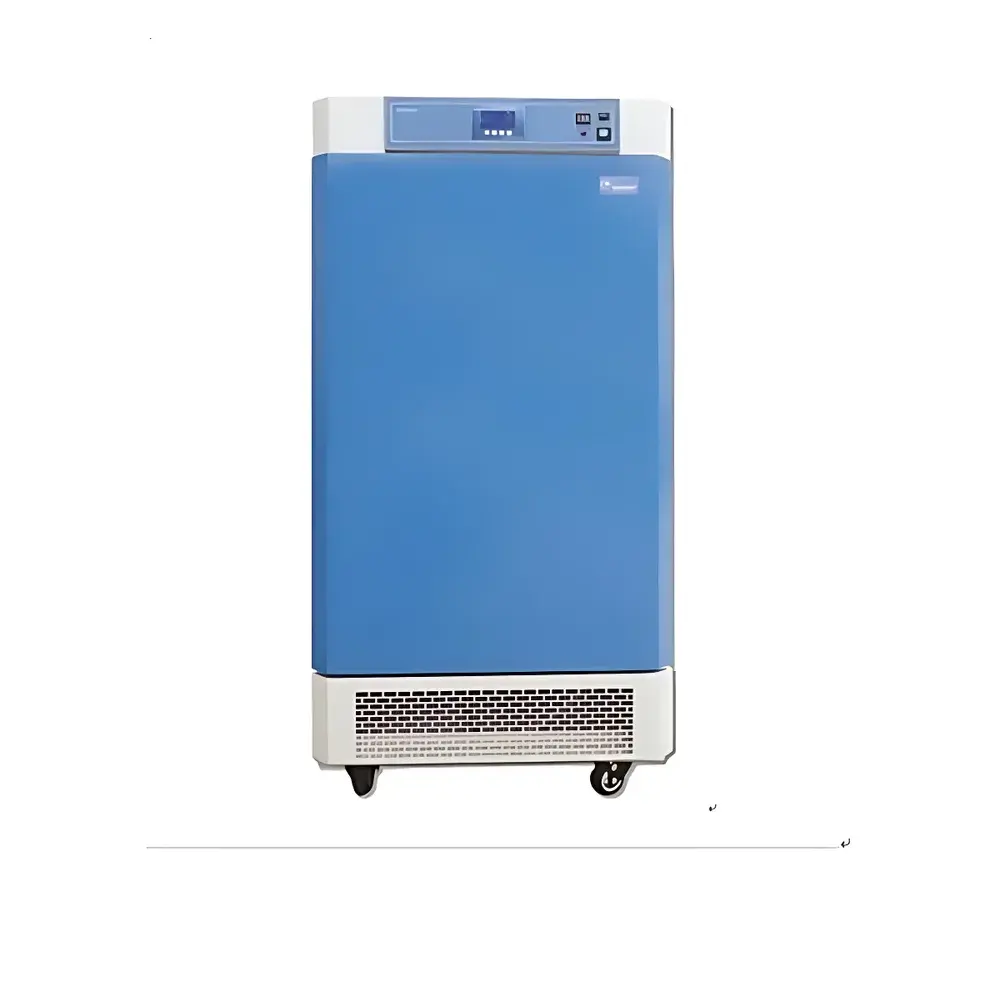
English Product Name
| Brand | Jihepu |
|---|---|
| Origin | Shandong, China |
| Model | KRG-300A |
| Temperature Range (Dark) | 0–50 °C |
| Temperature Range (Illuminated) | 10–50 °C |
| Temperature Resolution | 0.1 °C |
| Temperature Uniformity | ±2.0 °C |
| Temperature Stability (Fluctuation) | ±1.0 °C |
| Illuminance Range | 0–12,000 lx (5-level adjustable) |
| Chamber Volume | 300 L |
| Interior Dimensions (W×D×H) | 525 × 670 × 1140 mm |
| Exterior Dimensions (W×D×H) | 840 × 880 × 1850 mm |
| Standard Shelving | 4 trays |
| Power Supply | AC 220 V, 50 Hz |
| Control System | PID-based microprocessor (CPU) with power-failure memory |
| Humidity Management | Drain-free water recirculation system |
| Safety Features | Over-temperature alarm, upper-limit temperature cutoff, refrigeration pressure-balanced control |
Overview
The Jihepu KRG-300A Plant Growth Chamber is a precision-engineered environmental control system designed for reproducible, long-term plant cultivation and physiological studies under tightly regulated photoperiodic and thermal conditions. It operates on a dual-mode thermoregulation principle: in darkness, the chamber maintains temperatures from 0 °C to 50 °C; under active illumination, the operational range shifts to 10 °C–50 °C to prevent radiant heating interference from internal light sources. The chamber employs a closed-loop PID control algorithm executed by an embedded CPU microprocessor, continuously monitoring ambient temperature and dynamically modulating compressor duty cycle and heater output. Refrigeration is managed via a pressure-balanced system that enhances thermal efficiency while minimizing energy consumption—critical for multi-week experiments requiring uninterrupted operation. Constructed with high-stability stainless-steel interior walls and insulated double-glass observation windows, the KRG-300A ensures minimal thermal leakage and consistent irradiance distribution across its 300 L working volume.
Key Features
- PID-controlled microprocessor system with real-time temperature logging and automatic refrigeration load modulation based on ambient thermal feedback
- Drain-free humidity management architecture utilizing recirculated condensate—eliminates external plumbing and supports GLP-compliant lab hygiene protocols
- Five-step programmable illuminance control (0–12,000 lx), delivered via high-efficiency LED or fluorescent lamp arrays optimized for photosynthetically active radiation (PAR) spectrum fidelity
- Power-failure memory function retains setpoints, ramp profiles, and current operational state—ensuring experimental continuity after grid interruption
- Over-temperature protection circuitry with independent hardware limiter (non-software-dependent) and audible/visual alarm activation
- Reinforced structural design featuring corrosion-resistant interior surfaces, reinforced shelving supports rated for uniform 15 kg loading per tray, and vibration-dampened compressor mounting
Sample Compatibility & Compliance
The KRG-300A accommodates standard plant growth vessels—including Petri dishes, Magenta boxes, tissue culture jars, and hydroponic trays—across four adjustable stainless-steel shelves. Its interior geometry (525 × 670 × 1140 mm) allows vertical stacking of multi-tiered seedling racks without compromising airflow or light penetration. The chamber meets fundamental safety requirements per IEC 61010-1 (Laboratory Equipment) and incorporates electrical grounding, thermal cutouts, and insulated wiring conforming to GB 4793.1–2007 (Chinese national standard equivalent to IEC 61010-1). While not certified to UL or CE for export markets without local validation, its control architecture supports audit-ready data integrity when integrated with external validation protocols aligned with ISO/IEC 17025 or FDA 21 CFR Part 11 (via optional RS-485 or Ethernet data export modules).
Software & Data Management
The onboard controller provides local parameter configuration via a backlit LCD interface with tactile keypad navigation. All temperature and illumination settings—including ramp rates, dwell times, and daily photoperiod schedules—are stored in non-volatile memory. Optional PC connectivity (RS-232/RS-485) enables remote monitoring and CSV-formatted data export for traceability. When paired with validated third-party software (e.g., LabVIEW-based acquisition or custom Python scripts), the system supports time-synchronized logging at user-defined intervals (1 s to 60 min), generating timestamped datasets suitable for regulatory submission under GxP frameworks. Audit trails—including operator ID, parameter changes, alarm events, and power-cycle timestamps—are retained for ≥30 days unless manually cleared.
Applications
- Controlled-environment phenotyping of crop genotypes under defined photothermal regimes
- In vitro propagation and callus induction in horticultural and medicinal plant tissue culture
- Seed germination kinetics and stress-response assays (e.g., heat, cold, or light deprivation)
- Pre-clinical stability testing of botanical extracts and phytopharmaceutical intermediates
- Microbial co-culture studies involving light-sensitive symbionts (e.g., cyanobacteria–plant root interactions)
- Curriculum-based plant physiology instruction in university teaching laboratories
FAQ
What is the maximum sustained illuminance level achievable inside the KRG-300A?
The chamber delivers up to 12,000 lux at shelf level under full illumination, calibrated using a NIST-traceable lux meter at center-point measurement under standard operating conditions (25 °C, 50% RH, empty chamber).
Does the unit support independent humidity control?
No—the KRG-300A regulates relative humidity indirectly via temperature-driven condensation and recirculation; it does not feature active humidification or dehumidification subsystems.
Can the lighting spectrum be customized for specific research needs?
Standard configurations use broad-spectrum white LEDs; narrowband red/blue or UV-A modules are available as factory-installed options upon request, subject to optical recalibration and irradiance mapping verification.
Is validation documentation provided with the instrument?
A Factory Acceptance Test (FAT) report is included, listing as-tested temperature uniformity, illuminance homogeneity, and controller response latency. IQ/OQ protocol templates compatible with ISO 9001 and WHO TRS Annex 11 are available upon request.
What maintenance intervals are recommended for long-term reliability?
Compressor oil and refrigerant levels should be verified annually; air intake filters require cleaning every 90 days; door gasket integrity and sensor calibration should be assessed semiannually per internal SOPs.




