
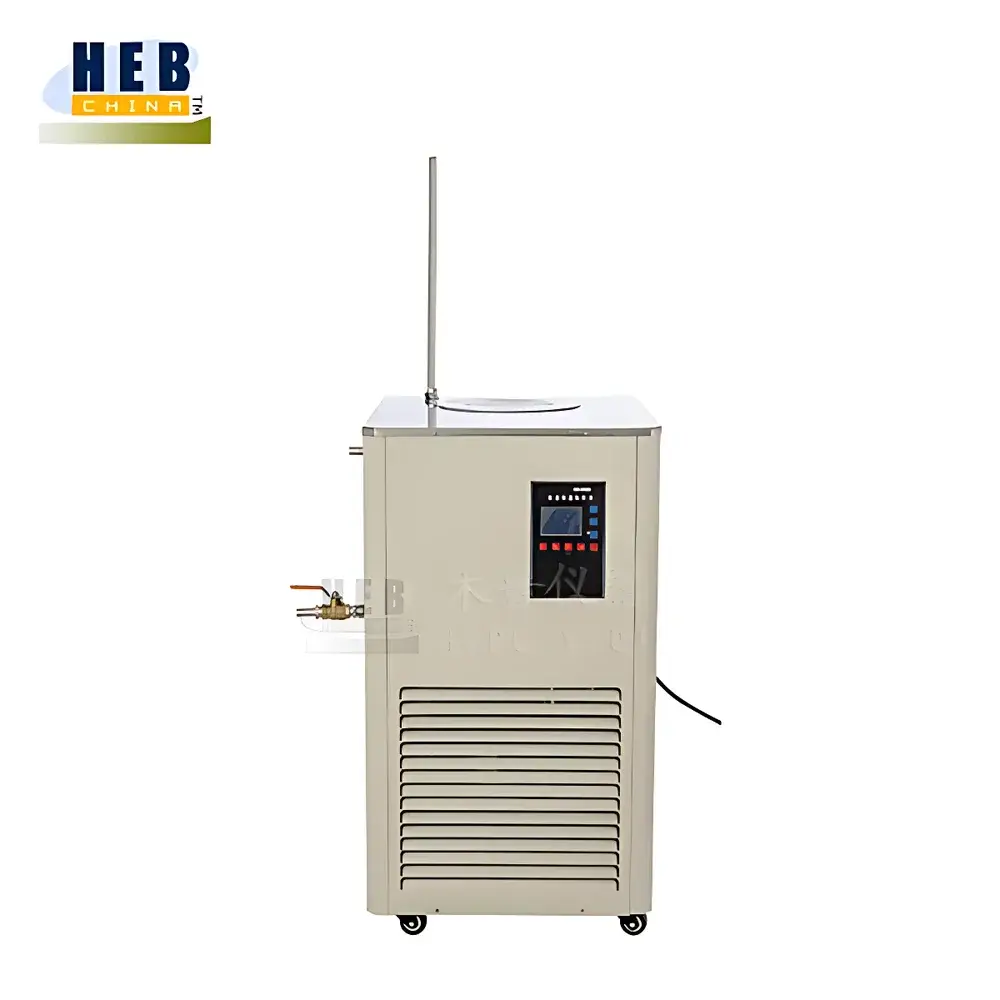
English Product Name
| Brand | HePu (Jinan Hepu Instrument Co., Ltd.) |
|---|---|
| Origin | Shandong, China |
| Model | DFY-20-30 |
| Bath Volume | 20 L |
| Temperature Range (No Load) | –30 °C to +98 °C |
| Temperature Stability | ±0.5 °C |
| Refrigeration Capacity | 2628–1350 W (at –30 °C to +20 °C) |
| Circulating Pump Flow Rate | Up to 30 L/min |
| Opening Diameter | Φ230 mm |
| Construction | 304 Stainless Steel Bath |
| Cooling System | Hermetically Sealed Air-Cooled Compressor |
| Stirring | Dual-Stage Magnetic Stirring (Optional Integrated) |
Overview
The HePu DFY-20-30 Cryogenic Circulating Thermostat is a precision-engineered laboratory temperature control system designed for stable, reproducible low-temperature operation across scientific and industrial R&D environments. Based on thermodynamic principles of vapor-compression refrigeration combined with forced liquid circulation, the unit maintains precise thermal equilibrium in external reaction vessels, analytical instruments (e.g., viscometers, spectrophotometers), or jacketed reactors via a closed-loop glycol/water mixture. Unlike cryogenic alternatives such as dry ice or liquid nitrogen—which introduce handling hazards, inconsistent thermal gradients, and logistical constraints—the DFY-20-30 delivers continuous, programmable sub-zero cooling from –30 °C while supporting elevated temperatures up to +98 °C. Its dual-range capability supports both cryogenic reaction kinetics studies and high-temperature stability testing within a single platform, making it suitable for applications requiring ISO/IEC 17025-compliant thermal conditioning in QC laboratories and academic research settings.
Key Features
- Digital PID temperature control with dual-display interface: real-time bath temperature and user-setpoint shown simultaneously on high-contrast LED screen for unambiguous monitoring and adjustment.
- Hermetically sealed, air-cooled compressor system using environmentally compliant R404A refrigerant—optimized for sustained operation at –30 °C with minimal maintenance and noise emission (<65 dB(A) at 1 m).
- 20-liter 304 stainless steel reservoir with electropolished interior surface, resistant to corrosion from aqueous, organic, and mildly acidic/alkaline solutions commonly used in synthesis and material testing.
- Integrated dual-stage magnetic stirring (optional configuration) enables uniform thermal distribution throughout the bath volume—critical for viscosity measurements per ASTM D2196 or temperature-sensitive enzymatic assays.
- High-efficiency centrifugal circulation pump delivering up to 30 L/min flow rate with adjustable pressure output (0.1–0.3 MPa), compatible with external jackets up to 30 m hydraulic head.
- Compact footprint (W×D×H ≈ 450 × 480 × 780 mm) with reinforced casters and ergonomic handle—designed for benchtop integration in space-constrained labs without compromising structural rigidity or thermal isolation.
Sample Compatibility & Compliance
The DFY-20-30 accommodates standard laboratory glassware (e.g., round-bottom flasks, jacketed reactors, and U-tube viscometers) through its 230 mm opening diameter and depth-adjustable immersion probe. It supports thermal conditioning of samples in contact with water-glycol mixtures (typically 30–50% v/v ethylene glycol), ensuring freeze protection down to –45 °C. The unit complies with IEC 61010-1:2010 safety standards for electrical equipment in laboratory use and meets CE marking requirements for electromagnetic compatibility (EMC Directive 2014/30/EU). While not certified for GMP manufacturing environments, its digital logging capability (via optional RS485/Modbus interface) supports GLP-aligned data integrity when paired with validated third-party software—enabling audit-ready temperature traceability per FDA 21 CFR Part 11 guidelines where electronic records are retained.
Software & Data Management
The thermostat operates autonomously via embedded firmware but supports external communication through an RS485 port (Modbus RTU protocol). When connected to a host PC running compliant SCADA or LabVIEW-based acquisition software, users can configure ramp-soak profiles, export timestamped temperature logs (CSV format), and trigger alarms based on deviation thresholds. Optional USB-to-RS485 adapters enable direct integration into existing LIMS or ELN infrastructures. All internal temperature readings are sampled at 1 Hz resolution with NIST-traceable calibration certificates available upon request. No proprietary cloud service or vendor-locked firmware is required—ensuring long-term interoperability and IT security compliance in regulated institutions.
Applications
- Low-temperature organic synthesis requiring precise exotherm control (e.g., Grignard reactions, lithiation steps).
- Rheological characterization of polymers and colloids using rotational viscometers under isothermal conditions per ISO 3219.
- Stability testing of biopharmaceuticals per ICH Q5C guidelines, including accelerated degradation studies at controlled sub-zero setpoints.
- Cooling of laser sources, CCD detectors, and FTIR accessories to minimize thermal drift during spectral acquisition.
- Calibration of thermocouples, RTDs, and infrared pyrometers across extended cryogenic ranges.
- Environmental simulation for material stress testing (e.g., thermal cycling of composites per ASTM D570).
FAQ
What is the minimum operating temperature with standard coolant?
The DFY-20-30 achieves –30 °C using a 40% aqueous ethylene glycol solution; lower temperatures require specialized heat transfer fluids and may reduce refrigeration efficiency.
Can this unit be used for external recirculation only—without internal bath immersion?
Yes. The device functions as a standalone chiller when connected to external equipment via inlet/outlet ports (G1/4″ BSP); internal bath heating/cooling remains active unless disabled via menu setting.
Is the magnetic stirrer compatible with all flask sizes?
The dual-stage stirrer is optimized for vessels ≤2 L placed centrally in the bath; larger reactors require external overhead stirring for adequate mixing uniformity.
Does the unit support remote start/stop via digital I/O?
Not natively—but optional relay modules (sold separately) enable dry-contact control integration with building management systems or PLC networks.
How often does the refrigerant require servicing?
Under normal operation and ambient conditions ≤30 °C, the sealed compressor requires no scheduled refrigerant recharge over a 10-year service life; annual visual inspection of condenser coils is recommended.



