
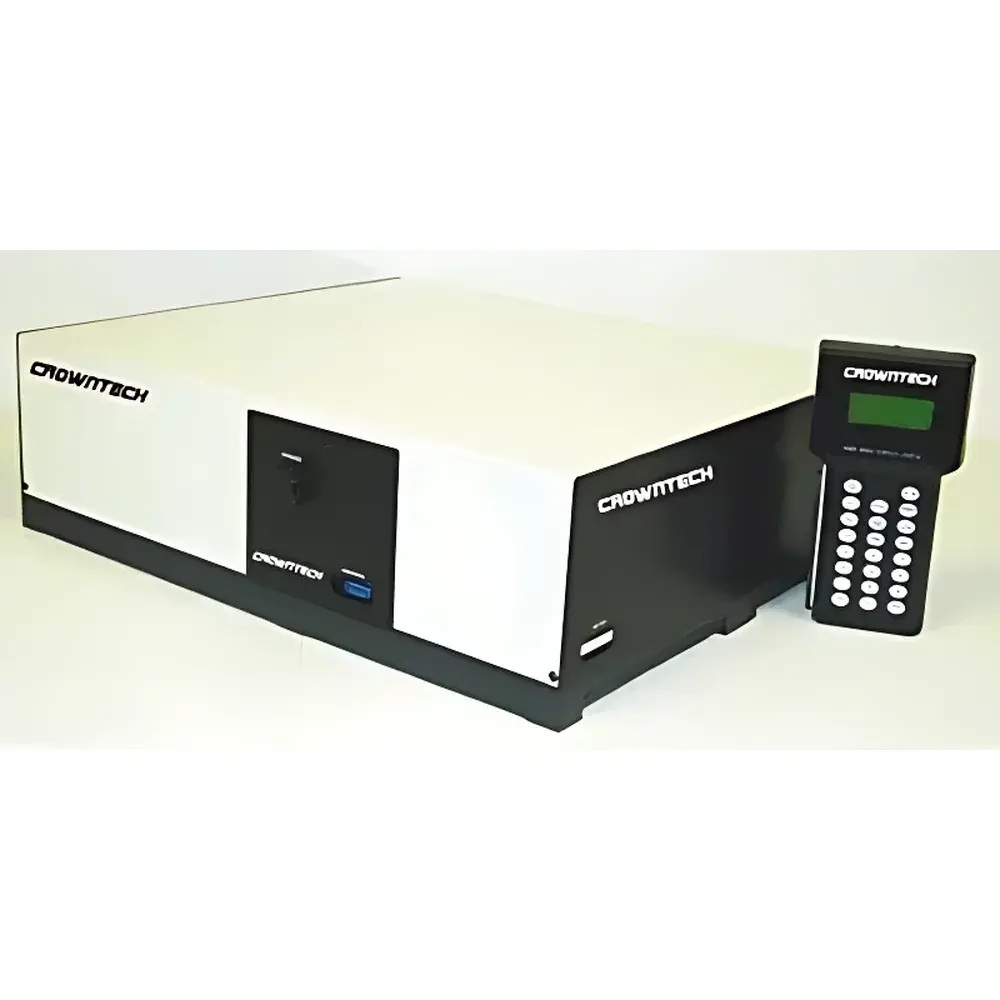
English Product Name
| Origin | USA |
|---|---|
| Supplier Type | Authorized Distributor |
| Import Status | Imported |
| Model | DK2400 |
| Pricing | Upon Request |
| Focal Length | 300 mm |
| f-number | f/3.9 |
| Stray Light Level | < 10⁻⁹ |
| Slit Width Range | 10–3000 µm |
| Slit Height Range | 2–20 mm |
| Grating Capacity | Up to six 68 × 68 mm (or 68 × 84 mm optional) gratings |
| Wavelength Accuracy | ±0.05 nm (additive mode), ±0.07 nm (subtractive mode) |
| Wavelength Precision | 0.01 nm (both modes) |
| Maximum Resolution | <0.04 nm (additive), 0.06 nm (subtractive) |
| Pulse Broadening | ≤200 ps (additive), ≤10 fs (subtractive) |
| Scan Speed | 1–1200 nm/min (with 1200 g/mm grating) |
| Control Interfaces | RS-232 (standard), IEEE-488/GPIB (optional) |
| Power Supply | 110–120 V / 50–60 Hz @ 1 A (standard) |
Overview
The Acton DK2400 1/4-meter dual monochromator is a high-performance optical spectroscopic instrument engineered for ultra-low stray light rejection, exceptional wavelength fidelity, and precise temporal dispersion control. Based on a tandem Czerny-Turner optical architecture with two independently configurable 300 mm focal length monochromators, the DK2400 operates in either additive or subtractive dispersion mode—enabling users to optimize for spectral resolution, background suppression, or ultrashort pulse preservation. In additive mode, the system delivers effective dispersion equivalent to a 1/2-meter monochromator while maintaining compact footprint and mechanical stability; in subtractive mode, it actively compensates for angular and temporal dispersion introduced by the first stage, reducing pulse broadening to sub-10-femtosecond levels—critical for time-resolved Raman, fluorescence lifetime, and pump-probe spectroscopy. Its f/3.9 aperture ensures high throughput across UV-VIS-NIR ranges, and its modular grating turret accommodates up to six standard 68 × 68 mm gratings (with extended 68 × 84 mm option), supporting flexible configuration for applications from deep-UV photoluminescence to near-infrared quantum cascade laser characterization.
Key Features
- Tandem Czerny-Turner design with dual 300 mm focal length stages and independent motorized grating rotation
- Selectable additive or subtractive dispersion operation via software or front-panel control
- Computer-controlled slits (10–3000 µm width, 2–20 mm height) with programmable step resolution
- Stray light suppression <10⁻⁹—validated per ASTM E275 and ISO 10110-7 standards for high-dynamic-range spectroscopy
- Wavelength precision of 0.01 nm and accuracy of ±0.05 nm (additive) / ±0.07 nm (subtractive)
- Scan speeds from 1 to 1200 nm/min using 1200 g/mm grating—optimized for rapid spectral mapping and kinetic studies
- Integrated dual-turbine drive system for synchronous, backlash-free wavelength scanning
- RS-232 as standard interface; IEEE-488/GPIB and USB-to-serial adapters available for legacy or automated lab integration
Sample Compatibility & Compliance
The DK2400 is compatible with free-space beam delivery, fiber-coupled input/output (via optional DK2PORT bifurcated port), and vacuum- or purged-environment configurations (N₂ or Ar purge ports available). It supports direct coupling to lasers (CW or pulsed), lamp sources (Xe, Hg-Ar, deuterium), and detector arrays (CCD, ICCD, PMT). All optical mounts conform to ANSI/ISO metric threading (M4, M6, M8) and accept standard kinematic mirror mounts and filter holders. The instrument complies with IEC 61000-6-3 (EMC emission) and IEC 61000-6-2 (immunity) requirements. Firmware and control logic are designed to support audit-ready operation under GLP and GMP frameworks, with optional LabVIEW drivers enabling full traceability of scan parameters, slit positions, and grating selections—including timestamped logging for FDA 21 CFR Part 11–compliant environments when integrated with validated data acquisition systems.
Software & Data Management
The DK2400 ships with Acton’s proprietary SpectraPro™ demonstration software (Windows 10/11, 64-bit), providing real-time wavelength calibration, multi-grating auto-selection, and synchronized slit/gantry control. Full LabVIEW 2020+ driver suite (NI-VISA compliant) enables seamless integration into custom DAQ platforms, including those used in automated QC workflows or synchrotron beamline control systems. All motor positions, grating identities, slit dimensions, and scan metadata are logged in HDF5 or CSV format with user-defined naming conventions. Software supports scripting via Python (PyVISA) and MATLAB (Instrument Control Toolbox), facilitating batch processing, spectral averaging, and real-time baseline correction. Firmware updates are delivered via secure HTTPS portal with SHA-256 signature verification and rollback capability.
Applications
- Low-background Raman spectroscopy—especially for graphene, 2D materials, and biological samples requiring <10⁻⁹ stray light rejection
- Time-resolved fluorescence and phosphorescence decay analysis using picosecond/femtosecond pulsed excitation
- High-resolution atomic emission spectroscopy (AES) and laser-induced breakdown spectroscopy (LIBS)
- Calibration source characterization for space-based spectrometers (e.g., satellite UV sensors)
- Quantum optics experiments requiring dispersion-compensated single-photon detection paths
- Photocatalysis and solar cell material bandgap mapping under tunable monochromatic illumination
FAQ
Can the DK2400 be configured as a spectrograph?
Yes—the instrument can be factory-configured in spectrograph mode with fixed grating and entrance slit, enabling direct CCD imaging of dispersed spectra without scanning.
What is the minimum resolvable bandwidth in subtractive mode?
At 532 nm with a 1200 g/mm grating, the practical resolution limit is 0.06 nm (FWHM), limited primarily by detector pixel size and optical aberrations—not grating dispersion.
Is vacuum compatibility available?
Standard units operate at ambient pressure; optional O-ring sealed housings with CF-35 flanges and N₂ purge fittings are available for operation down to 10⁻³ Torr.
How is wavelength calibration performed?
Using built-in Hg/Ar or Ne spectral lamps (optional), or external reference lasers; calibration coefficients are stored per grating and retained across power cycles.
Does the DK2400 support remote operation in unattended labs?
Yes—when paired with an industrial-grade PC and watchdog timer, the unit supports 24/7 scheduled scans with automatic error logging, email alerts, and FTP-based result upload.



