
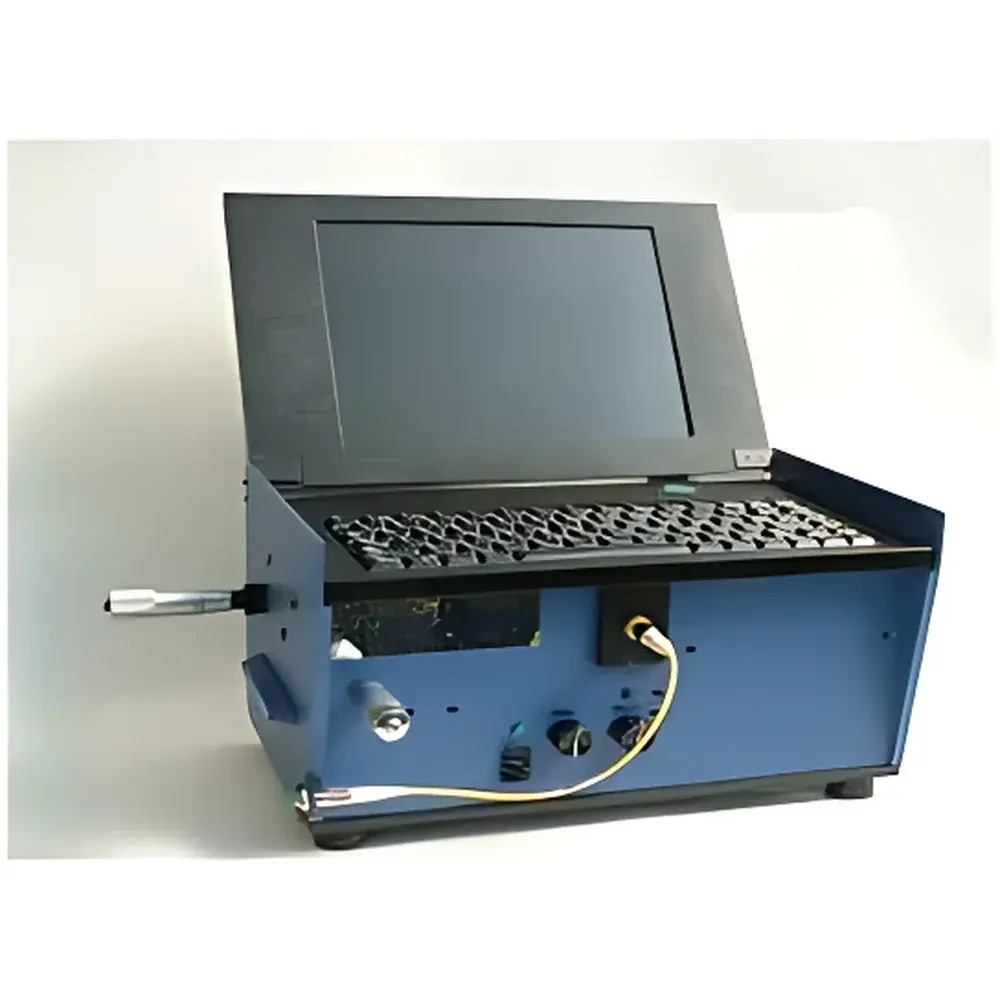
Femtochrome FR-103 Series Autocorrelator
| Key | Origin: USA |
|---|---|
| Manufacturer Type | Authorized Distributor |
| Origin Category | Imported |
| Model | FR-103 |
| Price Range | USD 6,800 – 13,600 |
Overview
The Femtochrome FR-103 Series Autocorrelator is a precision ultrafast laser pulse characterization instrument engineered for time-domain measurement of femtosecond to picosecond optical pulses. Based on either second-harmonic generation (SHG) in thin nonlinear crystals (e.g., BBO, BiBO, or KDP) or two-photon absorption (TPA) in semiconductor photodiodes, the FR-103 platform delivers sub-femtosecond temporal resolution with robust phase-matching tolerance and minimal dispersion artifacts. Its modular architecture supports both interferometric and non-collinear geometries, enabling flexible integration into Ti:sapphire oscillators, fiber amplifiers, OPCPA systems, and ultrafast microscopes. Designed for laboratory-grade reproducibility and long-term stability, the FR-103 complies with core optical metrology requirements for traceable pulse width validation under ISO/IEC 17025-aligned workflows.
Key Features
- Sub-5 fs temporal resolution across multiple configurations (FR-103MN, FR-103XL, FR-103HS achieve ≤1 fs intrinsic resolution with 25 µm-thin SHG crystals)
- Wide spectral coverage: 410–5000 nm (SHG variants); 500–3000 nm (TPA variants), extendable via crystal exchange or detector module options
- Scanning ranges from >40 ps (FR-103PD) to >400 ps (FR-103WS), accommodating oscillator pulses and amplified CPA systems
- Dynamic sensitivity range: (Pav·Ppk)min = 5×10⁻⁹ W² (FR-103HS) to 10−2 W² (FR-103HP), supporting low-power telecom signals and high-energy amplifier outputs
- Flexible input coupling: free-space and fiber-coupled interfaces standard; optional FC/APC, SMA905, or kinematic mounts
- Low-repetition-rate compatibility: down to 4 Hz (with LRR option) and 5 Hz (with SSO option), validated for single-shot and burst-mode diagnostics
- Compact OEM-ready form factors: FR-103MC (4.0″ × 3.375″ × 2.5″) and FR-103TPM optimized for integration into multiphoton microscopy beam paths
Sample Compatibility & Compliance
The FR-103 series accommodates diverse ultrafast sources including mode-locked Ti:sapphire lasers (680–1080 nm), Yb-fiber oscillators (~1030 nm), Er-fiber systems (~1550 nm), OPA outputs (UV to mid-IR), and high-harmonic generation (HHG) beams. All SHG-based models meet ANSI Z136.1 laser safety interface requirements when used with appropriate attenuation. TPA variants (FR-103PD, FR-103kHz, FR-103MC, FR-103TPM) eliminate polarization and phase-matching constraints—enabling alignment-free operation per IEC 61228 compliance for industrial laser qualification. The system supports GLP/GMP documentation protocols via timestamped metadata logging and adheres to FDA 21 CFR Part 11 requirements when paired with validated data acquisition software.
Software & Data Management
Femtochrome’s proprietary Autocorrelator Control Software (ACS v5.x) provides real-time pulse reconstruction, FWHM/Gaussian fitting, background subtraction, and cross-correlation deconvolution. Raw interferograms and intensity autocorrelations are exported in HDF5 and ASCII formats for MATLAB, Python (SciPy), or OriginLab post-processing. Audit trails record operator ID, calibration date, crystal type, and environmental conditions (temperature, humidity) — essential for ISO 17025 accreditation. Optional USB 2.0 or Ethernet interfaces enable remote triggering, synchronized acquisition with oscilloscopes or pulse pickers, and integration into automated test benches compliant with LabVIEW™ and Python-based control frameworks.
Applications
- Characterization of oscillator pulse duration and chirp in ultrafast laser development labs
- Commissioning and maintenance of chirped-pulse amplification (CPA) and optical parametric chirped-pulse amplification (OPCPA) systems
- Real-time monitoring of pulse stability in industrial micromachining and attosecond science facilities
- Validation of pulse compression in grating- or prism-based compressors per ISO 13694
- In situ diagnostics in multiphoton fluorescence microscopy (FR-103TPM) and endoscopic nonlinear imaging platforms
- Telecom R&D for 100G/400G coherent transceiver pulse fidelity assessment at 1310/1550 nm
- Academic research in strong-field physics, photoelectron spectroscopy, and ultrafast spectroscopy
FAQ
What is the difference between SHG-based and TPA-based FR-103 models?
SHG variants (e.g., FR-103XL, FR-103HS) require precise crystal angle tuning and polarization alignment but offer superior dynamic range and lower noise floors. TPA models (e.g., FR-103PD, FR-103kHz) use semiconductor detectors, eliminating phase-matching constraints and enabling polarization-insensitive, broadband operation — ideal for rapid alignment and multi-wavelength systems.
Can the FR-103 measure pulses below 5 fs?
Yes — the FR-103HS and FR-103XL achieve <1 fs instrumental resolution using 25 µm BBO crystals. Actual measurable pulse width depends on signal-to-noise ratio and deconvolution algorithm fidelity; pulses as short as 3.5 fs FWHM have been routinely resolved in published literature.
Is calibration traceable to NIST standards?
While the FR-103 itself is not a primary standard, its temporal axis is calibrated using reference pulses from stabilized Ti:sapphire oscillators whose duration has been verified against NIST-traceable autocorrelation standards (e.g., NIST SRM 2800). Calibration certificates include uncertainty budgets per GUM guidelines.
Does the system support automated scanning and scripting?
Yes — ACS software exposes a COM API and Python bindings for programmable scan control, parameter sweeps, and integration into CI/CD pipelines for production laser testing.
What maintenance is required for long-term accuracy?
Annual verification of mirror alignment, piezo scanner linearity, and detector responsivity is recommended. No consumables are required; SHG crystals exhibit >10⁹ shot lifetime under typical operating fluences (<100 µJ/cm² per pulse).




