
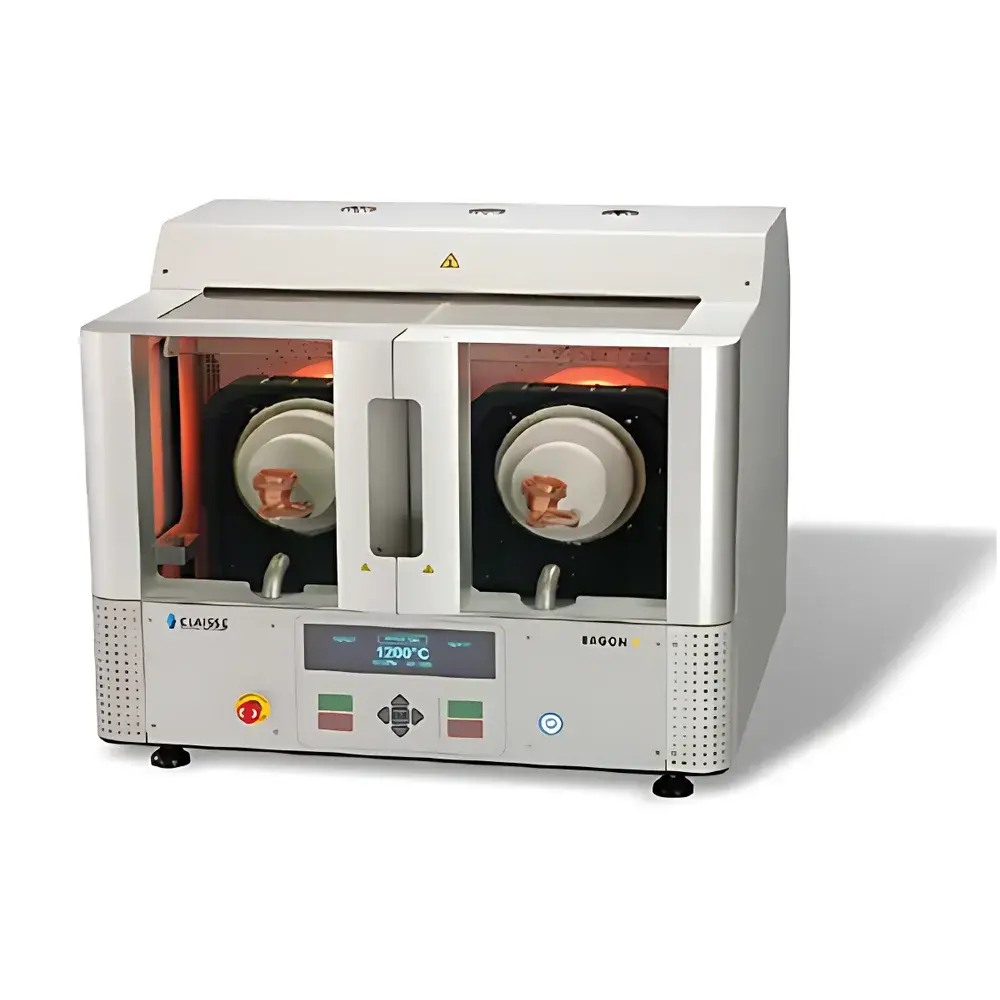
ENGON 2 Fusion Machine by Claisse
| Brand | Claisse |
|---|---|
| Origin | Canada |
| Model | ENGON 2 |
| Dimensions (L×W×D) | 56.5 × 68.5 × 64.5 cm |
| Temperature Control Accuracy | ±5 °C |
| Operating Temperature Range | 300–1200 °C |
| Sample Throughput Capacity | 5000 samples per year (typical lab usage) |
Overview
The ENGON 2 Fusion Machine, engineered and manufactured by Claisse (Canada), is a fully automated, microprocessor-controlled fusion system designed for high-precision preparation of homogeneous glass beads from inorganic powdered samples—including oxides, silicates, minerals, ores, slags, and environmental solids. It operates on the principle of high-temperature flux-assisted fusion (typically using lithium tetraborate, lithium metaborate, or mixed fluxes), enabling quantitative sample dissolution under inert or controlled-atmosphere conditions. The system delivers reproducible, bubble-free beads suitable for subsequent X-ray fluorescence (XRF) and inductively coupled plasma (ICP) spectroscopic analysis. Its robust thermal architecture—featuring dual-zone heating elements, ceramic insulation, and real-time thermocouple feedback—ensures stable temperature profiles across the full 300–1200 °C operating range, critical for stoichiometric flux-sample interaction and complete homogenization.
Key Features
- One-touch operation with intuitive front-panel interface and integrated audible completion signal.
- Full microprocessor control of the entire fusion cycle—from preheating and flux/sample dosing to fusion, homogenization, and casting—with programmable ramp rates, dwell times, and cooling profiles.
- Real-time visual monitoring via built-in observation window; user-initiated cycle interruption and manual inspection capability without compromising safety interlocks.
- Passive mechanical door lock activated during fusion phase—compliant with EU Machinery Directive 98/37/EC—preventing inadvertent access while molten material is present.
- External surface temperature limited to ≤70 °C under continuous operation, verified per EN 61000-6-3 and EN 61000-6-4 for laboratory electromagnetic compatibility and operator safety.
- Dual redundant thermal protection: independent overtemperature cutoff and crucible base temperature sensor integrated into the mold plate assembly.
- Password-protected user access levels (operator, supervisor, administrator) supporting audit-ready workflow governance.
Sample Compatibility & Compliance
The ENGON 2 accommodates standard platinum–gold (Pt–Au) or Pt–Rh crucibles (typically 30–50 mL capacity) and supports both sequential and batch fusion protocols. It is validated for use with common fusion fluxes (e.g., Li₂B₄O₇, LiBO₂, NH₄NO₃ oxidant blends) and compatible with certified reference materials (CRMs) traceable to NIST and BAM standards. The system conforms to CE marking requirements under the Low Voltage Directive (2014/35/EU), Electromagnetic Compatibility Directive (2014/30/EU), and Machinery Directive (2006/42/EU). It supports GLP-compliant documentation when paired with Claisse’s optional Fusion Manager software, including electronic signature support aligned with FDA 21 CFR Part 11 Annex 11 principles.
Software & Data Management
While the ENGON 2 operates autonomously via its embedded controller, it supports bidirectional RS-232/USB communication with Claisse Fusion Manager software (Windows-based). This application enables remote method upload/download, real-time cycle logging, parameter optimization for alphanumeric sample IDs, and export of time-stamped fusion records (including temperature profile, duration, error codes, and operator ID) in CSV or XML format. All method files are digitally signed and version-controlled; software audit trails record all modifications with timestamps and authenticated user identifiers—essential for ISO/IEC 17025-accredited laboratories.
Applications
The ENGON 2 is routinely deployed in geochemical, metallurgical, cement, and environmental testing laboratories for sample preparation prior to XRF quantification of major, minor, and trace elements (e.g., Si, Al, Fe, Ca, Mg, Na, K, P, S, Ti, Mn, Cr, Ni, Zn, Pb). It is particularly suited for high-volume routine analysis where precision (<0.5% RSD for major oxides), throughput consistency, and operator safety are paramount. Applications include ASTM C114 (cement analysis), ISO 9556 (iron and steel), ISO 12677 (rock and soil), and USP heavy metals screening in pharmaceutical excipients following fusion-dilution protocols.
FAQ
What types of fluxes are compatible with the ENGON 2?
Standard lithium-based fluxes (Li₂B₄O₇, LiBO₂, and eutectic mixtures) are fully supported; oxidizing additives such as NH₄NO₃ may be used under programmed atmosphere control.
Is the ENGON 2 suitable for regulatory-compliant environments?
Yes—it meets CE machinery safety directives and, when used with Fusion Manager software, supports 21 CFR Part 11–aligned electronic records and audit trails for GMP/GLP workflows.
Can the system handle volatile or hazardous samples?
Volatile components require pre-treatment (e.g., calcination); the unit does not provide active fume extraction but is compatible with external ducted hoods meeting ANSI/AIHA Z9.5 standards.
What maintenance is required for long-term calibration stability?
Annual verification of thermocouple accuracy against NIST-traceable references and periodic inspection of crucible integrity and door interlock functionality are recommended per Claisse Technical Bulletin TB-FM-02.
Does the ENGON 2 support custom crucible geometries?
It accepts industry-standard 30–50 mL cylindrical Pt–Au or Pt–Rh crucibles; non-standard geometries require mechanical adaptation and are not covered under warranty.



