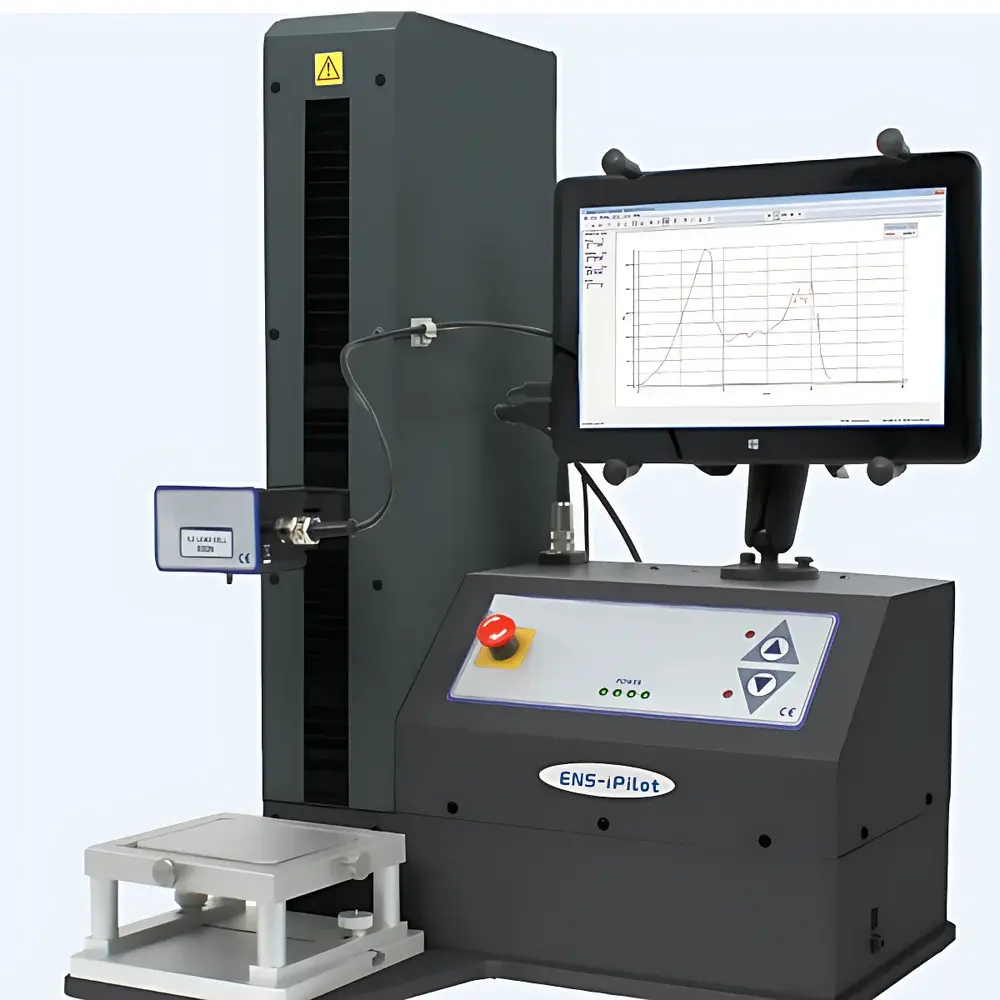
ENS-iPilot Texture Analyzer (Food & Pharmaceutical Texture Analysis System)
| Brand | ENSOUL |
|---|---|
| Origin | Beijing, China |
| Model | ENS-iPilot |
| Vertical Travel Range | 0–300 mm |
| Position Resolution | ≤ 0.1 µm |
| Speed Range | 0.01–20 mm/s (adjustable in 0.01 mm/s increments) |
Overview
The ENS-iPilot Texture Analyzer is a motor-controlled, single-column universal testing system engineered for precise mechanical property characterization of soft solids and semi-solids across food, pharmaceutical, cosmetic, agricultural, and packaging R&D and QC laboratories. Based on the fundamental principles of uniaxial compression, tension, penetration, and shear deformation—governed by Hooke’s law and empirical texture profile analysis (TPA)—the instrument quantifies force–displacement relationships under programmable speed, distance, and dwell conditions. Its architecture integrates a high-resolution encoder-driven stepper motor, low-inertia crosshead assembly, and temperature-stable load cell mounting platform to ensure repeatability ≤ ±0.5% of full scale across repeated cycles. Designed in collaboration with Food Technology Corporation (FTC), USA, the ENS-iPilot adheres to core metrological requirements defined in ISO/IEC 17025-accredited environments and supports method validation per FDA Guidance for Industry: Analytical Procedures and Methods Validation for Drugs and Biologics.
Key Features
- Integrated 7-inch capacitive touchscreen interface with real-time force/displacement graphing—enabling standalone operation without external PC connection
- Modular load cell selection: interchangeable sensors ranging from 0.5 N (for delicate gels or thin films) to 500 N (for dense meats or baked goods), each traceable to NIST standards
- Precision vertical travel system with ≤0.1 µm position resolution and closed-loop speed control (0.01–20 mm/s in 0.01 mm/s steps)
- Auto-calibration routine with built-in reference weights; calibration logs stored with timestamp, operator ID, and environmental metadata
- Standardized probe library compliant with ASTM F2796 (texture of cheese), ISO 20683 (fruit firmness), and USP (tablet hardness); custom probe design support available under NDA
- Robust aluminum alloy frame with vibration-dampening base plate, rated for continuous operation at ambient temperatures 10–30°C and relative humidity ≤80% non-condensing
Sample Compatibility & Compliance
The ENS-iPilot accommodates heterogeneous samples from viscous liquids (e.g., syrups, sauces) to rigid solids (e.g., crackers, tablets, rubbery polymers). Sample holders include adjustable clamps, cylindrical fixtures, and temperature-controlled platforms (optional –20°C to +80°C). All standard test methods—including TPA, puncture, extrusion, cutting, and tensile testing—map directly to regulatory frameworks: ISO 11357-3 (thermal-mechanical behavior), EN 15215 (cereal product texture), and ICH Q5E (comparability of biopharmaceutical formulations). Data integrity complies with ALCOA+ principles; optional 21 CFR Part 11 software package provides electronic signatures, role-based permissions, and immutable audit trails for GMP/GLP audits.
Software & Data Management
The embedded ENS-Analyzer v3.2 firmware supports method templates (e.g., “USP Tablet Hardness”, “AOAC Gel Strength”), real-time curve overlay, and automatic parameter extraction (hardness, adhesiveness, cohesiveness, springiness, chewiness, resilience). Raw force–time and force–distance datasets export in CSV, Excel, and XML formats. Advanced users may define custom calculation modules using Python-based scripting (via optional SDK). All data files embed EXIF-style metadata: instrument serial number, calibration certificate ID, environmental sensor readings (temperature/humidity), and operator credentials. Backup and restore functions operate over USB 3.0 or Ethernet (TCP/IP), with optional cloud sync to secure AWS S3 buckets under HIPAA-compliant encryption.
Applications
- Foods: Quantification of tenderness in marinated meats (ASTM E1957), crispness loss kinetics in fried snacks, gelation onset in pectin systems, and spreadability of dairy spreads
- Pharmaceuticals: Tablet friability assessment, capsule shell elasticity, transdermal patch peel strength, and lyophilized cake structural integrity
- Agriculture: Fruit firmness grading (ISO 20683), root crop compressive yield, and seed coat fracture energy
- Cosmetics: Emulsion stability under shear, lipstick break strength, and hydrogel film tackiness
- Packaging: Seal strength of laminated pouches, puncture resistance of blister foils, and cap torque–turn profiles
- Tobacco: Cut filler density uniformity, cigarette rod hardness, and reconstituted leaf tensile modulus
FAQ
Does the ENS-iPilot support third-party probe integration?
Yes—mechanical and electrical interfaces comply with ISO 80601-2-62 mechanical coupling standards; custom probes require mechanical drawings and load cell compatibility verification.
Is method transfer possible between ENS-iPilot and FTC’s TA.HD Plus?
Method parameters (speed, target distance, trigger force) are fully interoperable; however, force calibration curves require cross-validation due to sensor-specific linearity coefficients.
Can the system perform dynamic oscillatory tests?
No—the ENS-iPilot is a quasi-static texture analyzer; dynamic rheological characterization requires dedicated rotational or oscillatory rheometers.
What documentation is provided for IQ/OQ/PQ validation?
Factory-issued IQ/OQ protocols (with blank execution forms), certified calibration certificates, and material traceability reports are included; PQ support requires site-specific sample matrix validation.
Is remote diagnostics supported?
Yes—via encrypted TLS 1.3 connection; service engineers can initiate screen sharing and log review after multi-factor authentication.