
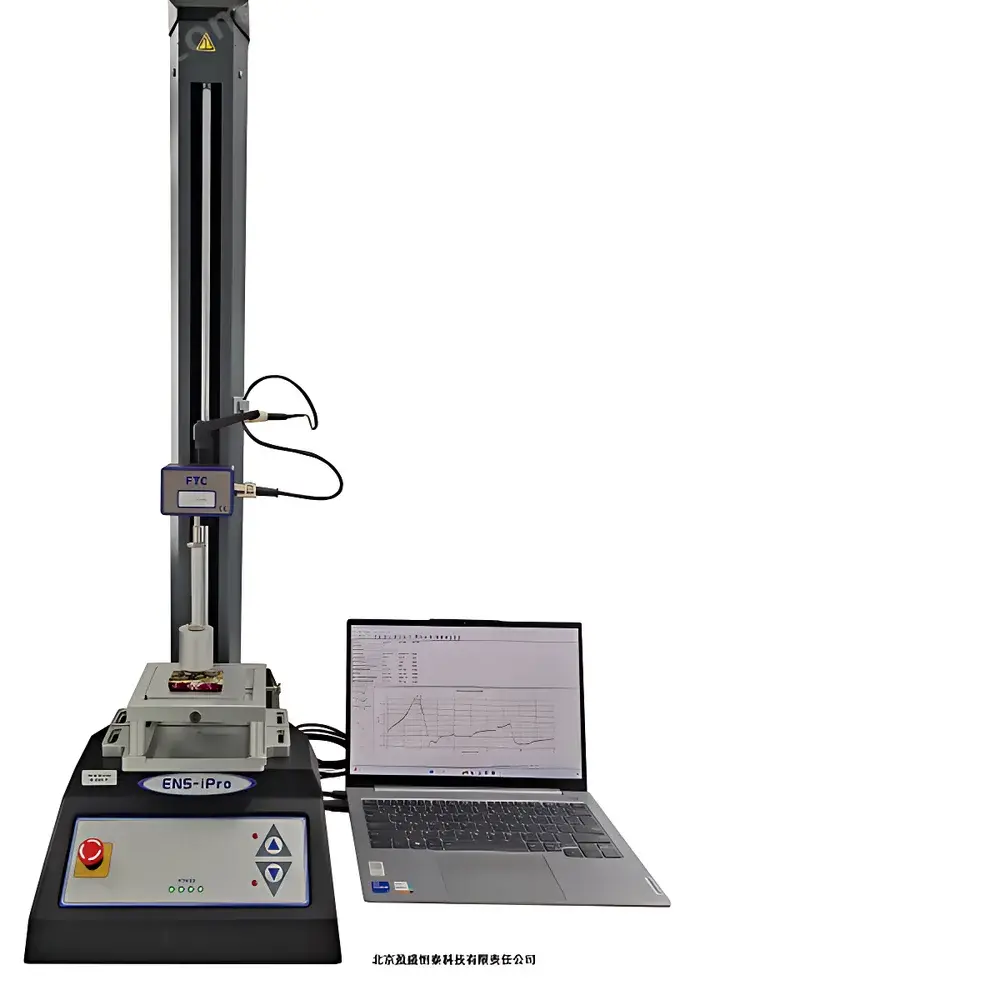
ENSoul ENS Series Tobacco-Specific Texture Analyzer
| Brand | ENSoul |
|---|---|
| Origin | Beijing, China |
| Manufacturer Type | Authorized Distributor |
| Country of Origin | China |
| Model | ENS Tobacco Texture Analyzer |
| Pricing | Available Upon Request |
Overview
The ENSoul ENS Series Tobacco-Specific Texture Analyzer is a high-precision, motor-driven mechanical testing instrument engineered for the quantitative measurement of mechanical and textural properties of tobacco materials using standardized compression, penetration, shear, bending, and tensile deformation protocols. Based on the fundamental principles of force–displacement transduction and controlled uniaxial loading, the system applies calibrated mechanical stress to tobacco samples—including raw leaf, cut filler, stems, reconstituted tobacco, filter rods, cigarette paper, and smokeless products—and records real-time force, distance, time, and derived parameters such as hardness, fracturability, cohesiveness, springiness, adhesiveness, and toughness. Designed in collaboration with Food Technology Corporation (FTC), USA, the ENS platform integrates ISO/IEC 17025-aligned metrological traceability and complies with ASTM D638, ASTM D790, ISO 1133, ISO 34, BS EN 15213, and relevant tobacco industry test methods (e.g., YC/T 245–2008, YC/T 446–2012). It serves as a core physical property characterization tool for R&D laboratories, QC/QA departments, and academic institutions engaged in tobacco science, process optimization, and regulatory compliance.
Key Features
- High-torque brushless DC motor enabling precise displacement control with ≤ ±0.01 mm repeatability and programmable speed range from 0.01 to 100 mm/s
- Modular load cell architecture supporting interchangeable force sensors (5 N, 50 N, 100 N, 500 N) with factory-calibrated linearity ≤ ±0.5% FS and temperature-compensated output
- Multi-axis probe mounting interface compatible with over 30 standardized FTC-style probes—including needle-type penetrometers, blade shears, three-point bend fixtures, tensile grips, and custom-engineered tobacco-specific fixtures (e.g., stem fracture jigs, filter rod compression platens)
- Robust aluminum alloy frame with vibration-damped base and integrated safety enclosure meeting IEC 61000-6-2 EMC immunity requirements
- Real-time force–distance curve acquisition at ≥ 1 kHz sampling rate, with automatic zeroing, pre-test calibration verification, and hardware-based overload protection
Sample Compatibility & Compliance
The ENS analyzer accommodates solid, semi-solid, and fibrous tobacco matrices across all processing stages: air-cured and flue-cured leaf, expanded tobacco sheet, stem fractions (whole, cut, granulated), reconstituted tobacco (RT), cigarette filters (acetate, PLA), tipping paper, and oral tobacco products. All standard probes conform to ASTM F3076 (tobacco product mechanical testing), ISO 14129 (fiber composite bending), and FDA-recommended geometry specifications for physical testing of combustible and non-combustible tobacco products. The system supports GLP-compliant operation through user access control, electronic signature capability, and audit-trail-enabled method storage—fully aligned with 21 CFR Part 11 requirements when paired with optional validated software modules.
Software & Data Management
The included ENS-TexturePro™ v4.2 software provides ISO 17025-compliant data handling with dual-mode operation: guided method templates (e.g., “Leaf Penetration”, “Filter Rod Crush”, “Stem Shear”) and fully customizable protocol scripting. Key functions include real-time curve overlay, multi-cycle averaging, automatic peak detection (first break, maximum force, yield point), modulus calculation (initial slope, secant modulus), and export of raw ASCII/CSV datasets with metadata tagging (operator ID, sample ID, environmental conditions). All analysis parameters are stored in encrypted project files; version-controlled method libraries support cross-laboratory reproducibility. Optional IQ/OQ/PQ documentation packages and third-party LIMS integration (via ASTM E1384 or HL7 interfaces) are available for regulated environments.
Applications
- Raw material evaluation: Leaf tensile strength, stem fracture resistance, lamina adhesion energy, progressive compressive hardness of baled leaf
- Processing validation: Cut filler uniformity assessment via shear profile analysis, expansion ratio correlation with puncture resistance, reconstituted sheet delamination testing
- Product quality assurance: Filter rod radial hardness profiling, cigarette butt crush resistance, tipping paper peel adhesion quantification, plug wrap tensile integrity
- R&D support: Formulation screening (binder effects on stem cohesion), moisture–texture response modeling, aging studies on mechanical property drift
- Academic research: Biomechanical modeling of tobacco leaf fracture mechanics, viscoelastic parameter extraction (relaxation time, creep compliance), comparative texture mapping across varietals and curing methods
FAQ
Is the ENS Series compliant with international tobacco testing standards?
Yes—the system implements test protocols referenced in YC/T 245–2008 (tobacco leaf puncture), YC/T 446–2012 (filter rod hardness), and ASTM D8178 (mechanical testing of tobacco products), with traceable calibration against NIST-certified force standards.
Can custom probes be validated for regulatory submissions?
Custom probe geometries undergo dimensional verification, finite element stress simulation, and inter-laboratory round-robin testing per ISO 5725; full validation reports are provided upon request.
Does the system support automated pass/fail decision logic for QC release?
Yes—user-defined specification limits can be embedded into test methods, triggering visual alerts and auto-flagging of out-of-spec results in real time, with configurable PDF certificate generation.
What maintenance intervals are recommended for long-term accuracy?
Annual metrological recalibration is advised; load cells and encoders include built-in self-diagnostic routines, and daily verification using certified reference weights and displacement gauges is supported by onboard calibration utilities.





