
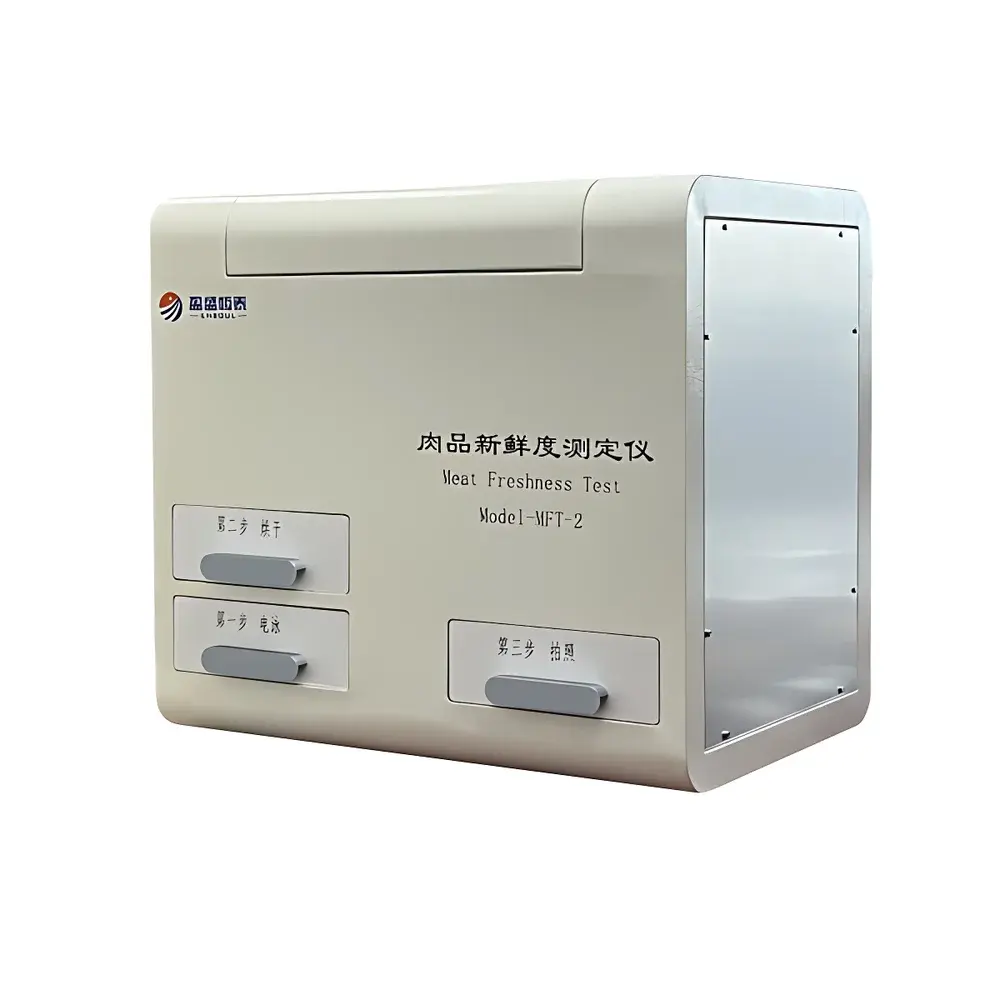
ENSOUL MFT2 Automated Meat Freshness Analyzer Based on ATP Metabolite Electrophoresis
| Key | Brand: ENSOUL |
|---|---|
| Origin | Beijing, China |
| Manufacturer Type | Authorized Distributor |
| Country of Origin | China |
| Model | MFT2 |
| Pricing | Upon Request |
Overview
The ENSOUL MFT2 Automated Meat Freshness Analyzer is a dedicated laboratory instrument engineered for the quantitative determination of the K-value—a scientifically validated freshness index derived from the enzymatic degradation pathway of adenosine triphosphate (ATP) in post-mortem muscle tissue. The K-value is defined as the molar percentage of hypoxanthine riboside (HxR) and hypoxanthine (Hx) relative to the total pool of ATP-related metabolites: ATP + ADP + AMP + IMP + HxR + Hx. This metric reflects the extent of purine nucleotide catabolism, which progresses predictably during spoilage and correlates strongly with sensory, microbiological, and biochemical deterioration. Unlike volatile basic nitrogen (VBN) or pH-based methods, the K-value exhibits superior linearity with storage time and temperature history, making it the preferred metric for high-integrity freshness assessment in raw fish, chilled meat, and poultry—particularly where raw consumption (e.g., sashimi-grade fish) demands stringent quality thresholds. The MFT2 implements capillary-free horizontal electrophoresis under controlled buffer conditions to resolve ATP, ADP, AMP, IMP, HxR, and Hx in a single run. Following UV-induced fluorescence excitation (254 nm), metabolite bands are captured by an integrated 20-megapixel CMOS imaging system and quantified via optical density calibration against internal stoichiometric references—eliminating reliance on external standard curves.
Key Features
- Integrated all-in-one architecture: Combines electrophoresis chamber, ambient-temperature drying module, high-resolution fluorescence imaging subsystem, and embedded computing unit within a single compact chassis.
- 11-inch capacitive touchscreen interface with guided workflow navigation—no specialized electrophoresis training required; full assay completion (including sample homogenization, extraction, electrophoresis, drying, imaging, and K-value computation) in ≤15 minutes.
- Simultaneous analysis of up to five samples per run using standardized gel lanes; minimal sample requirement of only 0.2 g of minced tissue (no precision weighing needed due to ratio-based normalization).
- Reagent-free quantification: Eliminates need for calibration standards or reference materials; proprietary image analysis algorithm computes K-value directly from band intensity ratios.
- Onboard data management: Stores ≥100,000 test records with timestamp, operator ID, sample ID, raw electropherogram images, and calculated K-values; exportable via USB 2.0 interface in CSV and PNG formats.
- Non-destructive, non-thermal sample preparation protocol compatible with fresh, chilled, frozen-thawed, and vacuum-packed muscle tissues—results independent of anatomical sampling site.
Sample Compatibility & Compliance
The MFT2 is validated for use with skeletal muscle tissue from teleost fish (e.g., tuna, salmon, mackerel), mammalian meat (beef, pork, lamb), and avian species (chicken, turkey). It conforms to the analytical requirements specified in SC/T 3048–2014 (People’s Republic of China Standard for Freshness Evaluation of Aquatic Products) and aligns methodologically with Japanese Agricultural Standards (JAS) for sashimi-grade seafood classification. While not certified under ISO/IEC 17025, the system supports GLP-compliant operation through audit-trail-enabled software logging, user-access controls, and immutable result archiving—facilitating internal QA/QC documentation and regulatory readiness for food safety management systems (e.g., HACCP, BRCGS, IFS Food).
Software & Data Management
The embedded firmware runs a real-time Linux-based OS with dedicated electrophoresis image analysis software. The application performs automatic lane detection, background subtraction, peak integration, and stoichiometric ratio calculation using pre-validated spectral response profiles. All processing steps—including exposure time adjustment, contrast enhancement, and band assignment—are logged with digital signatures. Data outputs comply with FDA 21 CFR Part 11 principles: electronic records include operator authentication, date/time stamps, and change history. Exported datasets retain metadata required for traceability in GMP-aligned environments.
Applications
- Food Processing & Supply Chain: Raw material acceptance testing at slaughterhouses, aquaculture facilities, and import inspection points; shelf-life modeling; cold-chain integrity verification.
- Food Service & Retail: In-store freshness grading of chilled/frozen meats; dynamic pricing based on objective K-value tiers; compliance verification for premium raw-consumption categories.
- Research & Education: Investigation of post-mortem metabolism kinetics; evaluation of novel preservation techniques (e.g., MAP, antimicrobial coatings, pulsed electric fields); teaching tool for food biochemistry and quality assurance curricula.
- Appliance Validation: Performance benchmarking of refrigeration units, blast freezers, and rapid thawing systems using standardized K-value drift protocols.
FAQ
What is the measurement principle underlying the K-value calculation?
The K-value is calculated from the relative concentrations of ATP degradation intermediates resolved by electrophoretic mobility differences in alkaline buffer, followed by UV-fluorescence densitometry.
Does the MFT2 require daily calibration with reference standards?
No—quantification relies on internal ratio-based normalization between co-migrating metabolites; no external calibration standards are used.
Can the instrument analyze frozen-thawed samples without bias?
Yes—method validation confirms consistent recovery across freeze-thaw cycles when using the recommended extraction protocol.
Is the reagent kit compliant with REACH and RoHS directives?
All consumables are formulated without hazardous substances listed in Annex XIV of REACH; SDS documentation is provided upon request.
How is data integrity ensured during long-term archival?
Each record includes cryptographic hash verification; stored files are write-once-read-many (WORM) by default, preventing unauthorized modification.





