
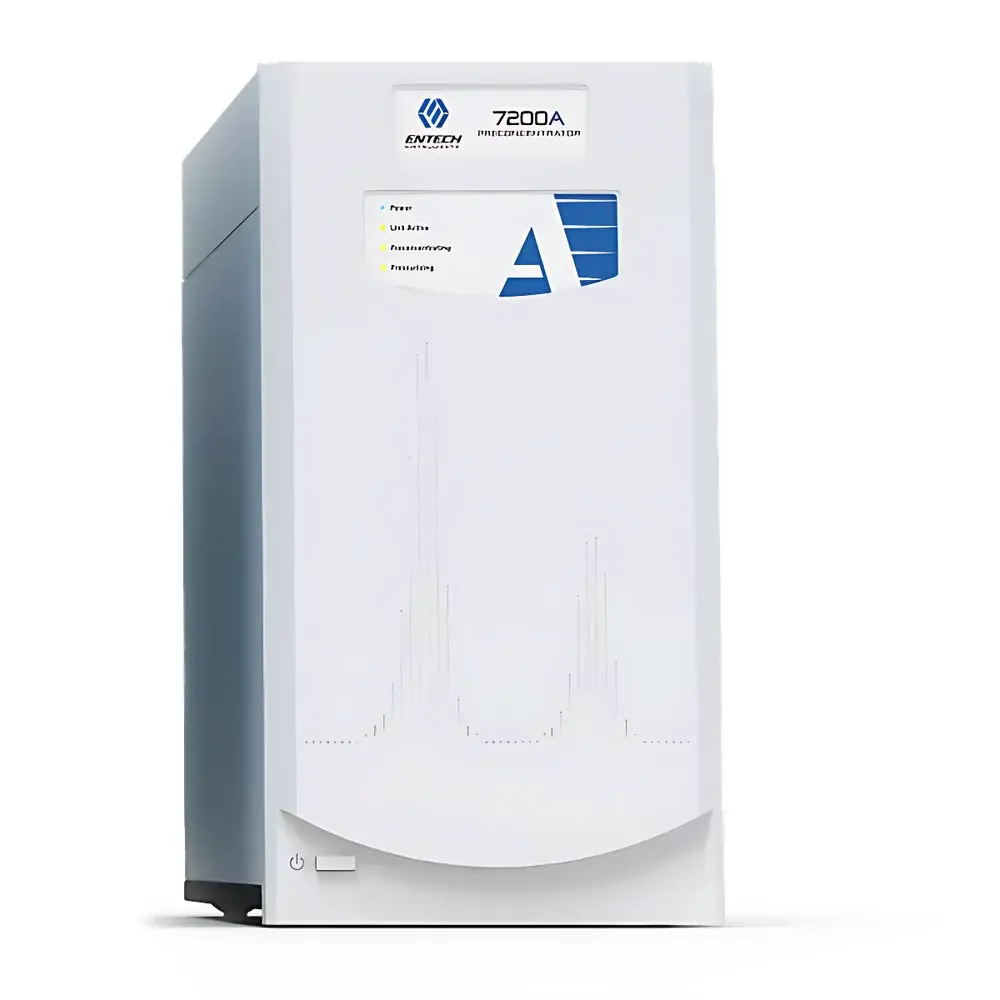
Entech 7200A Advanced Three-Stage Atmospheric Pre-concentrator with EFIT and Cryogenic Focusing
| Brand | Entech |
|---|---|
| Origin | USA (Imported) |
| Model | 7200A |
| Application | EPA Method TO-15A, TO-11A, ASTM D6196 |
| Cooling Medium | Liquid Nitrogen |
| Sample Volume Range | 25–1000 mL |
| Cycle Time (250 mL) | 20–25 min |
| EFIT Transfer Time | <1 s |
| Peak Width (EFIT) | 1.7–2.0 s |
| LN₂ Consumption Reduction | Up to 30% vs. 7200 |
| Water Removal Efficiency | Enhanced via Programmable Pressure-Programmed Split and Silonite-Coated Flow Path |
| Software Control | Entech AutoPrep v5.x (21 CFR Part 11 Compliant Audit Trail Optional) |
| Automation Support | Up to three 16-position autosamplers (max. 48 samples unattended) |
| Compliance | GLP/GMP-ready, ISO/IEC 17025 compatible |
Overview
The Entech 7200A is a next-generation, three-stage cryogenic pre-concentrator engineered for high-fidelity quantitative analysis of volatile organic compounds (VOCs) in ambient, indoor, soil gas, and industrial emission matrices. It operates on the principle of cryotrapping—where VOCs are selectively adsorbed onto multi-bed traps (typically Tenax TA, Carbopack B/C, and molecular sieve) at sub-ambient temperatures, followed by rapid thermal desorption and transfer into a gas chromatograph–mass spectrometer (GC–MS). The system integrates Entech’s proprietary Extreme Fast Injection Technology (EFIT), enabling sub-second analyte transfer (<1 s) and peak widths of only 1.7–2.0 seconds—significantly enhancing chromatographic resolution and sensitivity for trace-level VOC quantification. Designed explicitly to meet the analytical demands of EPA Method TO-15A and its evolving variants—including expanded aldehyde/ketone target lists—the 7200A delivers improved reproducibility, reduced carryover, and superior water management compared to legacy systems (e.g., 7100A, 7200), making it a core platform for regulatory-compliant air quality laboratories.
Key Features
- Extreme Fast Injection Technology (EFIT): Delivers ultra-narrow peak widths (1.7–2.0 s) and near-instantaneous analyte transfer from trap to column, enabling faster GC methods and improved separation of co-eluting compounds.
- Three-Stage Cryofocusing Architecture: Combines primary adsorption, secondary cryo-trapping, and tertiary focusing with programmable pressure ramping to maximize recovery of C2–C12 VOCs—including formaldehyde, acetaldehyde, and other polar carbonyls—without derivatization.
- Optimized Water Management: Integrates a programmable split vent upstream of the GC column to divert bulk water vapor while retaining water-soluble analytes; further enhanced by Silonite-coated flow paths and M3 trap temperature profiling to minimize hydrolysis and adsorption artifacts.
- Intelligent Trap Bake-Out Sequence: Implements staged thermal desorption—first removing residual moisture at lower temperatures (e.g., 120 °C), then purging non-polar residues at elevated setpoints (e.g., 320 °C)—synchronized with GC oven temperature ramps to ensure consistent trap cleanliness and inter-sample integrity.
- Reduced Cryogen Consumption: Redesigned LN₂ delivery module directs coolant directly to the trap core, improving cooling rate and thermal stability; achieves up to 30% lower liquid nitrogen usage versus the 7200 platform without compromising trapping efficiency or temperature precision.
- Enhanced System Robustness: All-wetted surfaces feature Entech’s industry-standard Silonite deactivation, minimizing catalytic degradation, memory effects, and artifact formation—critical for long-term monitoring of reactive VOCs such as isoprene, monoterpenes, and unsaturated aldehydes.
Sample Compatibility & Compliance
The 7200A supports a broad range of sampling media, including stainless-steel Summa canisters (0.5–1 L), Tedlar bags, and sorbent tubes (e.g., OSHA ID-255, NIOSH 2549). It is validated for use with EPA Methods TO-15A (determination of VOCs in ambient air), TO-11A (aldehydes and ketones), and ASTM D6196 (selection of sorbents, sampling, and thermal desorption analysis). The system meets essential requirements for GLP and GMP environments: full audit trail capability (via optional 21 CFR Part 11–compliant software configuration), electronic signature support, method version control, and calibration log archiving. Its hardware architecture conforms to IEC 61000-6-3 (EMC) and UL 61010-1 safety standards, and its performance is traceable to NIST-traceable calibration gases and certified reference materials.
Software & Data Management
Controlled via Entech AutoPrep v5.x software, the 7200A offers intuitive method setup, real-time system diagnostics, and automated sequence execution. The software supports scheduling of complex multi-step protocols—including trap conditioning, leak checks, blank runs, and calibration injections—and logs all operational parameters (trap temperatures, LN₂ levels, valve timing, pressure profiles) with timestamped metadata. Data export is compatible with common LIMS formats (e.g., ASTM E1384, HL7), and raw instrument files integrate natively with major GC–MS data systems (Thermo Fisher, Agilent, Shimadzu). For regulated laboratories, optional 21 CFR Part 11 compliance includes role-based access control, electronic signatures, and immutable audit trails for all critical actions.
Applications
The 7200A serves as a foundational tool in environmental monitoring labs performing regulatory VOC analysis for air quality assessment, source apportionment, and compliance reporting. Key use cases include: continuous ambient air monitoring networks (e.g., EPA Photochemical Assessment Monitoring Stations); indoor air quality investigations in commercial buildings and schools; vapor intrusion assessments at brownfield sites; landfill and biogas composition profiling; stack testing for industrial emissions; and high-throughput screening of consumer product emissions (e.g., paints, adhesives, cleaning agents). Its EFIT-enabled speed and precision also support emerging applications such as real-time odorant profiling and rapid method development for novel VOC markers in atmospheric chemistry research.
FAQ
What EPA methods is the 7200A validated for?
The 7200A is fully compatible with EPA Methods TO-15A, TO-11A, and TO-14A, as well as ASTM D6196 and ISO 16017-1.
Can the 7200A analyze formaldehyde and other polar carbonyls without derivatization?
Yes—its optimized cryofocusing, water-splitting capability, and Silonite flow path enable direct, quantitative analysis of formaldehyde, acetaldehyde, acetone, and other C1–C4 carbonyls at sub-pptr levels.
How does the 7200A reduce carryover between samples?
Through synchronized M3 trap bake-out sequences, programmable post-run purge cycles, and inert Silonite surface treatment—validated to achieve <0.1% carryover for benzene and chloroform across 100+ consecutive injections.
Is remote monitoring and unattended operation supported?
Yes—the system supports full remote start/stop, real-time status viewing, and alarm notifications via Ethernet; up to 48 samples can be processed unattended using integrated 16-position autosamplers.
What maintenance intervals are recommended for routine operation?
Trap beds require replacement every 500–1000 injections depending on sample matrix; LN₂ level sensors and valve actuators are verified during quarterly preventive maintenance; full system performance verification is recommended semiannually per ISO/IEC 17025 guidelines.



