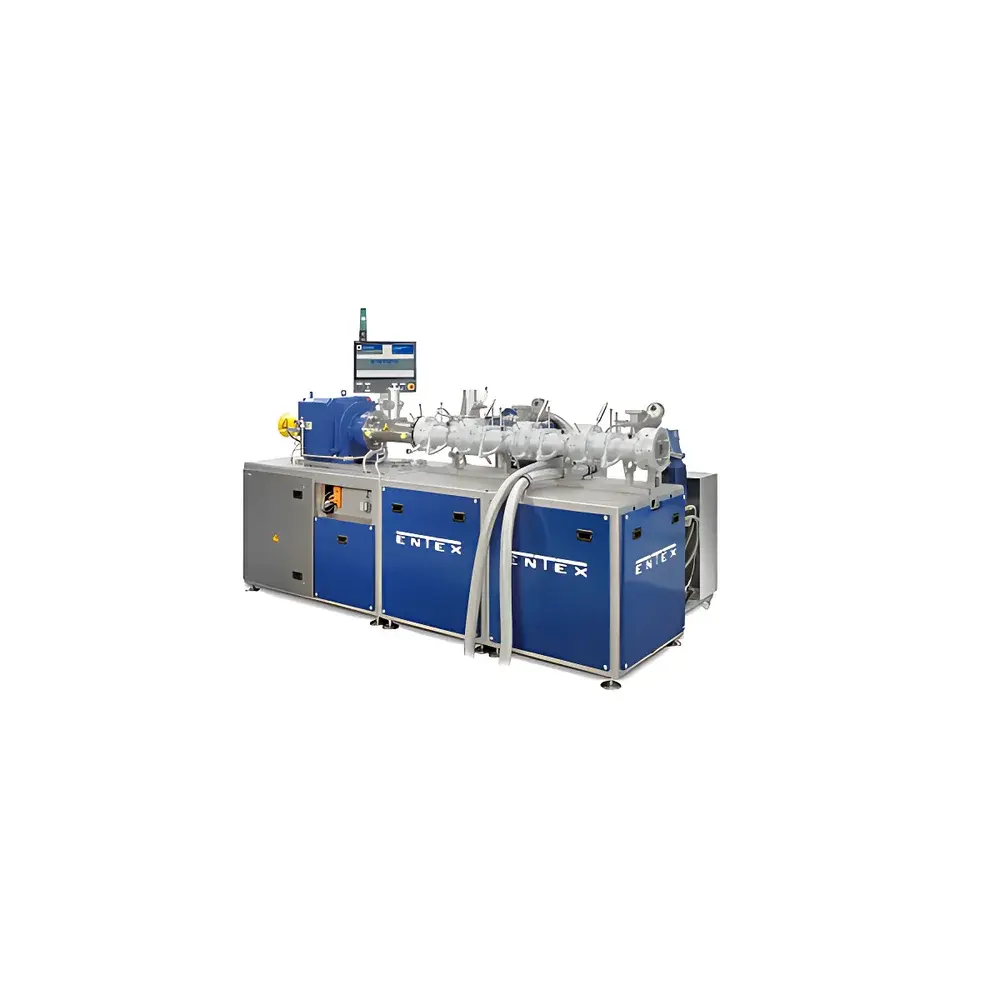
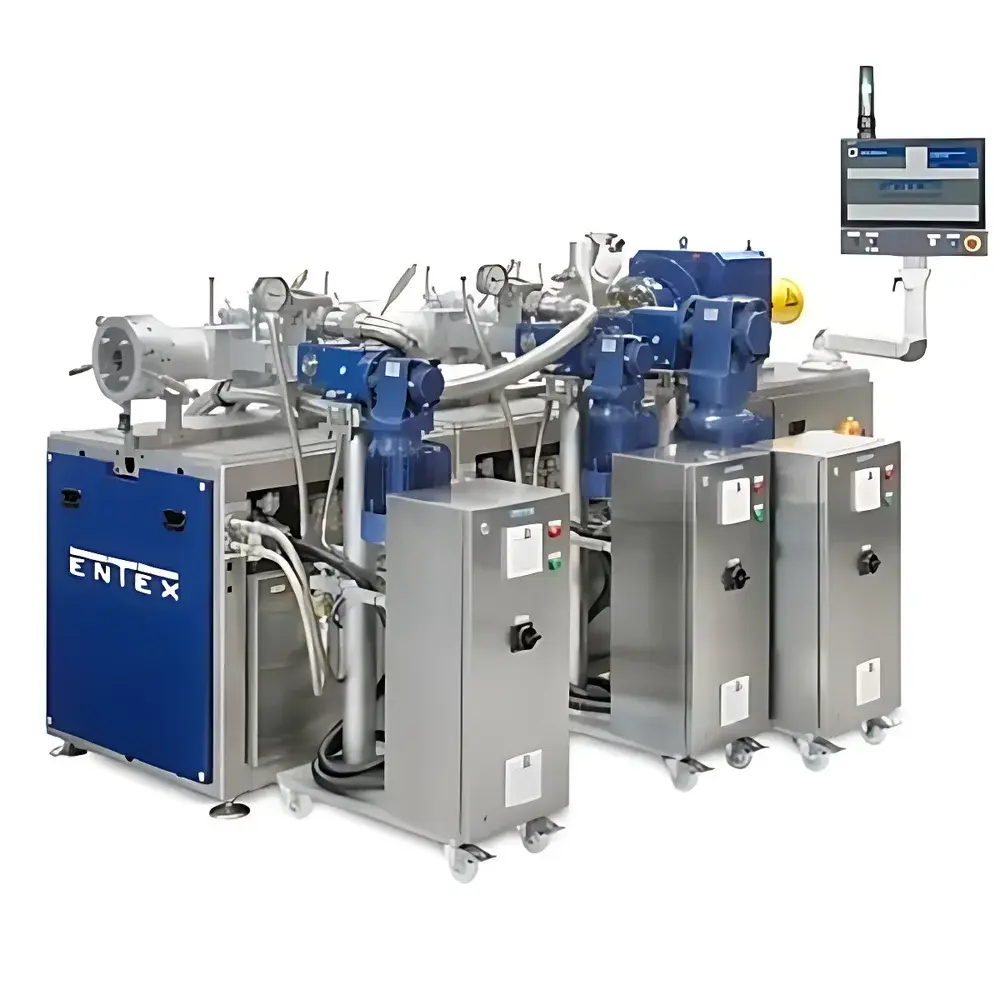
ENTEX L-WE 70 Modular Twin-Screw Extruder System
| Brand | ENTEX |
|---|---|
| Origin | Germany |
| Model | L-WE 70 |
| Type | Modular Twin-Screw Extruder for R&D and Process Simulation |
| Configuration | Horizontal, Co-rotating, Intermeshing |
| Screw Diameter | 70 mm |
| Modular Barrel Design | Yes |
| Drive Power | Up to 110 kW (configurable) |
| Screw Speed Range | 0–600 rpm |
| Torque Rating | Up to 450 Nm |
| Temperature Control Zones | Up to 12 independent zones |
| Feed Port Options | Gravimetric & Volumetric |
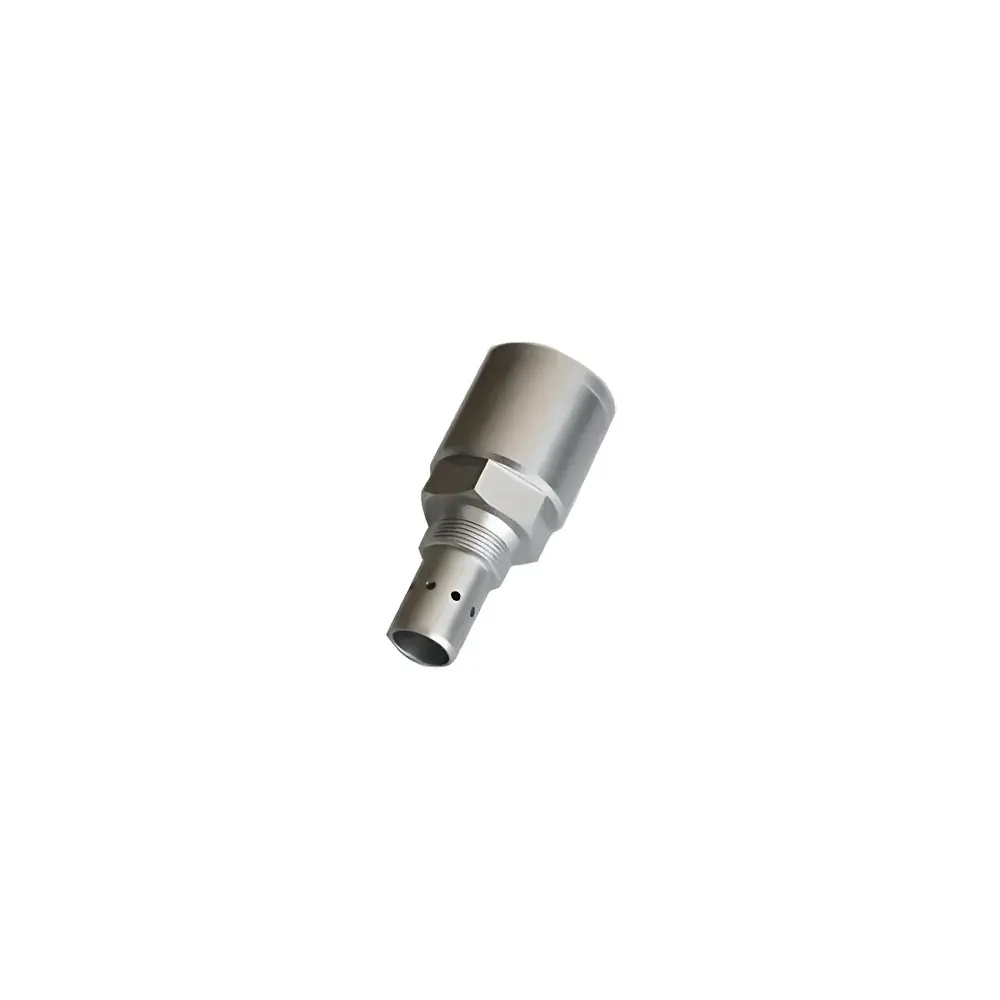
| Optional Add-ons | Melt pump, inline rheometer, strand pelletizer, vacuum venting, side feeder, liquid injection unit |
| Compliance | CE-marked, compliant with ISO 12100 (machinery safety), EN 61000-6-2/-4 (EMC) |
Overview
The ENTEX L-WE 70 is a high-precision, modular twin-screw extruder engineered for laboratory-scale formulation development, process validation, and scalable technology transfer in rubber, thermoplastic elastomer (TPE), compound, and filled polymer systems. Based on co-rotating, intermeshing screw geometry, it replicates the shear history, residence time distribution, and thermal profile of full-scale production extruders—enabling direct correlation between lab trials and industrial manufacturing. Its core architecture follows the Couette flow principle under controlled torque and temperature boundary conditions, supporting quantitative evaluation of melt viscosity, dispersion homogeneity, thermal degradation kinetics, and filler-matrix interaction. Designed and manufactured in Germany, the system meets stringent European machinery safety and electromagnetic compatibility standards, ensuring operational reliability in regulated R&D environments.
Key Features
- Modular barrel system with interchangeable heating/cooling zones (up to 12 independently controlled segments), enabling precise axial thermal profiling from feed throat to die.
- High-torque, variable-speed DC or servo-driven main drive (0–600 rpm, up to 450 Nm), delivering stable shear rates across low- to high-viscosity materials including carbon-black-filled EPDM, silica-reinforced TPSiV, and reactive polymer blends.
- Interchangeable screw configurations—including conveying, kneading, reverse, and mixing elements—allow rapid reconfiguration for compounding, devolatilization, reactive extrusion, or masterbatch dilution.
- Integrated gravimetric feeder with loss-in-weight control (±0.25% repeatability) and optional side feeder for additives, fillers, or liquid initiators, supporting multi-component feeding under GLP-aligned documentation protocols.
- Rigid cast-iron machine frame with precision-machined mounting interfaces ensures mechanical stability during long-duration runs and minimizes vibration-induced measurement drift.
- Standardized flange interfaces (DIN 28178 / ISO 2852) enable seamless integration with downstream units: gear pumps, static mixers, inline capillary rheometers (e.g., Gottfert RheoLogie), vacuum venting modules, and underwater pelletizers.
Sample Compatibility & Compliance
The L-WE 70 accommodates a broad spectrum of polymeric and elastomeric feedstocks: unfilled and reinforced thermoplastics (PP, PA6/66, PC, PBT), thermoplastic vulcanizates (TPVs), silicone compounds, styrenic block copolymers (TPE-S), and reactive systems involving peroxides or silanes. It supports ASTM D3740-compliant operator qualification procedures and is routinely deployed in laboratories operating under ISO/IEC 17025-accredited quality management systems. All electrical and mechanical subsystems carry CE marking per Machinery Directive 2006/42/EC and EMC Directive 2014/30/EU. Optional audit-trail-enabled HMI firmware supports FDA 21 CFR Part 11 compliance when integrated with validated data acquisition platforms.
Software & Data Management
The extruder operates via ENTEX’s proprietary EXTRUSOFT control suite, running on a real-time Windows-based industrial PC. The software provides synchronized logging of >50 process variables—including torque, melt pressure (via DIN 3852-compliant transducers), barrel zone temperatures, screw speed, feed rate, and motor current—at configurable sampling intervals (10 ms to 1 s). Raw data exports to CSV or HDF5 formats; trend analysis, batch comparison, and statistical process monitoring (SPC) are supported through built-in tools or third-party integrations (e.g., MATLAB, Python Pandas). For GMP environments, optional 21 CFR Part 11 add-on enables electronic signatures, role-based access control, and immutable audit trails for all parameter changes and run records.
Applications
- Formulation screening of polymer blends, nanocomposites, and conductive compounds under reproducible shear–temperature histories.
- Process window definition for scale-up: determination of optimal screw speed, feed rate, and barrel temperature profiles prior to pilot-line trials.
- Evaluation of dispersion quality in carbon black or silica-filled rubber compounds using inline rheometry or post-extrusion morphology analysis (SEM/TEM).
- Reactive extrusion studies—grafting, crosslinking, and compatibilization—leveraging controlled residence time and vacuum-assisted devolatilization.
- Customer-specific prototyping: rapid generation of physical samples for mechanical testing (tensile, hardness, compression set) or regulatory submission dossiers (e.g., REACH, RoHS).
- Training platform for plant engineers on extrusion fundamentals, troubleshooting, and DOE-based optimization methodologies.
FAQ
Can the L-WE 70 simulate single-screw extrusion behavior?
Yes—through specialized screw designs (e.g., low-compression conveying elements and shallow flights) and controlled feed rate modulation, it can approximate key single-screw output characteristics, though its primary design intent remains twin-screw compounding fidelity.
What is the typical lead time for custom screw configuration?
Standard configurations ship within 8–10 weeks; custom geometries requiring new tooling require 14–16 weeks from final drawing approval.
Is remote diagnostics supported?
Yes—the system includes embedded Ethernet/IP connectivity and optional TeamViewer-hosted remote maintenance access, subject to customer network security policies.
Does ENTEX provide application support for material-specific trials?
Yes—ENTEX Application Labs in Aachen offer fee-based trial services, including DOE setup, rheological characterization, and technical reporting aligned with ASTM D1238, ISO 1133, or customer-defined specifications.
How is calibration traceability maintained?
All temperature sensors are calibrated annually against NIST-traceable references; pressure transducers are verified per ISO 9001 internal procedures, with certificates available upon request.