
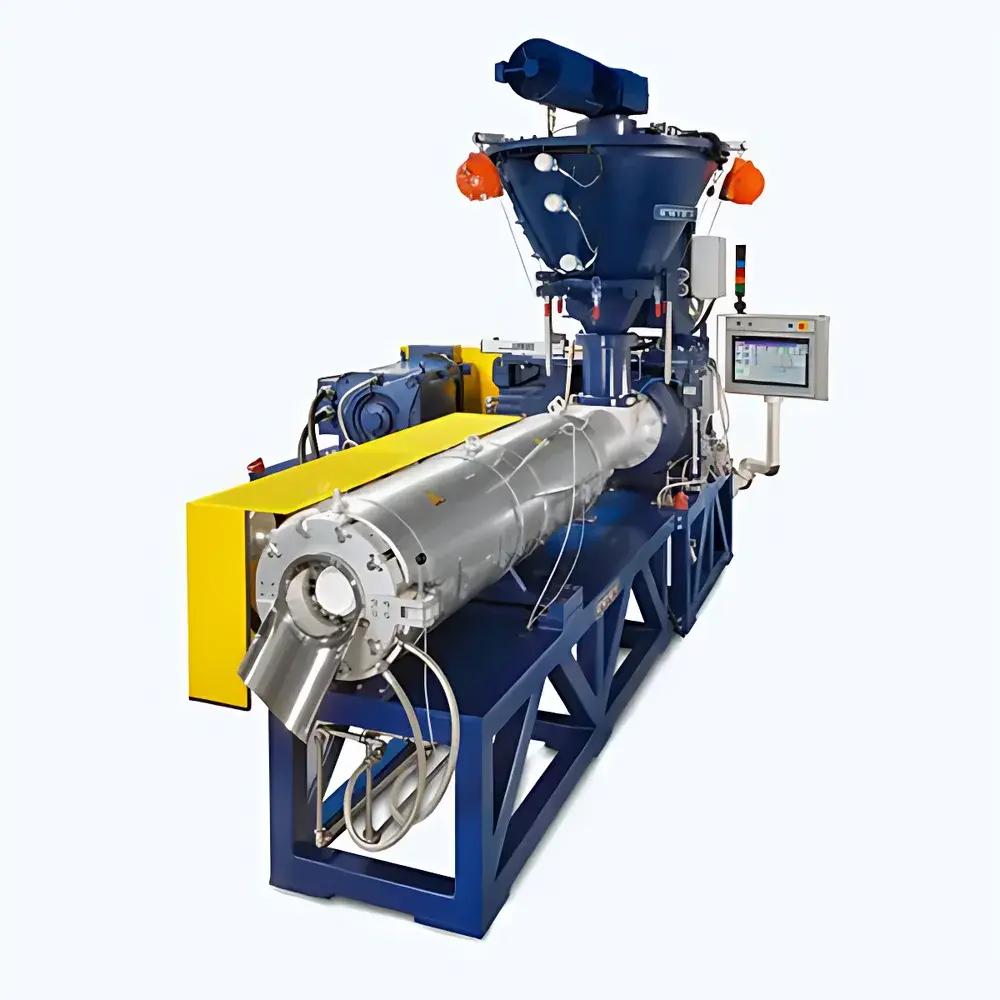
ENTEX Extrusion Line for Rubber & Plastic Processing
| Brand | ENTEX |
|---|---|
| Origin | Germany |
| Model | Extrusion Line |
| Type | Modular Planetary Screw Extruder System |
| Application Scope | Adhesives, Thermoplastics, Elastomers, Chemicals, Food-Grade Compounding |
| Configuration | Customizable Modular Design (Feeding, Melting, Mixing, Homogenization, Devolatilization) |
| Compliance | Designed to Meet ISO 9001 Manufacturing Standards and CE Machinery Directive 2006/42/EC |
Overview
The ENTEX Extrusion Line is a high-precision, modular planetary screw extrusion system engineered for continuous compounding, devolatilization, and reactive processing in demanding industrial environments. Unlike conventional single- or twin-screw extruders, the planetary screw architecture features a central sun screw surrounded by multiple satellite screws rotating within a fixed barrel—enabling exceptionally uniform shear distribution, superior melt homogeneity, and precise thermal control across the entire process zone. This configuration minimizes localized overheating and degradation, making it especially suitable for heat-sensitive polymers, high-viscosity elastomers, filled compounds, and multi-component adhesive formulations. The system operates on a fully modular principle: each functional unit—including gravimetric feeders, vacuum venting stations, gear pumps, die heads, and downstream pelletizing or calendering modules—is independently configurable and mechanically decoupled, allowing seamless integration into existing production lines or turnkey installation for new facilities.
Key Features
- Modular planetary screw design with interchangeable screw elements optimized for feeding, melting, distributive/dispersive mixing, and high-efficiency devolatilization
- Integrated torque monitoring and real-time melt temperature profiling via embedded Pt100 sensors at multiple axial positions
- CE-compliant safety architecture including emergency stop circuits, interlocked access doors, and hydraulic pressure relief systems
- Stainless steel wetted parts compliant with FDA 21 CFR §177.2400 for food-contact applications and USP Class VI certification for pharmaceutical-grade elastomer processing
- Variable-frequency drive (VFD) control of main drive motor (IE3 efficiency class), enabling precise screw speed regulation from 5–120 rpm with ±0.2% speed stability
- Optional integrated mass flow metering and inline rheometry for closed-loop viscosity feedback during continuous operation
Sample Compatibility & Compliance
The ENTEX Extrusion Line accommodates a broad spectrum of thermoplastic and thermoset materials—including polyolefins (PP, PE), engineering resins (PA6/66, PC, PBT), TPEs, silicone and EPDM rubber compounds, solvent-based adhesives, and reactive hot-melt formulations. Its modular barrel design supports both atmospheric and high-vacuum (<1 mbar) devolatilization zones, ensuring effective removal of residual monomers, solvents, or moisture without thermal decomposition. All electrical and mechanical subsystems conform to IEC 61800-5-1 (adjustable speed electrical power drive systems) and ISO 13857 (safety distances to prevent hazard zone access). Documentation packages include EU Declaration of Conformity, EC Type Examination Certificate (Notified Body No. 0197), and full traceability of critical components per ISO 9001:2015 quality management requirements.
Software & Data Management
Control is executed via ENTEX’s proprietary EXTRU-OS v4.2 HMI platform, running on an industrial-grade IPC with redundant SSD storage. The system provides full audit trail functionality compliant with FDA 21 CFR Part 11, including electronic signatures, user role-based access control (admin/operator/maintenance), and immutable event logging of all parameter changes, alarms, and batch records. Batch data—including screw speed, torque, melt pressure, zone temperatures, and feeder throughput—is timestamped and exportable in CSV or ASTM E1382-compliant XML format. Optional OPC UA server integration enables direct connectivity to MES/SCADA platforms (e.g., Siemens SIMATIC IT, Rockwell FactoryTalk) for real-time KPI dashboards and predictive maintenance analytics.
Applications
- High-filler loading compounding (e.g., CaCO₃-, silica-, or carbon black-filled TPEs and rubber masterbatches)
- Low-volatility adhesive production with <50 ppm residual solvent content
- Reactive extrusion of polyurethane prepolymers and silane-grafted polyolefins
- GMP-compliant medical-grade polymer extrusion (ISO 10993-1 biocompatibility support documentation available)
- Recycled polymer decontamination and stabilization using multi-stage vacuum stripping
- Lab-to-production scale-up via geometrically similar modular units (1:5 to 1:20 linear scale ratios validated)
FAQ
Is the ENTEX Extrusion Line suitable for processing silicone rubber compounds?
Yes—the system’s low-shear planetary architecture and precise temperature zoning minimize scorch risk and ensure homogeneous dispersion of high-viscosity silicone gums and fillers.
Can the line be retrofitted with inline spectroscopy for real-time composition monitoring?
Yes—standardized flanged ports are provided at key process locations (melt stream, devolatilization exit) for integration of FTIR or Raman probes compatible with ASTM E1655 spectral data handling protocols.
What level of validation support is provided for regulated industries?
ENTEX delivers full IQ/OQ documentation packages aligned with ISO/IEC 17025 and GAMP5 guidelines, including factory acceptance testing (FAT) reports, sensor calibration certificates, and software verification summaries.
Does the system support co-rotating or counter-rotating configurations?
The planetary screw design operates inherently in a fixed kinematic relationship; rotation direction is not adjustable—but its distributed shear profile eliminates the need for alternative screw rotation modes.
Are spare parts and technical service available outside the EU?
Yes—ENTEX maintains authorized service hubs in North America (Ohio), China (Shanghai), and Brazil (São Paulo), with 72-hour critical spares dispatch and remote diagnostics via encrypted VNC tunneling.





