
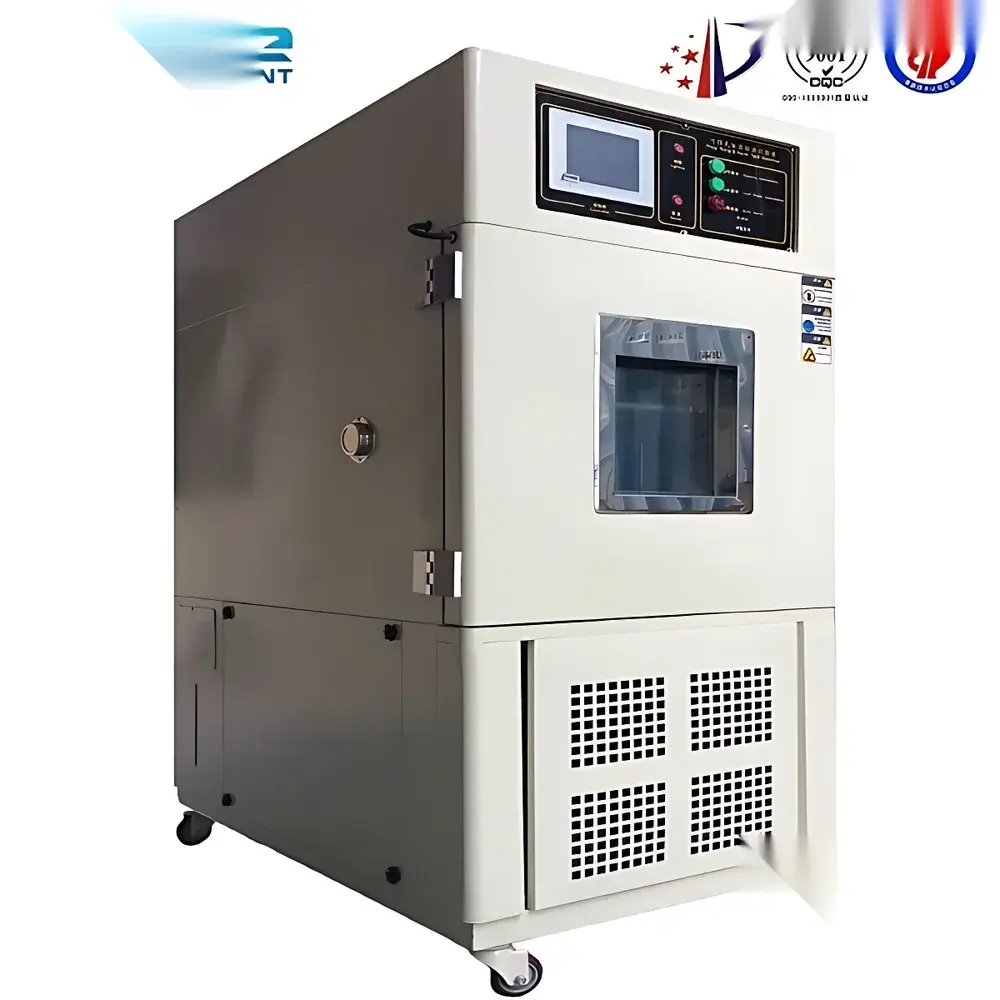
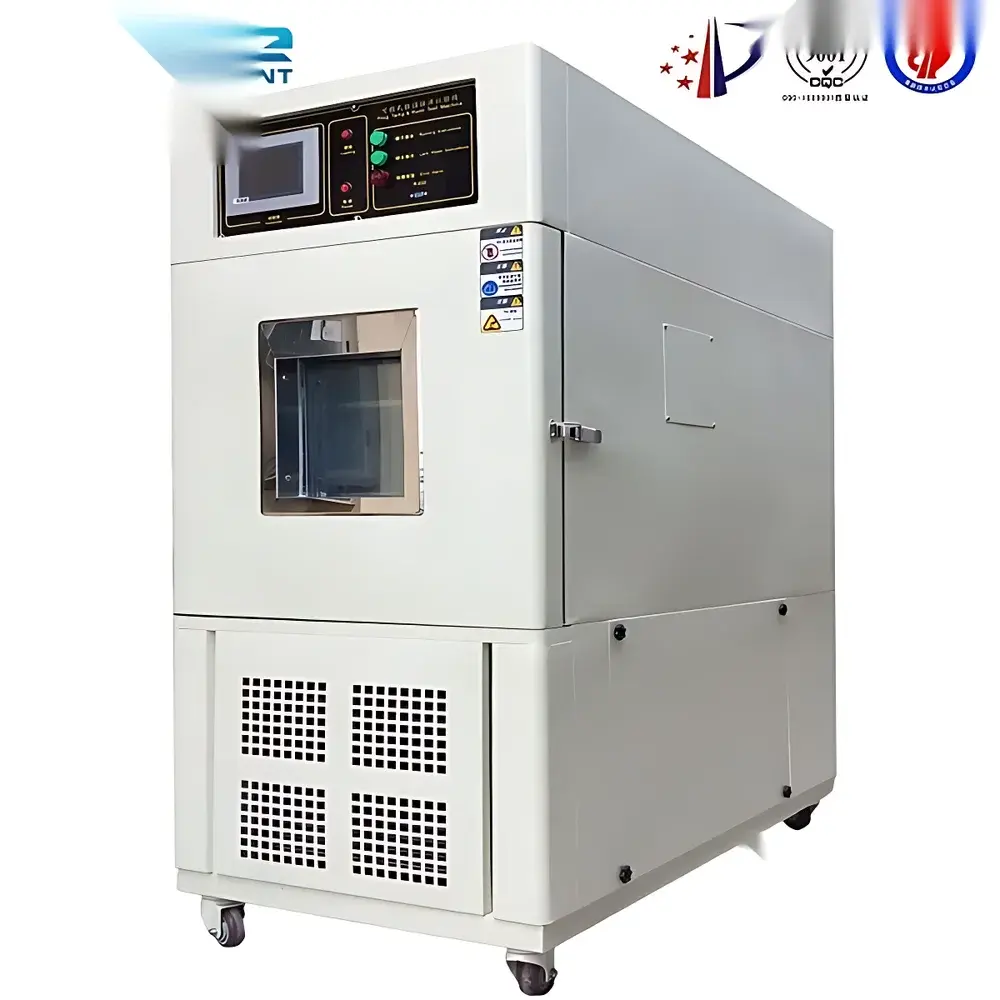
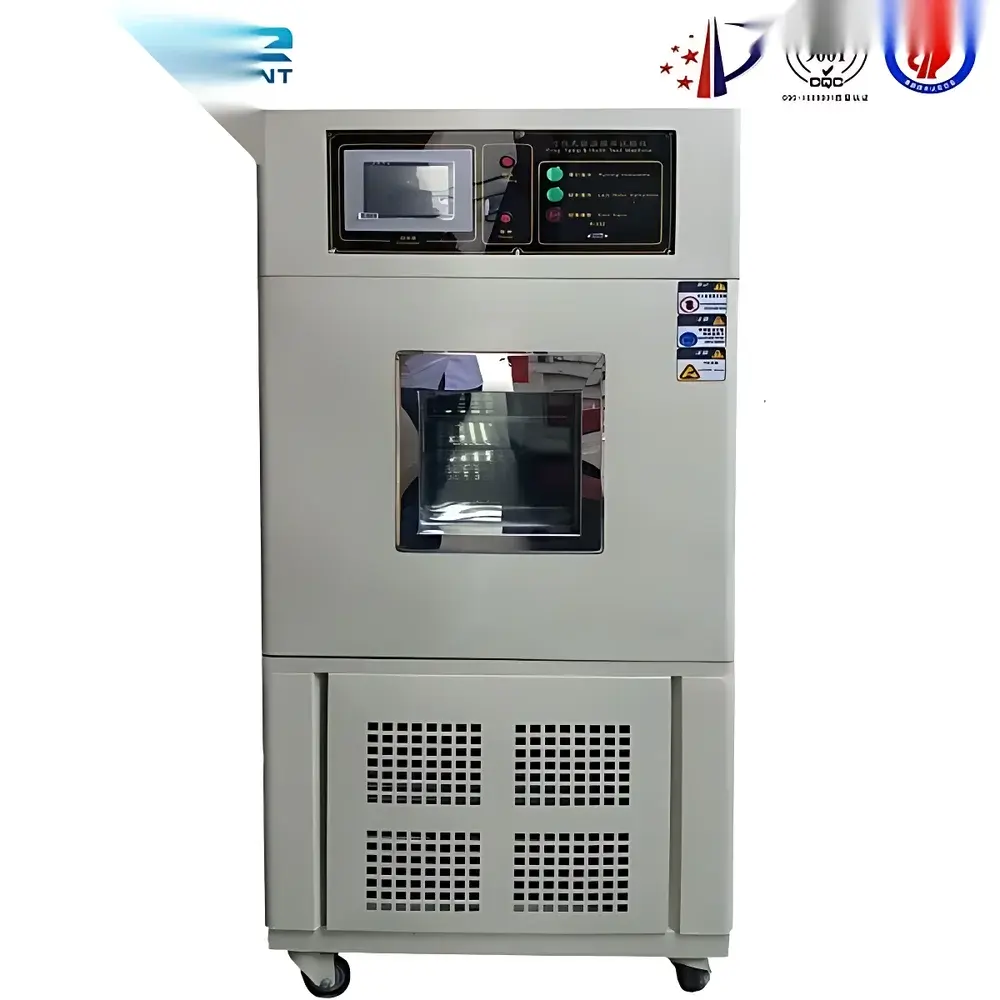
Environmental Test Chamber – Temperature and Humidity Controlled Chamber (OEM/ODM Supply)
No specifications available.
Overview
The Environmental Test Chamber – Temperature and Humidity Controlled Chamber is an industrial-grade climatic simulation system engineered for precise, repeatable, and long-term exposure testing of materials, components, and finished products under defined thermal and hygrothermal stress conditions. It operates on the principle of balanced temperature and humidity control (BTHC), utilizing proportional-integral-derivative (PID) regulation of solid-state relays (SSRs) to dynamically match heating and humidification output against thermal and moisture losses within the chamber cavity. This closed-loop architecture ensures stable setpoint maintenance across wide operational ranges—typically spanning −40 °C to +150 °C in temperature and 20 %RH to 98 %RH in relative humidity—without drift or overshoot. Designed for compliance-driven R&D, quality assurance, and reliability validation workflows, the chamber supports both steady-state conditioning and programmed ramp-soak profiles, with air-based average temperature change rates specified under no-load, ambient reference conditions (25 °C ±6 °C).
Key Features
- Robust dual-system safety architecture: independent overtemperature protection, dry-run prevention for humidifiers, low-water-level cutoff, compressor overload/overheat/overcurrent monitoring, high-pressure refrigerant switch, molded-case circuit breaker, and residual-current device (RCD) for personnel and equipment safety.
- Advanced BTHC control logic with PID-SSR actuation ensures thermodynamic equilibrium between energy input and chamber thermal/hygrometric loss—enabling extended unattended operation with <±0.5 °C temperature uniformity and <±2 %RH humidity stability (per IEC 60068-3-5).
- Full-capillary tube refrigeration system with automatic capacity modulation—eliminating mechanical expansion valves for enhanced reliability, smoother cooling transitions, and improved low-temperature recovery performance compared to conventional TXV-based designs.
- Ergonomic, arc-shaped stainless steel enclosure with flush-mounted non-reactive handles and a high-resolution capacitive touch controller featuring intuitive navigation, multi-segment program editing, real-time trend logging, and password-protected parameter access levels.
- Modular construction allows customizable internal dimensions and optional integration of auxiliary ports (e.g., electrical feedthroughs, sensor conduits, or purge gas inlets) to accommodate application-specific test fixtures and instrumentation.
Sample Compatibility & Compliance
This chamber accommodates a broad range of sample types—including electronic assemblies, polymer composites, automotive trim, aerospace fasteners, pharmaceutical packaging, and coated metal substrates—without compromising environmental fidelity. Its structural design conforms to international mechanical and electrical safety standards, including IEC 61000-6-2 (immunity) and IEC 61000-6-4 (emissions). The system meets or exceeds requirements for environmental stress screening (ESS) per MIL-STD-2164A, GJB 1032–90, and GJB 234–5.1.6, as well as basic environmental testing per GB/T 2423.1–2023 (cold), GB/T 2423.2–2023 (dry heat), IEC 60068-2-1 (cold), and IEC 60068-2-2 (dry heat). Calibration traceability follows ISO/IEC 17025 guidelines when performed by accredited service providers.
Software & Data Management
The embedded controller supports local data capture at user-configurable intervals (1–600 seconds), storing up to 10,000 data points internally with timestamping and alarm event tagging. Optional Ethernet or RS-485 interfaces enable remote monitoring via industry-standard protocols (Modbus RTU/TCP). For regulated environments, optional software packages provide 21 CFR Part 11-compliant audit trails, electronic signatures, role-based access control, and automated report generation in PDF or CSV formats—supporting GLP and GMP documentation requirements. All firmware updates are digitally signed and validated prior to installation to ensure integrity and continuity of validation status.
Applications
- Accelerated aging studies of elastomers, adhesives, and conformal coatings under combined thermal-hygric cycling.
- Pre-conditioning of lithium-ion battery cells prior to electrochemical characterization per UN 38.3 Section 4.1.
- Stability testing of medical device packaging in accordance with ISO 11607-1.
- Environmental stress screening (ESS) of avionics modules to identify latent manufacturing defects before field deployment.
- Validation of HVAC filter media performance under high-humidity, elevated-temperature exposure per ASHRAE Standard 52.2.
- Material compatibility assessment for spacecraft thermal control coatings exposed to simulated low-Earth orbit thermal vacuum cycling (with optional vacuum integration).
FAQ
What is the typical cooling water requirement for optimal chamber performance?
Cooling water must be maintained between 10 °C and 28 °C, with inlet pressure regulated to 0.1–0.3 MPa. Deviations outside this range may impair condenser efficiency and extend cooldown times.
How does load affect temperature and humidity ramp rates?
Ramp rates are specified under no-load, ambient-reference conditions. Actual performance varies with specimen mass, thermal mass, surface emissivity, and internal airflow obstruction. Load-dependent derating should be applied during test planning per IEC 60068-3-5 Annex D.
Can internal dimensions be customized?
Yes. Standard external footprints exclude protrusions (e.g., compressors, exhaust ducts). Internal volume and door configuration can be tailored to customer specifications without compromising chamber class certification.
Is the system compliant with FDA or EU regulatory frameworks?
While the base unit is not inherently certified for GxP use, it supports full qualification (IQ/OQ/PQ) and can be configured with 21 CFR Part 11–compliant software and audit-trail functionality upon request.
What maintenance intervals are recommended for sustained accuracy?
Compressor oil and refrigerant levels should be verified annually; humidity sensors require recalibration every six months; chamber seals and drain lines must be inspected quarterly. Full preventive maintenance is advised per ISO 13374–2 condition monitoring guidelines.



