
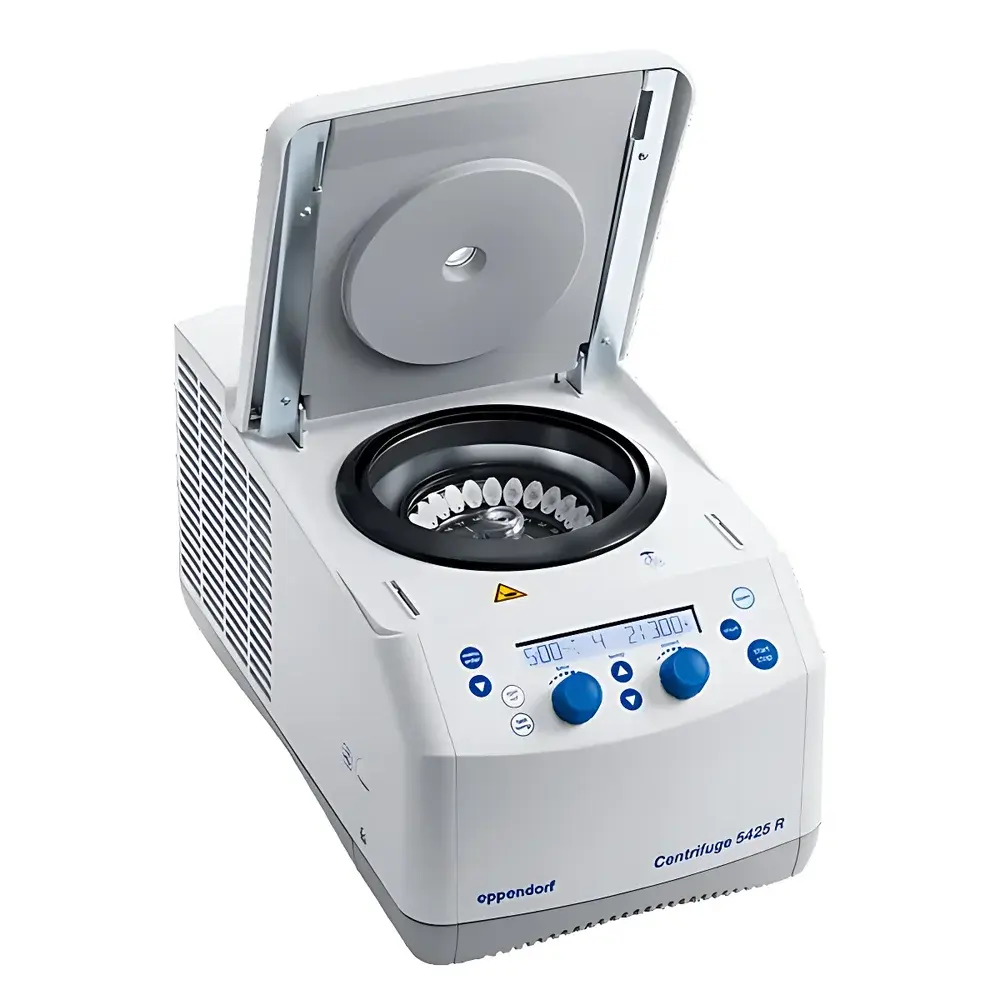
Eppendorf 5425 R Compact High-Speed Refrigerated Centrifuge
| Brand | Eppendorf |
|---|---|
| Origin | Germany |
| Manufacturer | Eppendorf AG |
| Product Type | Benchtop Refrigerated Centrifuge |
| Model | 5425 R |
| Speed Range | 100–15,060 rpm |
| Max RCF | 21,300 × g |
| Max Capacity | 10 × 5 mL |
| Temperature Range | −10 °C to 40 °C |
| Noise Level | <54 dB(A) |
| Timer Range | 10 s – 9 h 59 min |
| Dimensions (W × D × H) | 29 × 48 × 26 cm |
| Rotor Compatibility | Universal with Eppendorf 5425 series |
| Sterilization | Autoclavable rotors (CAMR-certified airtight lids) |
| Cooling System | High-efficiency compressor with ECO standby mode |
| Key Features | FastTemp pre-cooling (21 °C → 4 °C in 8 min), SOFT brake, At set rpm timing, Short spin button, rpm/rcf toggle, condensate tray |
Overview
The Eppendorf 5425 R Compact High-Speed Refrigerated Centrifuge is an engineered solution for temperature-sensitive biomolecular workflows in molecular biology, cell culture, and clinical research laboratories. Designed around the principles of precise refrigeration control and high-speed rotor dynamics, it employs a brushless drive motor coupled with a high-efficiency hermetic compressor system to maintain stable thermal conditions across the full operational range (−10 °C to 40 °C). Its compact footprint (29 × 48 × 26 cm) and low acoustic signature (<54 dB[A]) enable seamless integration into biosafety cabinets, cold rooms, and shared core facilities without compromising performance or ergonomics. The centrifuge operates on the fundamental principle of sedimentation under controlled gravitational force (RCF), where rotational motion generates radial acceleration that separates particles based on mass, density, and shape—critical for isolating nucleic acids, organelles, protein complexes, and cellular debris.
Key Features
- FastTemp Pre-Cooling: Achieves 4 °C chamber temperature from ambient (21 °C) in ≤8 minutes—enabling rapid workflow initiation without extended wait times.
- SOFT Brake Technology: Gradually decelerates rotors to prevent resuspension of delicate pellets, preserving integrity of RNA, plasmid DNA, and membrane fractions.
- At Set rpm Timing: Initiates countdown only after reaching user-defined speed—ensuring consistent exposure time at target RCF, essential for reproducible pelleting in quantitative assays.
- Short Spin Function: One-touch activation for transient centrifugation (e.g., quick tube wall collection), eliminating need for sustained button pressure.
- rpm/rcf Toggle: Real-time unit conversion on display supports protocol alignment with literature-based RCF specifications or instrument-specific rpm calibration.
- Condensate Management System: Integrated condensate tray prevents moisture accumulation inside the chamber, mitigating corrosion risk and supporting long-term reliability under repeated freeze-thaw cycles.
- ECO Standby Mode: Automatically reduces compressor activity during idle periods while maintaining setpoint temperature—extending service life and reducing energy consumption.
Sample Compatibility & Compliance
The 5425 R accommodates standard microcentrifuge formats including 1.5/2.0 mL tubes (up to 24), 5 mL conical tubes (up to 10), and 0.2 mL PCR strips or plates (up to 96 wells). All aluminum rotors are compatible with the broader Eppendorf 5425 platform, ensuring interchangeability and minimizing inventory complexity. Rotor lids are certified airtight by the UK’s Campden BRI (formerly CAMR) Applied Microbiology Research Centre and validated for autoclaving at 121 °C for 20 minutes—meeting ISO 13485 and GLP-compliant sterilization requirements. The device complies with IEC 61010-1 (safety) and IEC 61326-1 (EMC), and its temperature stability profile supports adherence to USP Analytical Instrument Qualification guidelines for routine laboratory use.
Software & Data Management
While the 5425 R operates via an intuitive front-panel interface without external software dependency, its embedded firmware supports audit-ready operation in regulated environments. All parameter changes—including temperature setpoint, speed, time, and brake profile—are logged internally with timestamped entries. Though not FDA 21 CFR Part 11–compliant out-of-the-box, the system permits manual documentation of run records in accordance with GMP/GLP traceability standards. Optional integration with Eppendorf’s VisioNize Lab Suite (via USB or network gateway) enables remote monitoring, fleet management, and electronic logbook generation—facilitating compliance with ISO/IEC 17025 quality management systems.
Applications
This centrifuge serves as a primary workhorse for routine and sensitive separation tasks, including but not limited to: phenol-chloroform nucleic acid extraction; spin-column–based purification of genomic DNA, mRNA, and miRNA; clarification of lysates post-sonication or enzymatic digestion; pelleting of bacterial cultures prior to plasmid isolation; recovery of PCR products from multiplex reactions; and preparation of supernatants for ELISA or mass spectrometry analysis. Its ability to maintain 4 °C throughout high-speed runs ensures enzyme stability during rapid spin-down steps in enzymatic assays and kinase activity profiling.
FAQ
Can the 5425 R be used for continuous operation at maximum speed and low temperature?
Yes—the compressor and thermal architecture support sustained operation at 15,060 rpm and 4 °C, provided ambient conditions remain within specified environmental limits (15–30 °C, ≤80% RH).
Are all rotors autoclavable?
All aluminum rotors and CAMR-certified airtight lids are fully autoclavable; however, polymer components (e.g., rotor adapters, tube holders) must be verified against manufacturer-recommended sterilization protocols.
Does the 5425 R meet international safety standards?
It conforms to IEC 61010-1 for electrical safety and IEC 61326-1 for electromagnetic compatibility, with CE marking valid for EU markets and recognized under mutual recognition agreements in Canada, Australia, and Singapore.
How does the condensate tray improve long-term reliability?
By capturing and channeling condensed moisture away from electronics and rotor seating surfaces, it prevents galvanic corrosion and maintains mechanical precision over thousands of cycles.
Is rotor balancing required before each run?
Yes—manual balance remains mandatory per IEC 61010-2-020; the instrument does not include automatic imbalance detection, though its robust suspension system tolerates minor deviations typical of microcentrifuge applications.



