
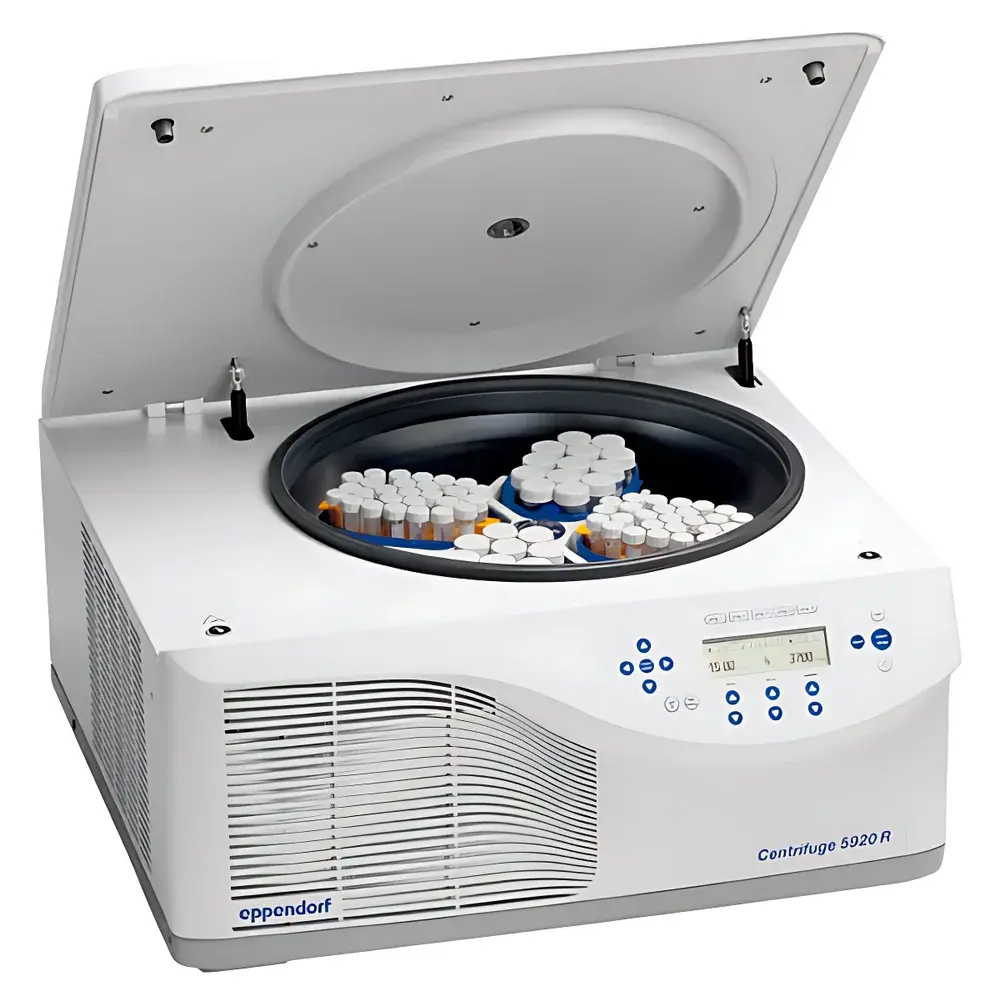
Eppendorf 5920 R Refrigerated Benchtop Centrifuge
| Brand | Eppendorf |
|---|---|
| Origin | Germany |
| Manufacturer | Eppendorf AG |
| Type | Benchtop Refrigerated Centrifuge |
| Model | 5920 R |
| Maximum Speed | 14,000 rpm |
| Maximum RCF | 22,132 × g |
| Maximum Capacity | 4 × 1000 mL |
| Temperature Range | −11 °C to 40 °C |
| Dimensions (W × D × H) | 740 × 710 × 400 mm |
| Rotor Type | Horizontal (Swinging-Bucket) |
| Application Class | Biomolecular Separation |
| Compliance | IEC 61010-1, ISO 13485 (for medical device manufacturing), GLP/GMP-ready audit trail support via software |
Overview
The Eppendorf 5920 R is a high-capacity refrigerated benchtop centrifuge engineered for reproducible, temperature-sensitive biomolecular separations in demanding laboratory environments. Utilizing horizontal (swinging-bucket) rotor dynamics and precision-controlled refrigeration, it delivers consistent sedimentation profiles across large-volume samples—particularly critical for cell harvesting, virus purification, organelle isolation, and preparative nucleic acid workflows. Its 4 × 1000 mL capacity accommodates standard Nalgene® wide-mouth or narrow-neck 1 L bottles—enabling full-scale process-scale prep without requiring floor-standing instrumentation. Unlike conventional benchtop units limited to ≤2 L total volume, the 5920 R redefines throughput boundaries while maintaining strict adherence to space-constrained lab footprints (740 × 710 × 400 mm). The system integrates dynamic compressor control (DCC) and FastTemp Pro scheduling to ensure thermal stability during both active runs and standby—essential for preserving labile proteins, exosomes, or primary cell lysates.
Key Features
- Horizontal S-4×1000 rotor with integrated workplate/tube hybrid carrier—supports simultaneous centrifugation of microtiter plates (MTPs), PCR strips, deep-well plates, and up to 40 × 50 mL conical tubes or 140 mm × 13 mm round-bottom tubes
- Eppendorf QuickLock sealing mechanism on both rotor lid and bucket covers—ensures rapid, tool-free closure with validated aerosol containment per EN 149:2001+A1:2009 standards
- Intelligent temperature management: −11 °C to 40 °C operating range; FastTemp Pro allows time- and date-stamped pre-cooling sequences; standby cooling maintains chamber setpoint without continuous compressor cycling
- Energy-optimized operation: <2 W standby power consumption; ECO mode automatically deactivates compressor after user-defined idle period (default 8 h), extending service life and reducing operational cost
- Automated rotor recognition and real-time imbalance detection—prevents mechanical stress and ensures compliance with IEC 61010-1 safety requirements
- Large backlit graphical display with multilingual menu navigation (English, German, French, Spanish, Chinese, Japanese); stores up to 99 user-defined protocols; five programmable quick-start keys for routine assays
Sample Compatibility & Compliance
The 5920 R supports broad sample container compatibility—from 0.2 mL PCR tubes to 1000 mL reagent bottles—via interchangeable adapters and purpose-engineered rotors including fixed-angle variants (up to 25,062 × g at 13,700 rpm) for high-g applications such as plasmid pelleting or membrane fractionation. All rotors are certified for autoclaving (121 °C, 20 min) and validated for long-term mechanical integrity under cyclic load conditions. The system meets ISO 13485 requirements for manufacturers of in vitro diagnostic devices and supports GLP/GMP documentation workflows through optional Eppendorf VisioN software, which logs all run parameters—including temperature history, rotor ID, acceleration/deceleration profiles, and operator credentials—with tamper-evident digital signatures compliant with FDA 21 CFR Part 11.
Software & Data Management
When paired with Eppendorf VisioN PC software (sold separately), the 5920 R enables centralized instrument monitoring, remote protocol deployment, and electronic lab notebook (ELN) integration. Audit trails capture timestamped events—start/stop commands, parameter edits, door openings, error codes—with role-based access control. Export functions support CSV and PDF formats compatible with LIMS platforms. All firmware updates are digitally signed and delivered via secure HTTPS channel, ensuring traceability and cybersecurity alignment with NIST SP 800-53 Rev. 5 controls.
Applications
- Preparative isolation of mammalian cells, bacteria, and yeast from fermentation or culture supernatants
- Cold-active enzyme purification where sustained sub-10 °C rotor temperatures prevent denaturation
- High-yield plasmid DNA extraction using alkaline lysis followed by 1000 mL-scale pelleting
- Extracellular vesicle (EV) enrichment from serum or conditioned media using differential ultracentrifugation-compatible protocols
- Quality control of biopharmaceutical intermediates—including monoclonal antibody aggregates—under controlled thermal conditions
- Environmental microbiology workflows involving large-volume water sample concentration prior to qPCR analysis
FAQ
What is the maximum relative centrifugal force (RCF) achievable with the standard S-4×1000 horizontal rotor?
The S-4×1000 rotor achieves a maximum RCF of 22,132 × g at 14,000 rpm.
Can the 5920 R accommodate standard 96-well microtiter plates?
Yes—the optional S-4×1000 workplate/tube hybrid carrier accepts ANSI/SLAS-compliant MTPs, including flat-bottom, U-bottom, and V-bottom plates, as well as PCR and deep-well formats.
Does the system support regulatory compliance for pharmaceutical QC laboratories?
Yes—when used with VisioN software and configured with audit trail logging enabled, the instrument satisfies core elements of FDA 21 CFR Part 11, EU Annex 11, and ISO/IEC 17025 documentation requirements.
How does the Dynamic Compressor Control (DCC) improve thermal performance?
DCC continuously modulates refrigerant flow based on real-time thermal load, minimizing temperature overshoot during ramp-up and stabilizing cavity temperature within ±0.5 °C during extended runs.
Is rotor calibration required after each autoclave cycle?
No—Eppendorf-certified rotors undergo factory calibration with permanent laser-etched identification; no field recalibration is needed unless physical damage occurs.



