
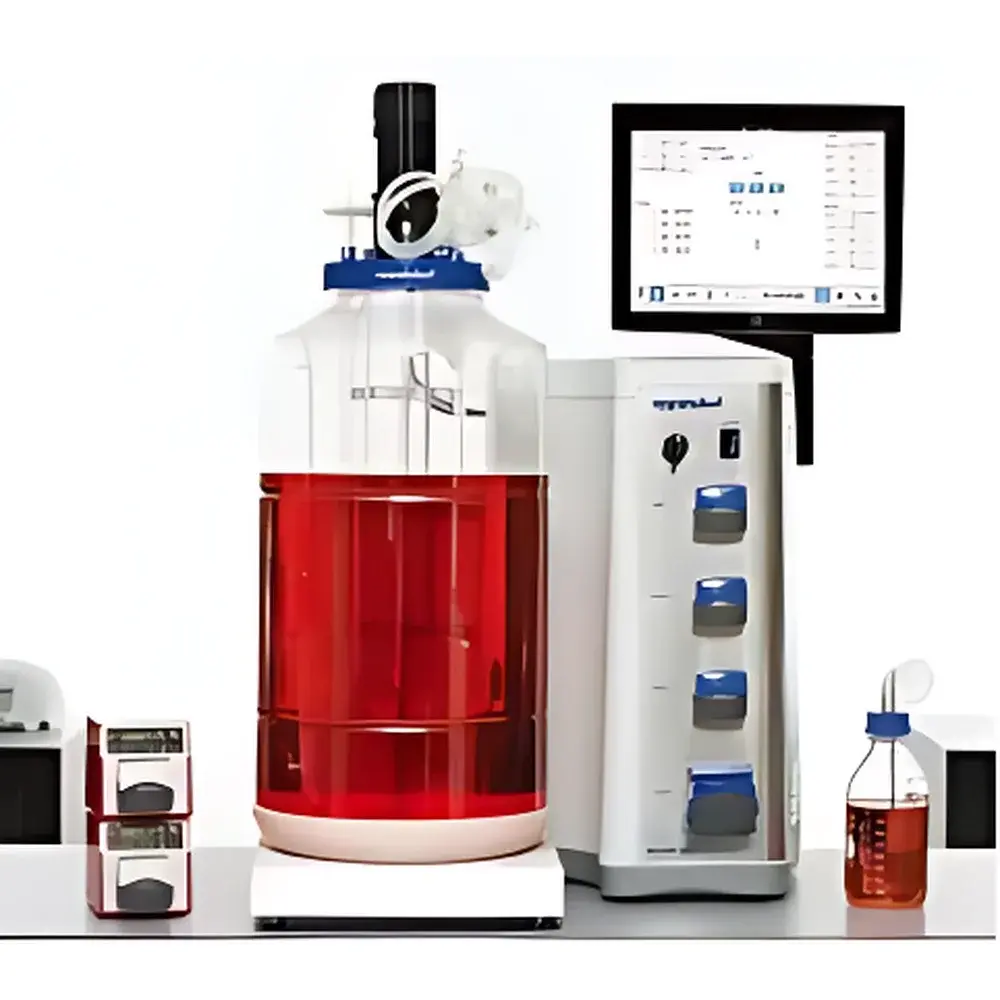
Eppendorf BioBLU Single-Use Bioreactor Vessels
| Brand | Eppendorf |
|---|---|
| Origin | USA |
| Manufacturer Type | Original Equipment Manufacturer (OEM) |
| Import Status | Imported |
| Model | BioBLU |
| Volume Range | 380 mL – 50 L |
| Aeration System | 1, 3, or 4 thermal mass flow controllers |
| pH Control Range | 2–12 |
| Dissolved Oxygen (DO) Control Range | 0–200% air saturation |
| Temperature Control Range | 5°C above coolant temperature to 60°C (via heating blanket) |
Overview
The Eppendorf BioBLU single-use bioreactor vessels represent an engineered integration of disposable technology with performance characteristics traditionally associated with stainless-steel stirred-tank reactors. Designed for mammalian cell culture, microbial fermentation, and high-density perfusion applications, the BioBLU platform employs a patented packed-bed impeller geometry that ensures homogeneous mixing while minimizing shear stress on sensitive suspension or adherent cells. Unlike conventional bag-based systems, BioBLU vessels feature a rigid, single-layer polymeric construction—eliminating concerns related to leachables, extractables, and structural deformation during installation or operation. This architecture supports precise process control across scales from benchtop (380 mL working volume) to pilot-scale (up to 50 L), enabling seamless transition from process development to clinical manufacturing under consistent operational parameters.
Key Features
- Patented packed-bed impeller design delivering efficient oxygen transfer and low-shear mixing without mechanical agitation components in contact with culture medium
- Integrated optical pH sensing technology—non-invasive, drift-resistant, and compatible with sterilization-in-place (SIP) protocols
- Modular aeration configuration supporting 1, 3, or 4 independent thermal mass flow controllers for precise gas blending (e.g., O2, N2, CO2, air)
- Flexible sparger options: annular ring for uniform gas distribution or microbubble sparger for enhanced mass transfer in viscous or high-cell-density cultures
- Temperature regulation via external heating blanket combined with integrated coolant jacket interface—enabling stable setpoint maintenance from 5°C above coolant temperature up to 60°C
- Single-layer, USP Class VI-certified polymer construction—validated for absence of extractables and eliminating pre-use media rinsing or conditioning steps
Sample Compatibility & Compliance
BioBLU vessels are validated for use with suspension-adapted CHO, HEK293, and hybridoma cell lines, as well as bacterial (e.g., E. coli) and yeast (e.g., Pichia pastoris) strains. The system complies with ISO 13485:2016 for medical device manufacturing environments and supports alignment with ICH Q5D, Q5A(R2), and USP sterility requirements. Optical pH sensors meet ASTM E2064-20 standards for non-electrode-based pH monitoring in bioprocess applications. All vessel configurations support GMP-compliant documentation packages—including material traceability, extractables profiling, and gamma irradiation validation reports (25–40 kGy).
Software & Data Management
BioBLU vessels interface seamlessly with Eppendorf’s BioControl™ software suite, which provides real-time visualization of critical process parameters (pH, DO, temperature, agitation rate, gas flow rates) and supports audit-trail-enabled data logging compliant with FDA 21 CFR Part 11. The platform enables synchronized acquisition from third-party sensors (e.g., capacitance-based viable cell density probes) and exports time-stamped CSV/Excel files for offline analysis. Batch records include electronic signatures, deviation tracking, and configurable alarm thresholds—facilitating regulatory submissions and internal quality audits under GLP/GMP frameworks.
Applications
- Process development and scale-down modeling for monoclonal antibody production
- High-yield perfusion culture using Fibra-Cel® disk carriers (BioBLU 5p variant)
- Seed train expansion and inoculum preparation under controlled DO and pH setpoints
- Metabolic engineering studies requiring rapid media exchange and gas modulation
- Comparative bioprocess evaluation against stainless-steel platforms for tech transfer validation
- Accelerated stability testing of biologics under varied temperature and pH stress conditions
FAQ
Are BioBLU vessels suitable for sterile filtration of inlet/outlet gases?
Yes—each vessel includes standardized 0.2 µm hydrophobic membrane ports for both inlet and exhaust lines, validated for integrity testing per ASTM F838-22.
Can BioBLU vessels be autoclaved?
No—BioBLU vessels are gamma-irradiated (25–40 kGy) and intended for single-use only; autoclaving is not recommended and will compromise structural integrity.
What is the maximum operating pressure rating?
The vessels are rated for continuous operation at ≤0.5 bar(g) headspace pressure, with burst pressure exceeding 2.0 bar(g) per ISO 11607-1 mechanical testing protocols.
Is the optical pH sensor calibrated prior to shipment?
Yes—all optical pH sensors undergo two-point calibration (pH 4.01 and 7.00 buffers) and include certificate of calibration traceable to NIST standards.
Do BioBLU systems support fed-batch or continuous feeding strategies?
Yes—integrated peristaltic pump interfaces and programmable dosing modules enable precise nutrient feed control synchronized with DO and pH feedback loops.
Related Products




