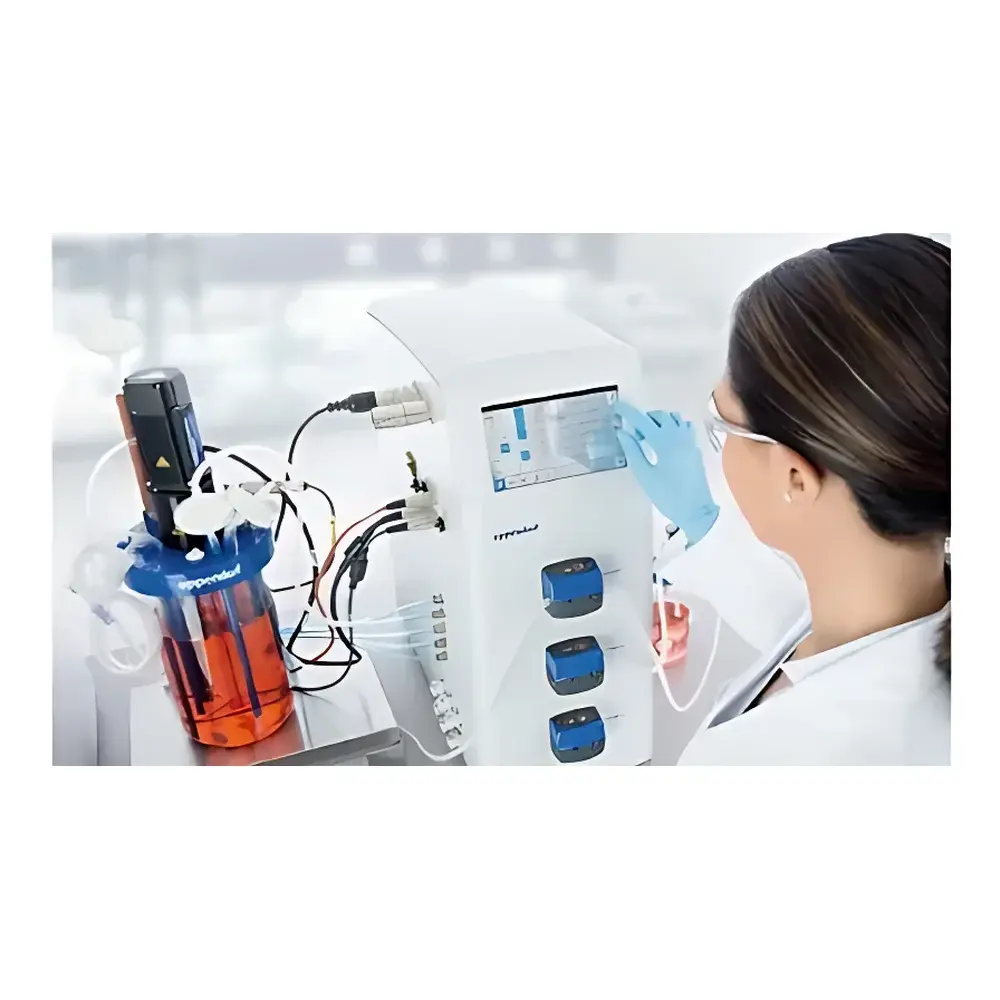
Eppendorf BioFlo 120 Benchtop Bioreactor
| Brand | Eppendorf |
|---|---|
| Origin | USA |
| Manufacturer Type | Original Equipment Manufacturer (OEM) |
| Import Status | Imported |
| Model | BioFlo 120 |
| Vessel Total Volume | 2.5–14.0 L |
| Working Volume | 0.4–10.5 L |
| Aeration System | 1, 3, or 4 thermal mass flow controllers |
| pH Control Range | 2.0–12.0 |
| Dissolved Oxygen (DO) Control Range | 0–200% air saturation |
| Temperature Control Range | 5°C (cooling fluid inlet) to 90°C |
Overview
The Eppendorf BioFlo 120 is a modular, benchtop bioreactor system engineered for precision process development in academic research, biopharmaceutical R&D, and early-stage manufacturing environments. It operates on standard stirred-tank reactor (STR) principles—employing controlled agitation, regulated gas blending, and real-time feedback loops for pH, dissolved oxygen (DO), temperature, and foam—to maintain physicochemical conditions essential for reproducible microbial, mammalian, insect, plant, fungal, and stem cell culture. Designed with scalability in mind, the BioFlo 120 supports seamless transition from small-scale screening (down to 250 mL working volume using compatible vessels) to pilot-scale process characterization (up to 40 L via vessel interchangeability). Its architecture integrates hardware modularity with deterministic control logic, enabling consistent implementation of batch, fed-batch, continuous, and perfusion modes—including high-density, microaerobic, and anaerobic fermentations—as well as recombinant protein secretion and cell/gene therapy (CGT) process development.
Key Features
- Modular vessel compatibility: Supports autoclavable glass vessels (2.5–14.0 L total volume) and single-use Eppendorf BioBLU® vessels (0.4–10.5 L working volume), facilitating rapid changeover and eliminating cross-contamination risk.
- Configurable aeration architecture: Optional 1-, 3-, or 4-channel thermal mass flow controllers enable precise gas blending (e.g., O2, N2, CO2, air) with either annular ring or microbubble spargers to optimize mass transfer efficiency across diverse cell types and metabolic demands.
- Wide-range environmental control: Temperature regulation spans 5°C (minimum cooling fluid inlet) to 90°C; pH control covers 2.0–12.0 via peristaltic acid/base dosing; DO control maintains setpoints from 0–200% air saturation using cascade logic with agitation speed, gas flow rate, and O2 enrichment.
- Flexible sensor integration: Universal analog/digital ports accept both analog electrodes and ISM-enabled digital sensors (e.g., Mettler Toledo InPro series), supporting automatic sensor recognition, calibration history logging, and diagnostic alerts per ISO 13485-aligned workflows.
- Intuitive human-machine interface (HMI): Touchscreen-driven operation with expandable real-time trend visualization, preconfigured automation sequences (e.g., “Auto-Culture Mode”), and one-touch startup protocols reducing setup time to under five minutes post-unboxing.
Sample Compatibility & Compliance
The BioFlo 120 accommodates suspension and adherent cultures across prokaryotic and eukaryotic systems—including E. coli, S. cerevisiae, CHO, HEK293, Sf9, plant protoplasts, and primary human mesenchymal stem cells. All wetted materials comply with USP Class VI and FDA 21 CFR Part 11 requirements for material biocompatibility and electronic record integrity. The system supports GLP/GMP-aligned documentation through audit-trail-enabled software logging, electronic signatures, and configurable user access levels. Vessel sterilization follows ASME BPE-2021 standards for bioprocessing equipment, and steam-in-place (SIP) validation is supported via integrated temperature mapping ports.
Software & Data Management
Control and data acquisition are managed via Eppendorf’s proprietary SCADA platform, accessible locally or remotely over IP networks using secure HTTPS/TLS encryption. The software provides full IEC 62304-compliant firmware architecture, with timestamped event logging, configurable alarm thresholds, and export of raw sensor data in CSV/Excel-compatible formats. Process data archives are structured to meet FDA 21 CFR Part 11 requirements—including operator authentication, change tracking, and immutable audit trails. Integration with third-party LIMS and MES systems is enabled via OPC UA and Modbus TCP protocols.
Applications
- Upstream process development for monoclonal antibodies, viral vectors, and recombinant enzymes
- Optimization of fed-batch strategies for high-titer CHO cell cultures
- Microaerobic cultivation of Corynebacterium glutamicum for amino acid production
- Anaerobic fermentation of Clostridium acetobutylicum in butanol pathway studies
- Perfusion-based expansion of human pluripotent stem cells under defined xeno-free conditions
- Scale-down modeling of commercial-scale bioreactors for quality-by-design (QbD) initiatives
FAQ
Can the BioFlo 120 be validated for GMP manufacturing use?
Yes—when deployed with documented IQ/OQ protocols, calibrated sensors traceable to NIST standards, and configured with Part 11-compliant software settings, it meets baseline requirements for Phase I–II clinical material production.
Is remote monitoring possible without installing additional hardware?
Yes—the built-in Ethernet port and embedded web server allow secure remote access via standard browsers without external gateways or cloud intermediaries.
Does the system support custom control algorithms beyond preset cascades?
Yes—advanced users may implement user-defined PID tuning parameters and logical branching via the scripting interface, subject to firmware version 4.2 or later.
What is the maximum allowable pressure rating for the glass vessels?
Standard glass vessels are rated for 1.5 bar(g) operating pressure, with optional pressure-rated variants available upon request.
How frequently must the mass flow controllers be recalibrated?
Annual recalibration is recommended; however, factory-certified verification can be performed in-house using certified reference gases and the onboard diagnostic utility.