
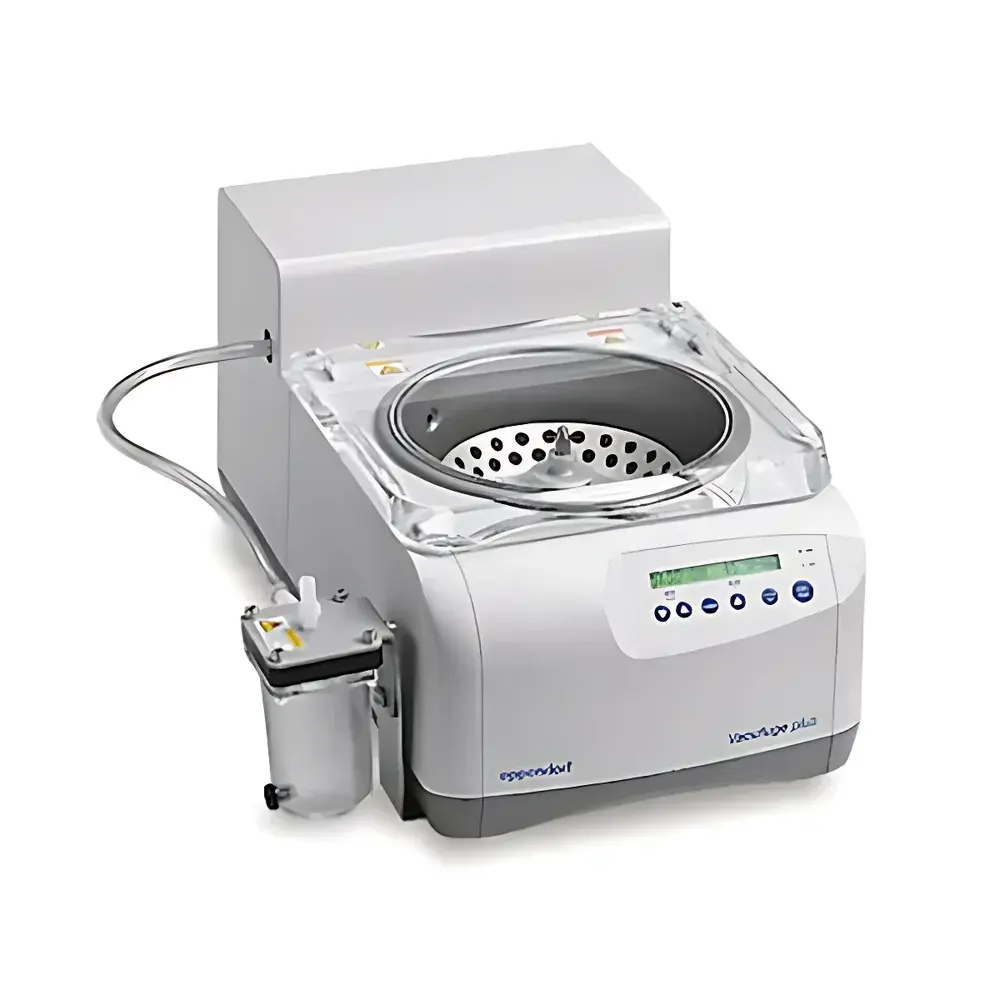
Eppendorf Concentrator plus Vacuum Centrifugal Concentrator
| Brand | Eppendorf |
|---|---|
| Origin | Germany |
| Manufacturer | Eppendorf AG |
| Product Type | Vacuum Centrifugal Concentrator |
| Model | Concentrator plus |
| Temperature Settings | 30 °C, 45 °C, 60 °C (±1 °C accuracy) |
| Sample Capacity | Up to 144 tubes (0.2–50 mL), microplates, or PCR plates |
| Noise Level | < 50 dB(A) |
| Pump Options | External vacuum source, integrated PTFE-coated diaphragm pump with cold trap, or integrated pump with auxiliary vacuum port |
| Rotor Compatibility | 15 interchangeable rotors |
| Heating Chamber | Chemically resistant stainless steel, induction-driven rotor motor |
Overview
The Eppendorf Concentrator plus is a high-performance vacuum centrifugal concentrator engineered for precise, reproducible concentration and drying of biological and chemical samples under reduced pressure. It operates on the principle of simultaneous centrifugation, vacuum-induced solvent evaporation, and controlled conductive heating—enabling gentle yet efficient removal of volatile solvents (e.g., ethanol, acetone, ethyl acetate, TFA, DMSO) from heat-sensitive biomolecules including DNA, RNA, oligonucleotides, peptides, proteins, and small-molecule compounds. Designed and manufactured in Hamburg, Germany, the system adheres to stringent quality management standards compliant with ISO 13485 and meets essential requirements of the EU Machinery Directive 2006/42/EC and Electromagnetic Compatibility Directive 2014/30/EU. Its compact benchtop footprint (W × D × H: 340 × 520 × 290 mm), low acoustic emission (<50 dB(A)), and modular vacuum architecture make it suitable for shared core facilities, QC laboratories, and regulated environments requiring spatial efficiency and operational flexibility.
Key Features
- Three configurable system variants: Basic unit (vacuum inlet only), complete system with integrated chemically inert PTFE-coated diaphragm pump and condensate separator, or advanced configuration with dual-purpose vacuum port enabling concurrent operation with external vacuum-dependent instruments (e.g., gel dryers, vacuum ovens).
- Induction-driven, brushless rotor motor ensures maintenance-free, vibration-minimized rotation across all speed ranges—eliminating carbon dust contamination and extending service life.
- Chemically resistant stainless-steel heating chamber with uniform thermal distribution; temperature presets at ambient, 30 °C, 45 °C, and 60 °C (±1 °C stability over full operating range).
- Enhanced lid material formulation provides superior resistance to aggressive reagents—including trifluoroacetic acid (TFA), dimethyl sulfoxide (DMSO), chloroform, and concentrated mineral acids—supporting rigorous cleaning protocols and extended component longevity.
- Intuitive, tactile control panel with real-time status indicators; programmable run time from 1 minute to 9 hours 59 minutes, with optional soft-brake deceleration to prevent sample resuspension.
- 15 standardized rotor options accommodate tubes from 0.2 mL PCR strips to 50 mL conical tubes, as well as 96-well microplates and deep-well plates—enabling parallel processing without cross-platform adaptation.
Sample Compatibility & Compliance
The Concentrator plus supports a broad spectrum of sample formats and matrices common in molecular biology, proteomics, metabolomics, and synthetic chemistry workflows. It is validated for use with aqueous buffers, alcohol-based precipitates, acidic eluents, and organic solvent mixtures—provided vapor pressure and boiling point remain compatible with the selected temperature/vacuum profile. The system complies with Good Laboratory Practice (GLP) documentation requirements through unambiguous event logging (start/stop timestamps, temperature setpoints, runtime, rotor ID). While not inherently 21 CFR Part 11–compliant, its deterministic behavior, stable firmware, and audit-ready operational records support integration into validated environments when paired with appropriate electronic lab notebook (ELN) or LIMS systems.
Software & Data Management
The Concentrator plus operates via embedded firmware with no external software dependency—ensuring deterministic, interference-free execution and eliminating cybersecurity surface area. All user-defined parameters (temperature, time, brake activation) are retained in non-volatile memory across power cycles. Event logs—including date/time stamps, active rotor identification, and actual vs. setpoint temperature deviation—are accessible via front-panel display and persist for the last 100 runs. For laboratories requiring traceability, optional RS232 or USB-to-serial interfaces enable passive data capture by third-party acquisition software (e.g., LabVIEW, custom Python scripts), supporting alignment with internal SOPs for instrument usage tracking and preventive maintenance scheduling.
Applications
- Post-PCR cleanup and nucleic acid precipitation (ethanol/isopropanol washes)
- Concentration of dilute protein solutions prior to SDS-PAGE or mass spectrometry analysis
- Drying of lyophilized intermediates in peptide synthesis workflows
- Removal of residual solvents following solid-phase extraction (SPE) or liquid-liquid extraction (LLE)
- High-throughput sample preparation for NGS library construction and qPCR assay development
- Stabilization of labile metabolites in clinical and pharmaceutical bioanalysis
FAQ
Can the Concentrator plus be used with corrosive solvents such as TFA or DCM?
Yes—the upgraded lid material and PTFE-coated internal pump components are specifically engineered to withstand repeated exposure to strong acids (e.g., TFA), halogenated solvents (e.g., DCM, chloroform), and polar aprotic solvents (e.g., DMSO), provided appropriate cold trap capacity and ventilation are maintained.
Is the integrated pump oil-free and maintenance-free?
Yes—the diaphragm pump features a fully PTFE-coated compression chamber and requires no lubricating oil, periodic membrane replacement, or scheduled servicing under normal operating conditions.
Does the system support GLP-compliant record keeping?
While the device does not include electronic signature or audit trail functionality per 21 CFR Part 11, its deterministic operation, persistent event logging, and stable firmware allow integration into GLP-aligned workflows when supported by procedural controls and complementary documentation systems.
What rotor configurations are available for 96-well microplates?
Eppendorf offers dedicated swing-out and fixed-angle microplate rotors (e.g., FA-45-6-30, S-4-104) certified for use with standard SBS-format plates; maximum relative centrifugal force (RCF) is 2,100 × g at 3,000 rpm.
Can the vacuum port be used simultaneously for internal concentration and external equipment?
No—the auxiliary vacuum port operates in either “pump-only” mode (for external devices) or “concentrator mode” (internal chamber evacuation); automatic switching is not supported. Manual valve selection is required to isolate or share the vacuum source.



