
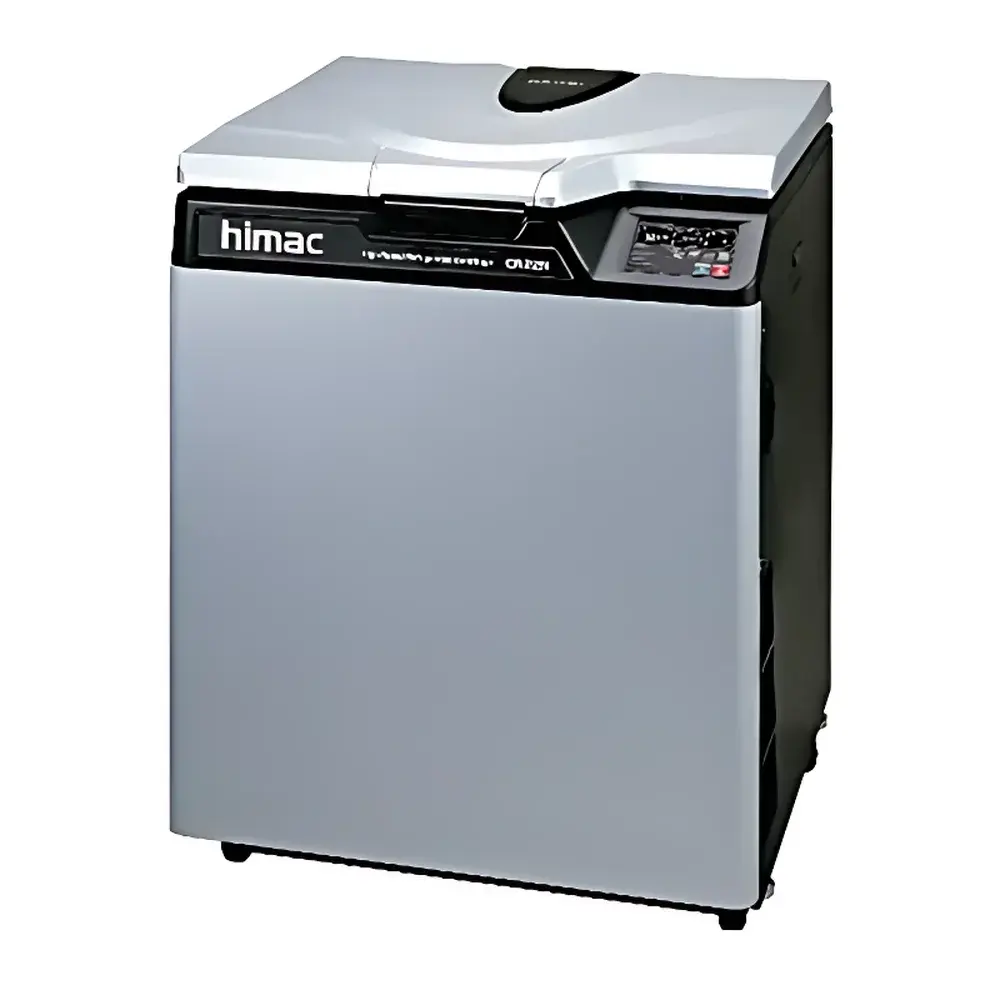
Eppendorf CR22N High-Capacity Refrigerated Floor-Standing Centrifuge (Himac)
| Brand | Eppendorf |
|---|---|
| Origin | Japan |
| Manufacturer | Hitachi High-Technologies (Himac) |
| Type | Floor-standing refrigerated centrifuge |
| Max Speed | 22,000 rpm |
| Max RCF | 58,700 × g |
| Max Capacity | 4 × 1,500 mL |
| Dimensions | 700 × 760 × 915 mm |
| Weight | 260 kg |
| Refrigerant | R410A |
| Noise Level | 64 dB(A) |
| Power Supply | 220–240 V, 50/60 Hz, 3200 W max |
| Interface | USB port for operation log export |
| Safety Features | Auto rotor recognition, non-contact imbalance detection, lid interlock, overspeed protection, rotor cover detection, overtemperature monitoring |
| Acceleration/Deceleration | 9 programmable modes each |
| Programmable Methods | 30 user-defined protocols with RCF and g·sec calculation |
| Compliance | Designed to support GLP/GMP workflows |
Overview
The Eppendorf CR22N High-Capacity Refrigerated Floor-Standing Centrifuge (Himac) is an engineered solution for high-throughput, temperature-sensitive separation tasks in core research and industrial laboratories. Built on Hitachi High-Technologies’ proven Himac platform, the CR22N employs a high-torque, brushless frequency-controlled induction motor coupled with a variable-speed rotary compressor refrigeration system using R410A — enabling precise thermal control from –20 °C to +40 °C across all operating speeds. Its fundamental design principle centers on delivering reproducible, high-RCF separations at large volumes while maintaining sample integrity through consistent thermal management and mechanical stability. Unlike benchtop or compact floor models, the CR22N is structurally reinforced for continuous operation under demanding conditions — particularly relevant for applications requiring repeated 4 × 1,500 mL runs in bioprocessing, vaccine development, or upstream/downstream purification workflows.
Key Features
- High-efficiency refrigeration system with R410A refrigerant and digital temperature control (–20 °C to +40 °C), maintaining setpoint accuracy ±1 °C even at maximum speed (22,000 rpm)
- Non-contact imbalance detection technology — continuously monitors vibration signatures without physical sensors contacting the rotor assembly, minimizing wear and enhancing long-term calibration stability
- Auto rotor recognition and mechanical self-locking mechanism — ensures correct rotor identification and secure engagement prior to acceleration, preventing misconfiguration errors
- 10.4-inch full-color capacitive touch LCD interface with intuitive icon-based navigation, multilingual OS support (English, Japanese, Chinese, German, French), and real-time display of RCF, g·sec, elapsed time, and remaining run time
- Regenerative braking system reduces energy consumption during deceleration and enables faster turnaround between runs
- Eco Mode (automatic standby) reduces power draw to 30 minutes, supporting ISO 50001-aligned lab sustainability initiatives
- Comprehensive safety architecture: dual redundant lid interlocks, overspeed cutoff, rotor cover presence verification, and real-time motor temperature monitoring
Sample Compatibility & Compliance
The CR22N accommodates a broad spectrum of biological and biochemical sample types — including mammalian and bacterial cell pellets, yeast and algal biomass, clarified lysates, serum/plasma fractions, and protein-containing supernatants — across both fixed-angle and horizontal rotors. Its standard R9A2 4 × 1,500 mL fixed-angle rotor (rated to 8,500 rpm / 15,100 × g) and optional R27A rotor (22,000 rpm / 58,700 × g) meet common separation needs in cell harvesting, organelle isolation, and macromolecular pelleting. All rotors are manufactured from aerospace-grade aluminum alloy and certified to ISO 15504 (SPICE) and JIS B 8701 standards. The instrument’s firmware and optional Himac LogManager Ver. 5.0 software enable electronic record keeping compliant with 21 CFR Part 11, EU Annex 11, and GLP/GMP documentation requirements — including user authentication, electronic signatures, and immutable audit trails for method execution and parameter changes.
Software & Data Management
Data integrity and traceability are embedded into the CR22N’s operational framework. Internal memory stores up to 30 user-defined methods, each supporting RCF/g·sec calculations, multi-step acceleration/deceleration profiles, and temperature ramping. Operation logs — including start/stop timestamps, rotor ID, speed, temperature, and error codes — are exportable via USB to CSV format for LIMS integration. For regulated environments, the optional Himac LogManager Ver. 5.0 (network edition) provides centralized remote monitoring, role-based access control, electronic signature capture, and automated report generation. This configuration satisfies ALCOA+ principles (Attributable, Legible, Contemporaneous, Original, Accurate, Complete, Consistent, Enduring, Available) and supports internal quality audits as well as external inspections by regulatory bodies such as FDA, EMA, or PMDA.
Applications
The CR22N serves as a primary workhorse in academic core facilities, CROs, biomanufacturing QC labs, and pharmaceutical R&D units. Typical use cases include: large-volume clarification of fermentation broths (e.g., monoclonal antibody harvest); high-yield pelleting of CHO or HEK293 cells prior to lysis; preparation of platelet-rich plasma (PRP) and extracellular vesicle isolates from clinical-scale blood volumes; fractionation of lipid nanoparticles (LNPs) during mRNA vaccine process development; and routine sedimentation of environmental water samples for microbiological analysis. Its ability to sustain 4 °C operation at full speed ensures cold-chain continuity for thermolabile enzymes, nucleic acids, and membrane proteins — critical for structural biology and functional assay prep.
FAQ
What is the minimum and maximum operating temperature range?
The CR22N maintains temperatures from –20 °C to +40 °C, with active cooling fully functional across the entire speed range (300–22,000 rpm).
Does the CR22N support 21 CFR Part 11 compliance?
Yes — when paired with Himac LogManager Ver. 5.0 (network edition), it provides electronic signatures, audit trails, and role-based access control required for regulated GxP environments.
Can I use third-party rotors with this centrifuge?
No — only Himac-certified rotors with integrated RFID tags are recognized and enabled by the auto-identification system; unauthorized rotors will not initiate operation.
What is the K-factor, and why does it matter for method transfer?
The K-factor quantifies rotor efficiency in pelleting time estimation (lower K = faster pelleting). CR22N rotors publish K-values (e.g., R15A: 534; R10A5: 1673), enabling direct comparison and scaling between instruments per ISO 21501-4 guidelines.
Is service and technical support available globally?
Eppendorf and Hitachi High-Technologies maintain authorized service networks across North America, EMEA, and APAC, with certified field engineers trained on Himac-specific diagnostics and calibration procedures.



