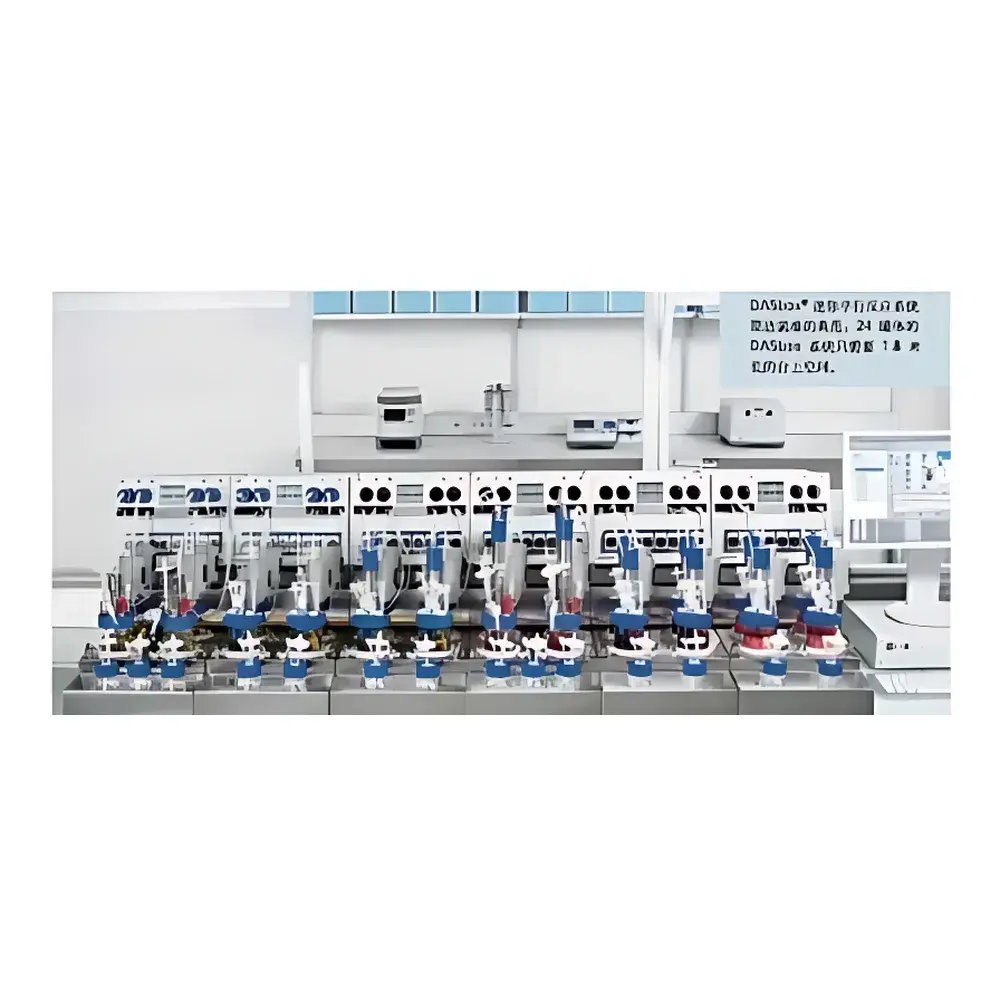
Eppendorf DASbox Mini Bioreactor System
| Brand | Eppendorf |
|---|---|
| Origin | Germany |
| Manufacturer Type | Original Equipment Manufacturer (OEM) |
| Product Category | Imported Instrument |
| Model | DASbox Mini Bioreactor System |
| Temperature Range | 2–12 °C (external jacket control) |
| Working Volume Range | 0.06–0.25 L per vessel |
| Vessel Configuration | 1, 3, or 4 independent vessels |
| Gas Control | Four thermal mass flow controllers (MFCs) per vessel for air, O₂, CO₂, and N₂ |
| Sparging Options | Ring-type or microbubble spargers |
| pH/DO/Liquid Level Monitoring | Integrated electrochemical sensors with real-time feedback control |
| Sterilization Method | Autoclavable (121 °C, 20 min, saturated steam) |
| Agitation | Top-driven motor with interchangeable impellers (flat-blade, pitched-blade, marine propeller) |
| Cooling System | Water-free Peltier-based temperature regulation per vessel |
| Exhaust Condensation | Modular, tool-free, dry cold trap with one-click activation/deactivation |
| Feed Control | Peristaltic pumps with programmable speed and volumetric precision |
| Operational Modes | Batch, fed-batch, continuous, and perfusion culture |
Overview
The Eppendorf DASbox Mini Bioreactor System is a modular, benchtop-scale parallel bioreactor platform engineered for high-fidelity process development in mammalian cell culture, microbial fermentation, and synthetic biology applications. Based on proven stirred-tank reactor (STR) architecture, it employs closed-loop, model-assisted control of critical process parameters—including temperature, pH, dissolved oxygen (DO), agitation speed, gas composition, and feed rate—within physically isolated vessels. Each vessel operates under independent PID-controlled conditions, enabling rigorous comparative studies across multiple experimental conditions simultaneously. Designed to support Quality by Design (QbD) frameworks, the system integrates seamlessly with statistical experimental design (DoE) workflows and meets foundational requirements for GLP-compliant process characterization, including traceable parameter logging, audit-ready event histories, and secure user access management.
Key Features
- Modular scalability: Configurable for 1, 3, or 4 vessels per base unit; expandable via networked deployment to up to 24 vessels without compromising control fidelity or data synchronization.
- Water-free thermal regulation: Peltier-based cooling/heating modules deliver precise, vessel-specific temperature control from 2 °C to 12 °C without external chillers or coolant loops—reducing footprint, maintenance, and cross-contamination risk.
- Multi-gas blending capability: Four independent thermal mass flow controllers (MFCs) per vessel enable dynamic, real-time adjustment of air, O₂, CO₂, and N₂ partial pressures—supporting both surface aeration and deep sparging via ring or microbubble spargers.
- Top-driven agitation system: Brushless DC motor with torque monitoring, compatible with flat-blade, pitched-blade, and marine impellers—optimized for low-shear suspension of sensitive adherent or suspension cells.
- Dry exhaust condensation: Tool-free, removable cold trap with integrated Peltier cooling eliminates need for glycol baths or liquid nitrogen; activated/deactivated via software command with automatic condensate detection.
- Peristaltic feed precision: Programmable multi-channel pumps deliver accurate, pulse-free addition of nutrients, bases, acids, or inducers—enabling reproducible fed-batch, continuous, and perfusion protocols with sub-milliliter resolution.
Sample Compatibility & Compliance
The DASbox Mini supports both reusable glass vessels (autoclavable at 121 °C for 20 minutes) and single-use bioreactor bags with pre-sterilized sensor ports. It accommodates a wide range of biological systems—including CHO, HEK293, hybridoma, yeast (e.g., Saccharomyces cerevisiae), bacteria (e.g., E. coli), and insect cells—under sterile, controlled environmental conditions. The system complies with ISO 13485 design controls for medical device-related bioprocess development and aligns with FDA 21 CFR Part 11 requirements for electronic records and signatures when deployed with validated DASware software configurations. All hardware components meet IEC 61000-6-2/6-4 electromagnetic compatibility standards and are CE-marked for laboratory use in the EU.
Software & Data Management
DASware Control serves as the embedded real-time operating system, providing deterministic loop execution (<50 ms cycle time), synchronized multi-vessel control, and configurable alarm thresholds with email/SNMP notification. DASware Connect enables secure remote access, role-based permissions, and live dashboard visualization across local networks or cloud-hosted infrastructure. Data export follows ASTM E2500-18 guidelines for raw signal integrity and includes timestamped, uneditable .csv and .hdf5 formats. Optional DASware Analyze supports multivariate analysis (MVA), PCA, and batch trajectory comparison—facilitating root cause analysis and process window definition per ICH Q5 and Q8 recommendations.
Applications
- Early-stage bioprocess screening: Rapid evaluation of media formulations, feeding strategies, and pH/DO setpoint combinations across parallel vessels.
- Cell line selection and clone ranking: Comparative growth kinetics, viability profiles, and product titer assessment under identical environmental constraints.
- Process characterization for regulatory filings: Generation of design space maps, robustness testing, and failure mode identification per ICH Q5E and Q8(R2).
- Scale-down model validation: Correlation of miniaturized process behavior with pilot- and manufacturing-scale bioreactors using dimensionless number matching (e.g., Po, Re, Fr).
- Academic and translational research: Teaching platforms for bioreactor engineering principles, synthetic pathway optimization, and metabolic flux analysis.
FAQ
Can the DASbox Mini be used with single-use vessels?
Yes—vessels are available in both autoclavable borosilicate glass and gamma-irradiated single-use configurations with integrated, calibrated pH and DO sensors.
Is DASware software compliant with 21 CFR Part 11?
When deployed in validated environments with enabled electronic signature, audit trail, and user permission modules, DASware meets core technical requirements for Part 11 compliance.
What is the minimum working volume per vessel?
The system maintains stable control down to 60 mL working volume, with optimized mixing and gas transfer efficiency verified per ASTM E2875-22 guidelines for small-volume bioreactors.
How is temperature uniformity maintained across multiple vessels?
Each vessel features an independent Peltier module with dual-sensor feedback (junction + vessel wall), achieving ±0.2 °C stability and <±0.5 °C inter-vessel deviation under steady-state conditions.
Does the system support integration with external analytics?
Yes—via OPC UA and Modbus TCP protocols, DASbox interfaces with HPLC, Raman spectrometers, and off-gas analyzers for real-time metabolite and gas composition feedback control.